How to Write about Hobbies on Your Résumé (Tips & Examples) (original) (raw)
“Never, ever include hobbies and interests in your résumé.” That has been the golden rule for CV or résumé writing for decades now.
But it’s a very narrow-minded rule. It doesn’t take into account the many situations when mentioning your hobbies and interests can actually add value to your application.
Of course, we’re not talking about things like long walks on the beach — your résumé is not a dating profile, after all. We’re talking about pastimes, activities and general interests that help you create a more rounded presentation of your skills and strengths, and that demonstrate your fit to the position you’re applying for.
So, how do you write about hobbies and personal interests on a résumé?
From when to include this section in your résumé to how to mention your hobbies and interests, this guide has you covered.
When to include hobbies and interests in your CV/résumé
Mentioning hobbies and interests on your résumé isn’t always appropriate or necessary. If you’re applying for a C-suite role, for example, mentioning your interest in fashion would only hamper your application. Likewise, “if you’re trying to save space, drop these off your [résumé],” says Matthew Warzel, CPRW, a certified résumé writing expert and the president of MJW Careers.
That said, there are several situations where listing hobbies and interests can add value to your CV/résumé, including when:
- You have limited work experience
- You have little educational experience
- You are switching careers or are new to the industry
- They show your fitness with the company culture
- They align with the job’s duties and responsibilities
- You have extra room on your résumé
- The employer specifically asks you to include your hobbies and interests
- The company is looking for candidates with unique traits and personalities
Warzel sums it up by saying: “The only instance I find them to be useful is if they either relate to the targeted role or are so unique [that they stop] readers in their tracks.”
Types of hobbies and interests to list (and avoid)
Once you’ve decided to include hobbies and interests in your résumé, it’s important that you choose the right ones — particularly those that reflect positively on you, showcase the skills and qualities that employers look for, and help you demonstrate your overall fitness for the job.
Modupe Sarumi, a career transition coach and the founder of Learnable by Dr Mo, advises to always leverage hobbies and interests to your advantage: “Avoid listing hobbies that portray you more as a liability, and focus on the ones that present you as an asset.”
Here are some good examples of hobbies and interests for your résumé:
- Team sports, like bowling or football
- Solo sports, like cycling or swimming
- Artistic activities, like drawing or photography
- Arts and crafts, like DIY or sewing
- Knowledge-based activities, like pub quizzes
- Creative activities, like blogging or painting
- Outdoor activities, like gardening or hiking
- Cultural interests, like literature or cinema
- Academic interests, like psychology or sociology
- Community involvement, like volunteering for a local charity
- Musical activities, like singing in a choir or playing an instrument
And here are some bad examples to avoid:
- Activities that make you sound antisocial, like stamp collecting
- Activities that are violent, dangerous or, worse, illegal, like launching rockets into their air or hacking
- Activities that reveal political allegiances or ideals
- Activities that reveal religious affiliations or beliefs
- Activities that make you sound lazy, like watching TV
- Activities that may be controversial or polarising, like pole dancing or hunting
- Hobbies or interests intended as a joke that can be misinterpreted, like “Scheming for world domination”
- Hobbies or interests that go against the core values of the company you’re applying to
Where to list hobbies and interests in your CV/résumé
Your work history, education and achievements should be the focal point of your résumé. This means that if you choose to include hobbies and interests, they should always be placed at the very end of the document — no matter your level of experience or which résumé format you’re using.
You’ll need to separate these from everything else on your résumé and create a designated section for them. Make sure to give the section an appropriate name, like “Hobbies and Interests”, as you would with your résumé’s other sections.
Tips for writing about hobbies and interests
Here are a few things to keep in mind when putting your hobbies and interests section together:
1. Don’t add more than five
You want to keep this section as short as possible. It should only help the overall message you’re conveying to the employer: that you’re a good fit for the job and company.
A general rule of thumb is to list between two and five activities here — not every single hobby you ever picked up. Adding more than five hobbies and interests risks taking the focus away from what’s really important: your experience, results and achievements.
Likewise, if you’re just going to list a single hobby, you’ll end up wasting valuable real estate on your résumé, so you might as well leave out this section altogether.
2. Use bullet points
Recruiters are pushed for time, so they will usually only spend a few seconds skimming your résumé to determine whether it’s worth a more thorough review. And the more user-friendly your CV/résumé is, the better are the chances of this happening.
Your hobbies and interests (and everything else on your résumé, for that matter) should be skimmable, and this can be achieved by listing them as individual bullet points. (Round bullets are the standard, but square bullets or even hyphens are fine, too. Whichever style you choose, though, make sure it’s consistent.)
3. Be specific
Rather than simply adding a list of hobbies at the end of your CV/résumé, provide a brief description for each one, explaining how it applies to the role or the company’s work culture.
For example, instead of simply listing travel among your hobbies and interests, say something like: “International travel to 25 countries to experience and learn about new cultures and traditions”. This can help you set yourself apart from the competition, particularly if the job you’re applying for involves working with a diverse mix of people.
Always keep descriptions short, typically no longer than one line. “It doesn’t need to be a detailed biography,” says Nikki Thomas, founder of Winning in Work.
4. Emphasize your transferable skills
Make sure that the hobbies and interests that you list in your CV/résumé somehow relate to the job you’re applying for.
“I recommend reviewing the job description and identifying the skills relevant to the day-to-day tasks,” says Tracy Cote, the Chief People Officer at Zenefits.
This, of course, doesn’t necessarily mean they need to be directly related to the position, but they should at the very least be transferable and add value to your application. For example, playing chess might not seem very relevant to a job in accounting, but it does demonstrate your analytical thinking skills, which are relevant.
“The most important thing to keep in mind when listing hobbies in your résumé is to show recruiters and hiring managers that you are a multifaceted person with external interests and multiple skill sets,” says Cote.
5. Be honest
You might be tempted to add hobbies that you’re not actually invested in because you feel they will enhance your chances of getting an interview. But you should never embellish or downright lie about anything on your résumé — including something as seemingly trivial as your pastimes — because you will get caught.
The hiring manager will likely ask you about the hobbies you’ve listed, and you’ll be automatically disqualified from the pool of candidates when it becomes evident that you lied on your résumé. Dishonesty, after all, is not a quality that employers look for in employees.
Hobby examples for top professions
Listing hobbies on your résumé can help you stand out from other candidates, especially when they’re as relevant to the job as possible. Below are some examples for popular professions to give you an idea of what to put on your résumé:
1. Teacher
- Reading extensively, both fictional and non-fictional works.
- Baking, participating in local bake sales (and treating my students!).
- Yoga and meditation, as a way to wind down and stay in shape.
2. Accountant
- Running, currently totaling 15k a week.
- Local chess club member.
- Camping and hiking, spending time outdoors.
3. Architect
- Street photography — I maintain an active Instagram page.
- Painting, as a means to relax and find inspiration for my work.
- Origami making, occasionally running my own workshops.
4. Software developer
- Solving jigsaw, Sudoku and crossword puzzles.
- Outdoor swimming throughout the year.
- Playing the violin in a local orchestra.
5. Bartender
- Theater group member, participating in amateur play productions.
- DJing as a way to relax after work and engage in something creative.
- Traveling as often as possible to learn about different cultures.
6. Copywriter
- Journaling, as a way to declutter the mind.
- Public speaking classes.
- Blogging — I maintain my own blog with resources and advice for fellow writers.
7. Marketing executive
- Weekly basketball practice, team captain.
- Learning Spanish through online tutoring.
- Digital art and 3D modeling — primarily on Adobe Photoshop and ZBrush.
8. Flight attendant
- Scuba diving and underwater exploration — working towards my certification.
- Writing short prose pieces on the places I visit and people I meet.
- Watching documentaries, particularly on sustainable travel and living.
9. Nurse
- Gardening at home, including making my own floral arrangements.
- Crossfit, as a way to stay fit both mentally and physically.
- Singing in a local choir, often to fundraise for local charities.
10. Office administrator
- C++ coding challenges — yes, just for fun!
- Fostering dogs, until they find their forever homes.
- Listening to professional development podcasts and audiobooks.
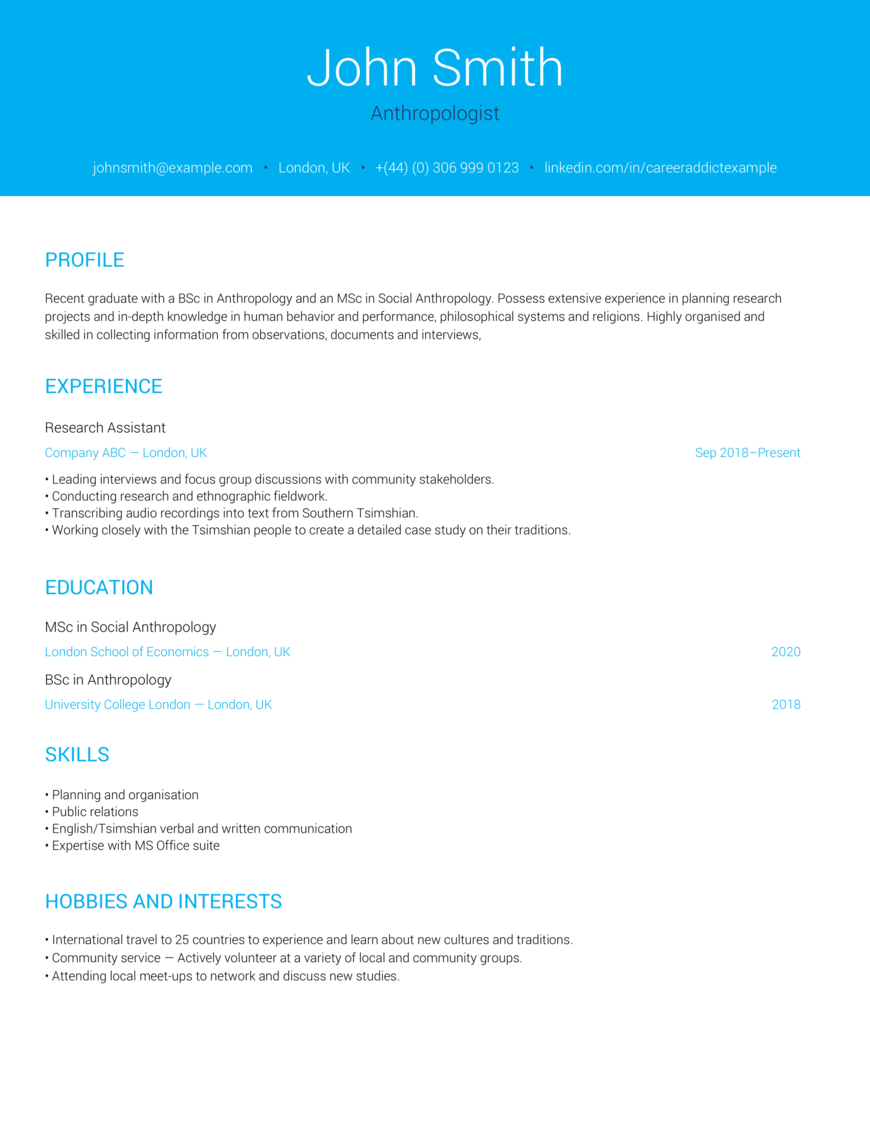
CV/résumé example with hobbies and interests
So, what would a typical résumé with a dedicated hobbies and interests section look like?
Here’s an example we put together, using one of our professionally designed and ATS-friendly résumé templates, to give you an idea:
Want to try a different look? Stand out from the crowd with our 7-in-1 CV template bundle, plus get a free job application checklist! Get the bundle
Key takeaways
While many experts argue against adding your hobbies and interests on your CV/résumé, it is one of the most overlooked and underutilized résumé sections.
With some careful thought and planning, mentioning what you do in your downtime can help you stand out from the crowd and is, as Thomas notes, “a chance to provide a human element to your CV”.
Some key things to remember when putting together this section on your résumé:
- Make sure it makes sense to mention your hobbies and interests.
- Be strategic with the ones you choose to include.
- Put them in a dedicated section at the end of your résumé.
- Use bullet points and brief descriptions.
- Emphasize your transferable skills.
Got a question? Whether you’re skeptical about listing a specific hobby or wondering if you should even include a hobbies section in your CV/résumé, we’re here to help — just drop us a comment below!
This article was originally published in 2017. Updated by Electra Michaelidou.