Oversubscription of Shares: Prorata Allotment (original) (raw)
Last Updated : 11 Jun, 2026
A share is a unit of ownership in a company and represents an equal portion of its share capital. When a company's total capital is divided into smaller units, each unit is called a share. For example, if ABC Ltd. has a share capital of ₹10,00,000 divided into 10,000 units of ₹100 each, every unit of ₹100 is a share. Shares are numbered for easy identification, and ownership of shares is evidenced by a share certificate. Shares are movable property and can be transferred according to the provisions of the company's Articles of Association. According to the Companies Act, 2013, a share means a share in the share capital of a company and includes stock, except where a distinction between stock and share is expressly or impliedly made
Oversubscription of Shares: Pro-rata Allotment
It occurs when a company receives applications for more shares than it has offered and decides to allot shares proportionately among the applicants. Under this method, each applicant receives shares in the same ratio as the shares available to the total shares applied for. For example, if a company offers 10,000 shares but receives applications for 15,000 shares, the allotment ratio will be 2:3. Thus, an applicant who applied for 300 shares will receive 200 shares. Any excess application money received may be adjusted towards allotment money due or refunded to the applicants. Pro-rata allotment ensures a fair distribution of shares among all applicants during an oversubscribed issue.
Accounting treatment of excess money received if pro rata allotment made
1. Receipt of Application Money

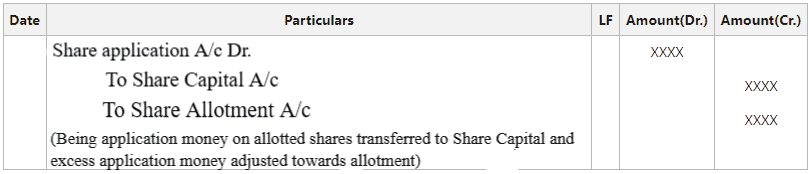
2. Transfer of Application Money and Adjustment of Excess
If Excess Application Money is Refunded Instead of Adjusted
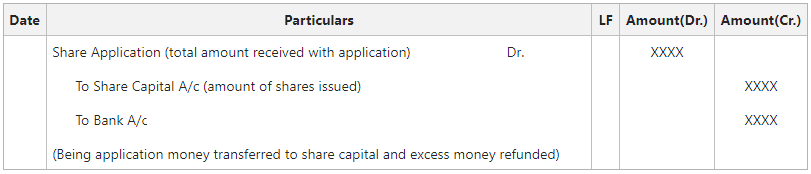
**Illustration:
Vijay Ltd. invited applications for 20,000 shares @ ₹20 each payable as follows:
₹8 on Application
₹3 on Allotment
₹4 on First Call
₹5 on Second & Final Call
The company received applications for 25,000 shares. Excess money received on the application was refunded. All the money was duly received except the call money on 600 shares. Pass the necessary Journal Entries.
**Solution:


**Illustration
Akanksha Ltd. invited 40,000 shares @ ₹10 each payable as:
₹4 on Application
₹2 on Allotment
₹3 on First Call
₹1 on Second & Final Call
The company received applications for 70,000 shares, and a pro-rata allotment was made to all the applications. The excess money left after adjusting on allotment is refunded. All the money was duly received. Pass the necessary Journal Entries in the books of Akanksha Ltd.
**Solution:


3. Excess amount Adjusted with Allotment and Calls with Interest on Calls in Advance:
At times of oversubscription of shares, sometimes a company adjusts the excess money on allotment and calls. And for the calls received in advance, it pays the applicants Interest on Calls in Advance.
**Journal Entries:
**1. When excess application money is received:

**2. When application money is adjusted:

**Illustration:
Sayeba Ltd. was registered with 50,000 shares @ ₹10 each. It invited applications for 40,000 shares payable as follows:
₹3 on Application (on 1st January 2021)
₹1 on Allotment (on 1st Feb 2021)
₹2.5 on First Call (on 1st May 2021)
₹3.5 on Second & Final Call (on 1st July 2021)
The applications were received for 60,000 shares, and the allotment was made as follows:
To Applicants for 20,000 shares: Full
To Applicants for 30,000 shares : 20,000
To Applicants for 10,000 shares: Nil
Excess money received on applications was utilised towards allotment and subsequent calls. Interest is paid on Calls in Advance @ 12% per annum. Pass necessary journal entries assuming all the money was duly received.
**Solution:

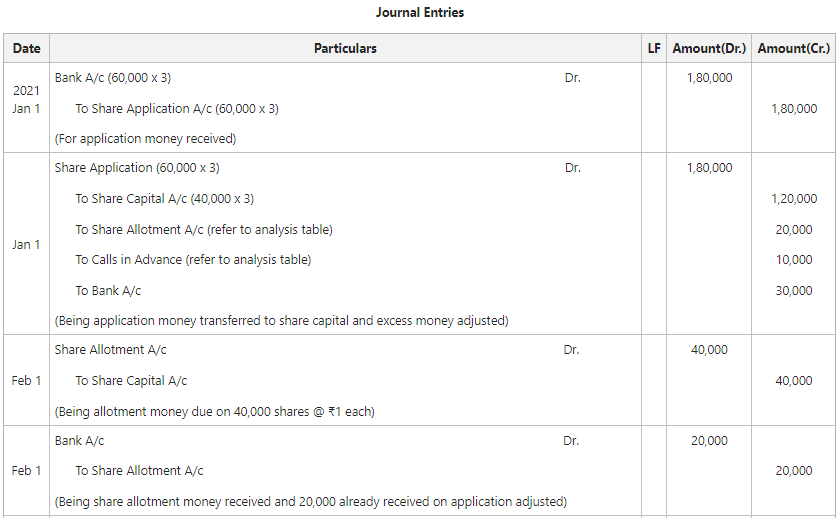
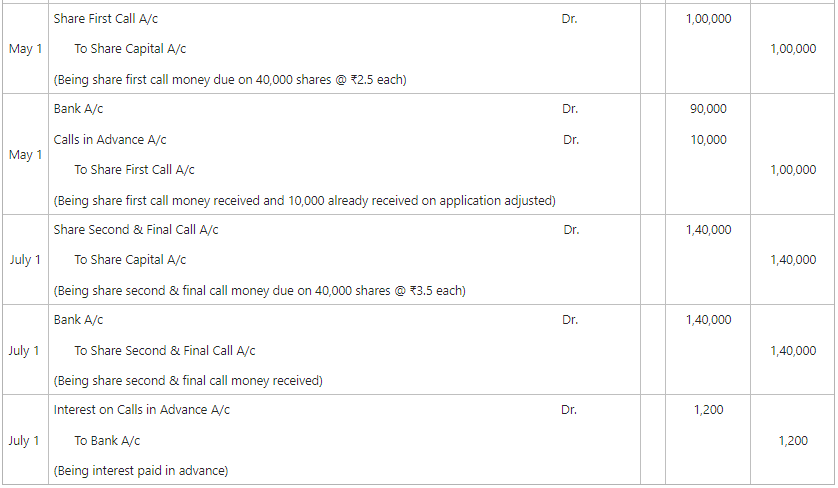
**Calculation of Interest on calls in advance:
₹40,000 for 3 months
Interest=40,000\times{\frac{12}{100}}\times{\frac{3}{12}}
= 1200
**Note: Interest on Calls in Advance is always calculated from the date of allotment in case any advance amount is received on the application.
4. Over-subscription of Shares issued at Premium with Pro-rata Allotment:
At times of over-subscription of shares at a premium, sometimes a company adjusts the excess money by making pro-rata allotment.
**Journal Entries:
**1. When excess application money is received:

**2. When application money is adjusted:

**Illustration:
Rishav Ltd. was registered with 40,000 shares @ ₹10 each and 10% premium. It invited applications for 30,000 shares payable as follows:
₹3 on Application
₹2 on Allotment (including premium)
₹2 on First Call
₹4 on Second & Final Call
The applications were received for 70,000 shares and the allotment was made as follows:
To Applicants for 15,000 shares: Full
To Applicants for 40,000 shares : 15,000
To Applicants for 15,000 shares: Nil
Excess money received on applications was utilised towards allotment and subsequent calls. Pass necessary journal entries assuming all the money was duly received.
**Solution:


