Agent2Agent (A2A) (original) (raw)
Last Updated : 5 Jun, 2026
AI agents are transforming automation, decision-making, and software collaboration, but they often face challenges when working together across different platforms and systems. To solve this, the Agent2Agent (A2A) protocol provides a standardized way for agents to communicate and collaborate effectively.
- Enables agents to discover each other and interact using Agent Cards that describe their capabilities.
- Supports smooth task coordination through structured communication, real-time messaging, and result sharing.
- Ensures interoperability by allowing agents built on different technologies to work together efficiently.
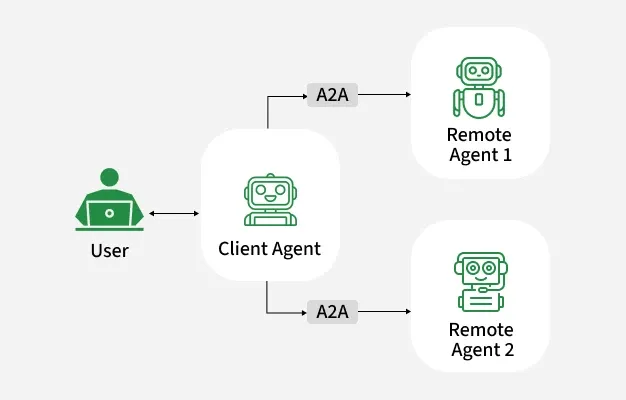
General working of Agent2Agent
**Key characteristics of agents in A2A systems:
- **Autonomy: Each agent operates independently without human intervention.
- **Interaction: Agents can interact with other agents to exchange information, delegate tasks or compete.
- **Communication: Communication between agents is done to solve problems collaboratively or competitively.
- **Adaptability: Agents can adapt their strategies based on interactions and external factors.
Key Components of Agent2Agent (A2A)
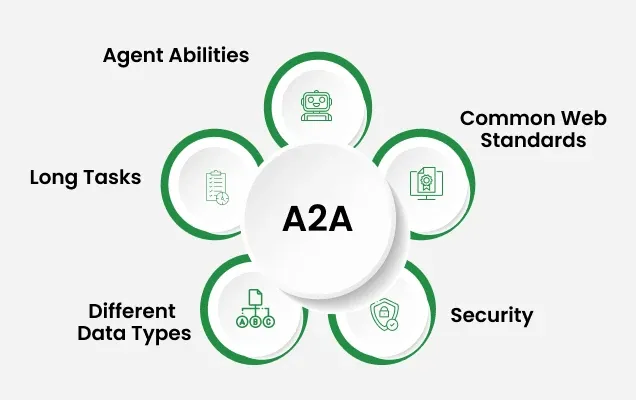
Principles Behind Agent2Agent
- **Agent Abilities: Enables agents to collaborate effectively without sharing memory or tools.
- **Use Common Web Standards: Uses standards like HTTP, SSE, and JSON-RPC for easy integration with existing systems.
- **Built-in Security: Includes authentication and permission checks for secure business applications.
- **Support for Long Tasks: Handles long-running tasks while providing real-time progress updates.
- **Handling Multiple Data Types: Supports text, audio, video, and interactive content for different use cases.
Workflow of Agent2Agent
The agent to agent protocol uses a client-server setup for organized communication. Let's understand the workflow with the help of an OrderBot example where one agent give order to other.
**1. Client-Server Model
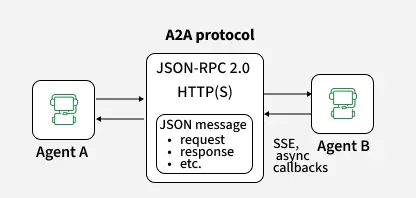
A2A protocol Architecture
- One agent i.e "client" (CustomerBot) requests a task such as checking if a product is in stock. Another agent "server" or "remote" agent (OrderBot) performs the task by querying the inventory.
- These roles can switch during the conversation which is a core feature of the communication protocol.
- **Example: CustomerBot (the client) asks OrderBot (the server) to check if an item is available for purchase.
**2. Agent Card
- An Agent Card is a JSON file that acts as an agent’s profile.
- It includes the agent’s ID, name, role, security needs and available capabilities.
- This helps client agents find the right server agent for a specific task.
- **Example: CustomerBot consults OrderBot’s Agent Card to see if OrderBot has the capability to check inventory.
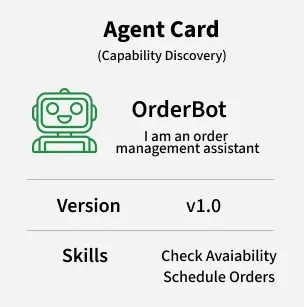
Example of an AgentCard
**3. Task-Based Workflow
- The main unit of work is called a task****.**
- The stages it goes through are: Submitted (started), Working (in progress), Input-required (needs more information), Completed (finished successfully), Failed (encountered an error) or Cancelled (stopped early).
- **Example: OrderBot goes through the task stages, starting with checking inventory and finally confirming availability.
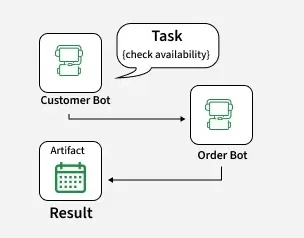
Agents communicating with each other for task completion
**4. Message Structure
- During task execution, agents communicate using messages.
- Messages contain parts that hold content such as text, files, data or forms allowing exchange of rich information.
- **Example: CustomerBot requests inventory information by sending a message to OrderBot.
**5. Artifacts for Results
- The output of a completed task is delivered as artifacts.
- These artifacts are structured results, ensuring the final output is consistent and easy to use.
- **Example: Once OrderBot completes the inventory check it provides an artifact with structured results.
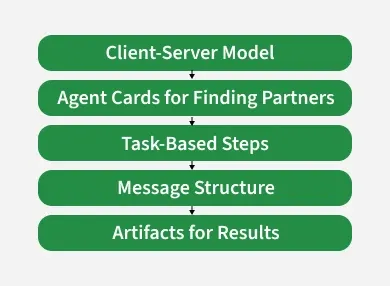
Workflow of Agent2Agent
**Types of Agent Interactions in A2A
**1. Cooperative Agent Interaction
- In cooperative A2A agents collaborate to achieve a shared goal. They exchange resources, strategies or plans to tackle tasks that would be difficult to complete individually.
- **Example: In a supply chain, agents representing suppliers, warehouses and retailers coordinate to optimize inventory management and ensure timely deliveries.
**2. Competitive Agent Interaction
- In competitive A2A interaction, agents have conflicting goals and may compete with each other to achieve their individual objectives. This is commonly seen in auctions, games or resource allocation scenarios.
- **Example: In an online auction like eBay, agents representing bidders compete for limited items each striving to place the highest bid.
**3. Negotiative Agent Interaction
- This interaction involves agents negotiating to reach mutually beneficial agreements. Such interactions typically occur when agents need to resolve conflicts or come to an agreement on terms of collaboration.
- **Example: In a supply negotiation two agents representing a buyer and a seller negotiate pricing, delivery schedules and other conditions.
**4. Mediated Communication
- In mediated A2A systems an intermediary agent often called a "mediator," facilitates communication between agents. This approach is useful when direct communication between agents would be inefficient or difficult.
- **Example: A traffic management system where individual vehicles (agents) communicate with a central traffic control system (mediator) to optimize the flow of traffic.
A2A vs. MCP
The following table provides a comparative overview of A2A and Model Context Protocol MCP:
| Feature | Agent2Agent (A2A) | Model Context Protocol (MCP) |
|---|---|---|
| Primary Focus | Facilitates communication and collaboration between autonomous agents. | Enables interaction between a model and external tools or data sources. |
| **Originator | Anthropic | |
| **Key Technical Concepts | Agent Cards, Tasks, Messages (Parts), HTTP/JSON-RPC, SSE for real-time streaming. | Host, Client, Server, Tools, Resources, Prompts. |
| Communication | Task-based, asynchronous communication with potential natural language tasks. | Structured requests for accessing external tools and contextual data, typically using specific schemas like JSON Schema. |
| **Primary Use Case | Supports collaborative workflows across independent agents in various systems. | Facilitates AI models access to external data, files and APIs. |
Applications
- **Robotics and Autonomous Vehicles: Coordinates vehicles for traffic management, route optimization, and collision avoidance.
- **Smart Grids: Helps energy systems balance supply, demand, and storage efficiently.
- **Supply Chain Management: Improves inventory management, demand forecasting, and delivery coordination.
- **Online Auctions and Markets: Supports communication and negotiation between buyers and sellers.
Advantages
- **Interoperability: Uses web standards like HTTP and JSON-RPC for seamless cross-platform communication.
- **Flexibility: Supports text, audio, video, and other data formats for diverse use cases.
- **Built-in Security: Provides authentication and permission controls for secure communication.
- **Real-Time Collaboration: Supports long-running tasks with continuous progress updates.
**Challenges
- **Coordination and Conflict Resolution: Ensuring smooth collaboration and resolving goal conflicts is vital for system efficiency.
- **Scalability: More agents increase communication and coordination complexity, requiring advanced management techniques.
- **Privacy and Security: Preventing data leaks and resisting attacks demands strong security measures.
- **Communication Protocols: Different protocols or languages complicate interactions; standardization or adaptability is needed.
- **Decentralized Control: Without central oversight, aligning agents toward shared goals is harder and can cause inefficiency, which requires careful management.