Types of Agents in AI (original) (raw)
Last Updated : 18 May, 2026
AI agents are the foundation of many intelligent systems which helps them to understand their environment, make decisions, and act to achieve specific goals, ranging from simple rule-based to adaptive learning models.
- Operate autonomously with minimal human intervention.
- Used in applications like assistants, automation, and robotics.
1. Simple Reflex Agents
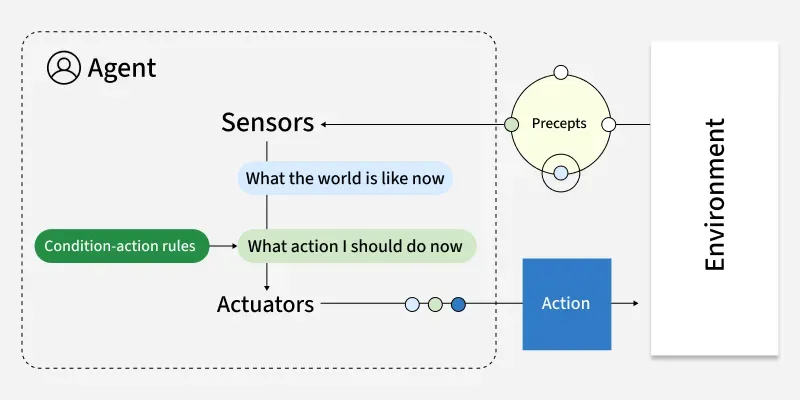
Simple Reflex Agent Working
Simple reflex agents act only on the current input using predefined rules, without memory or history. They are fast and suitable for simple, fully observable environments but perform poorly in dynamic or partially observable situations due to lack of memory and reasoning.
- **Reactive: These agents respond immediately to inputs without consideration for prior events or predicting future outcomes.
- **Limited Scope: They excel in predictable environments where tasks are straightforward and the relationships between actions and results are well understood.
- **Quick Response: Since decisions are made based only on immediate input, it can react without delay.
- **No Learning: These agents cannot improve or change their behavior based on past experiences.
**Example: Traffic light control systems that change signals based on fixed timing.
2. Model-Based Reflex Agents
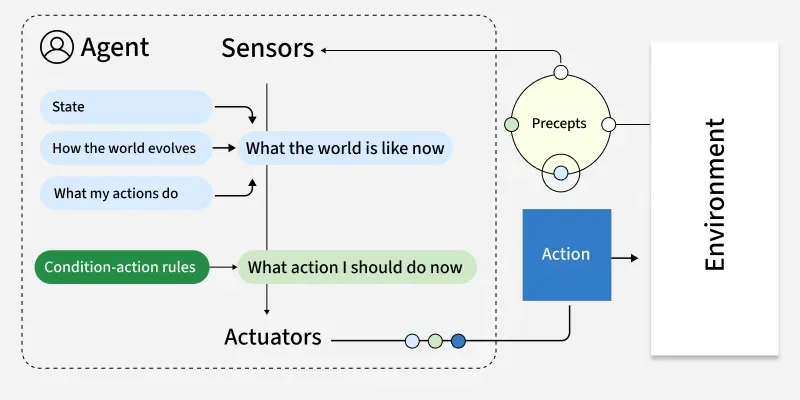
Model-Based Reflex Agent Working
Model-based reflex agents improve simple reflex agents by maintaining an internal state of the environment to handle partially observable and changing situations. However, their decisions are still mainly reactive and depend on the accuracy of the internal model.
- **Internal State: Maintains an internal model to handle partially observable environments and support flexible decisions.
- **Adaptive: Updates its internal state based on new information to adjust to changes.
- **Better Decision-Making: Uses stored information to make more informed and reliable choices.
- **Increased Complexity: Requires more memory and computation to maintain and update the internal model.
**Example: Robot vacuum cleaners that map rooms and tracks cleaned areas.
3. Goal-Based Agents
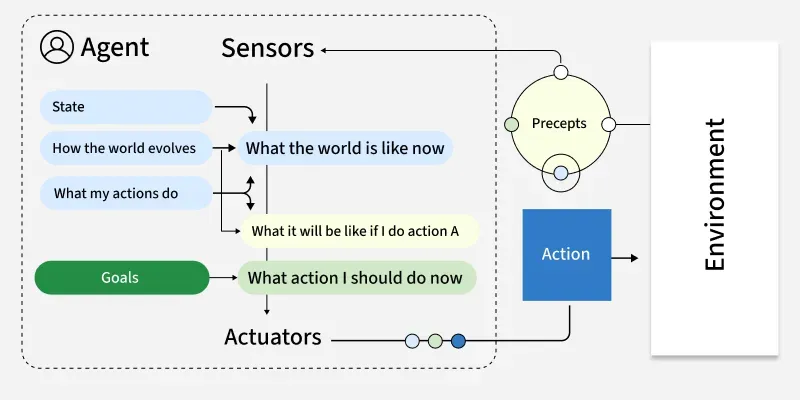
Goal-Based Agents Working
Goal-based agents choose actions by evaluating future states in relation to defined goals. They can plan action sequences to achieve objectives, enabling more flexible problem-solving, but depend on clear goals and effective planning methods in complex environments.
- **Goal-Oriented: Makes decisions based on how well actions align with defined objectives.
- **Planning and Search: Uses planning algorithms to evaluate possible action sequences to reach goals.
- **Flexible: Re-plans and adjusts strategies when conditions or information change.
- **Future-Oriented: Unlike reflex agents,they think ahead and predict future outcomes to find the best course of action.
**Example: Logistics routing agents that find optimal delivery routes based on factors like distance and time. They continuously adjust to reach the most efficient route.
4. Utility-Based Agents
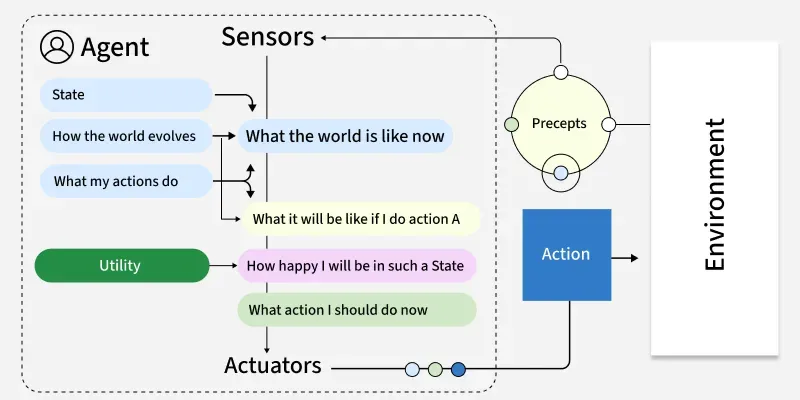
Utility-Based Agent Working
Utility-based agents go beyond goal-based agents by evaluating how desirable different outcomes are using a utility function. This allows them to make trade-offs and choose the most optimal action in uncertain or limited-resource situations. Their performance depends heavily on how well the utility function is designed.
- **Multi-Criteria Decision Making: Considers multiple factors such as cost, benefit, risk, and time to choose the best action.
- **Trade-Offs: Make decisions by balancing competing goals and preferences often finding the best "compromise."
- **Subjectivity: Adapts to user or organizational preferences through customizable utility functions.
- **Increased Complexity: Finding utility functions for different factors can be computationally intensive and complex.
**Example: Financial portfolio management agents that evaluate investments based on factors like risk, return and diversification operate by choosing options that provide the most value.
5. Learning Agents
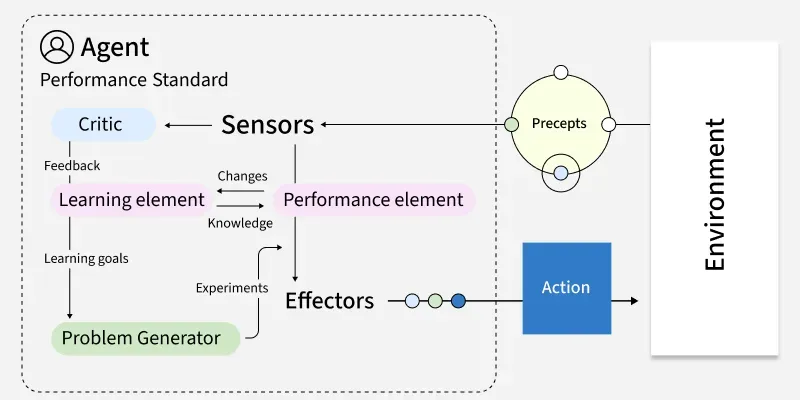
Learning Agent Working
Learning agents improve performance over time by learning from experience and updating their models or strategies. They adapt to changing environments and typically use supervised, unsupervised, or reinforcement learning.
- **Adaptive Learning: Improves their decision-making through continuous feedback from their actions.
- **Exploration vs. Exploitation: Tries balancing new actions and using known successful strategies.
- **Flexibility: Adapt to a wide variety of tasks or environments by modifying their behavior based on new data.
- **Generalization: Applies lessons learned in one context to new, similar situations enhancing their versatility.
**Example: Customer service chatbots can improve response accuracy over time by learning from previous interactions and adapting to user needs.
6. Multi-Agent Systems (MAS)
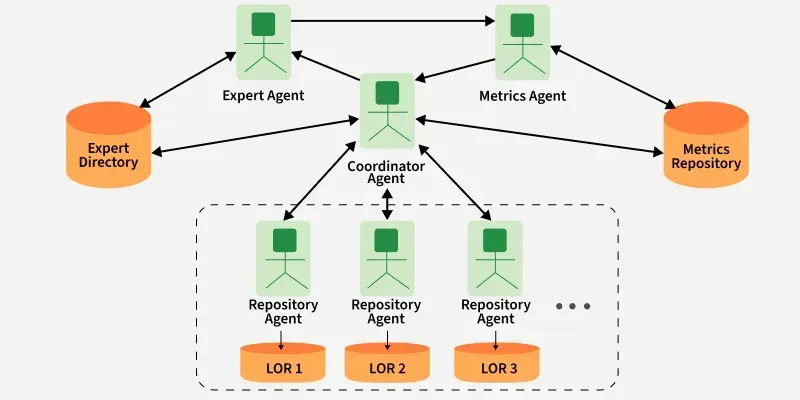
Multi-Agent System Working
Multi-agent systems involve multiple agents interacting in a shared environment to achieve individual or collective goals. They may cooperate or compete and use communication and coordination to operate, but can be complex due to unpredictable behaviors. Types of multi-agent systems:
- **Cooperative MAS: Agents work together toward shared objectives.
- **Competitive MAS: Agents pursue individual goals that may conflict.
- **Mixed MAS: Agents cooperate in some scenarios and compete in others.
**Key Characteristics:
- **Autonomous Agents: Each agent acts on its own based on its goals and knowledge.
- **Interactions: Agents communicate, cooperate or compete to achieve individual or shared objectives.
- **Distributed Problem Solving: Agents work together to solve complex problems more efficiently than they could alone.
- **Decentralization: No central control, agents make decisions independently.
**Example: A warehouse robot uses AI methods like reflexes for navigation, planning for tasks, utility-based choices for prioritization, and learning for route optimization.
7. Hierarchical agents
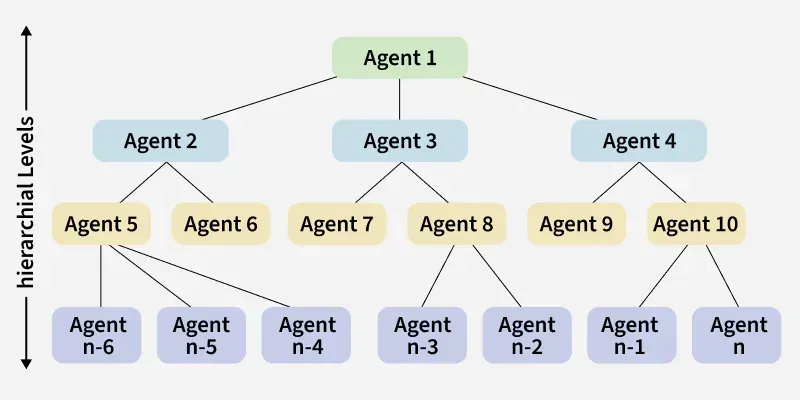
Hierarchical Agent Working
Hierarchical agents structure behavior into layers such as strategic, tactical, and operational. Higher levels set goals that are broken into smaller tasks for lower levels, improving scalability and handling of complex tasks, but requiring well-designed coordination between layers.
- **Structured Decision-Making: Decision-making is divided into different levels for more efficient task handling.
- **Task Division: Complex tasks are broken down into simpler subtasks.
- **Control and Guidance: Higher levels direct lower levels for coordinated action.
**Example: Drone delivery systems in which fleet management is done at top level and individual navigation at lower level.
Comparison of AI Agent Types
| Agent Type | Main Strength | Limitations | Best For | Example |
|---|---|---|---|---|
| **Simple Reflex Agent | Instant reaction based on fixed rules | No memory or learning; fails in dynamic environments | Fully observable, stable and simple environments | Traffic light timers |
| **Model-Based Reflex Agent | Handles partial observability with internal state | More computational demand; depends on model accuracy | Dynamic or partially observable environments | Robot vacuum cleaners |
| **Goal-Based Agent | Plans ahead to achieve specific objectives | Needs clear goals and planning algorithms | Strategic tasks with defined goals | Logistics route planning |
| **Utility-Based Agent | Balances multiple factors for best outcome | Requires complex utility functions | Multi-criteria decision-making | Financial portfolio management |
| **Learning Agent | Improves over time via experience | Needs data and training time | Dynamic environments with changing conditions | AI chatbots |
| **Multi-Agent System (MAS) | Distributed problem-solving with cooperation or competition | Complex interactions; unpredictable behaviors | Decentralized, multi-entity systems | Smart traffic control |
| **Hierarchical Agent | Breaks complex tasks into levels for efficiency | Requires well-defined interfaces between layers | Large-scale, multi-level operations | Drone delivery management |
When to Use Each AI Agent Type
**1. Simple Reflex Agent
- Environment is fully observable and predictable
- Tasks are repetitive with fixed rules
**2. Model-Based Reflex Agent
- Some information about the environment is hidden but can be modeled
- Environment changes but follows predictable patterns
**3. Goal-Based Agent
- Tasks require planning multiple steps ahead
- Clear goals are defined and can be measured
**4. Utility-Based Agent
- Need to balance trade-offs like cost, time and risk
- Multiple objectives must be prioritized
**5. Learning Agent
- Environment changes over time and the system must adapt
- Performance should improve with experience
**6. Multi-Agent System (MAS)
- Multiple agents must work together or compete
- Problem-solving is decentralized and distributed
**7. Hierarchical Agent
- Tasks can be split into strategic, tactical and operational levels
- Large-scale operations require coordination between layers