LLM Parameters (original) (raw)
Last Updated : 2 May, 2026
LLM parameters are the internal weights learned during training that capture patterns in language such as grammar, context and relationships between words. These parameters often number in billions and determine the model’s capacity to understand and generate text.
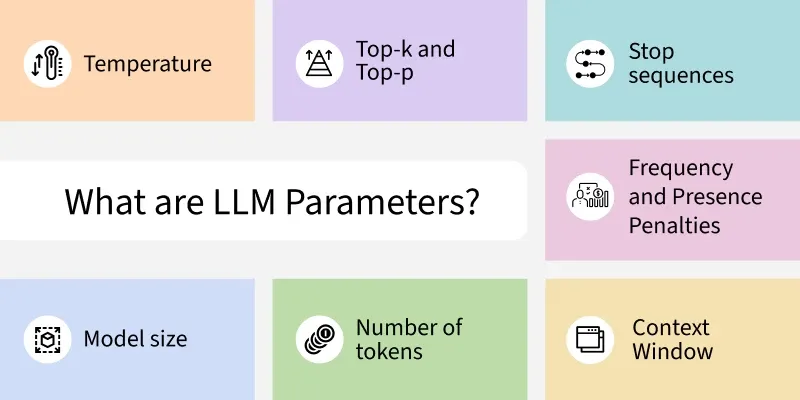
LLM Parameters
Decoding Parameters (Generation Controls)
These parameters control how the model generates output during inference and are different from the internal model parameters learned during training.
**1. Temperature
- Temperature controls the randomness or creativity in the output generation.
- A high temperature makes the model more diverse and creative while a low temperature produces more focused and deterministic responses.
- This parameter is specially important for tasks requiring creative generation like poetry or story writing.
**2. Max Tokens
- This parameter limits the maximum number of tokens the model can generate in response.
- It's an important parameter for controlling the length of the generated output ensuring that it stays within a defined range whether for more comprehensive content.
**3. Top-p (Nucleus Sampling)
- Top-p helps control the diversity of text by focusing on the top p probability mass when selecting the next token.
- For example, with a top-p value of 0.9 the model will select from the most probable tokens that make up 90% of the total probability distribution ensuring output is both coherent and varied.
**4. Presence Penalty
- Presence penalty discourages the model from reusing words or concepts that have already appeared in the generated text.
- It encourages the introduction of new ideas and improves diversity in the output.
**5. Frequency Penalty
- Frequency penalty reduces the likelihood of repeatedly using the same words based on how often they have already appeared.
- It helps control excessive repetition of common words or phrases in the output and ensures the generated text remains balanced and less repetitive.
**6. Top-k
Top-k restricts the model’s choice to the k most likely tokens for the next word. For example, with top-k = 50, the model only considers the 50 most probable tokens at each step, ignoring all others. Here Low k means output is more predictable and focused and High k means output is more varied but still coherent.
Impact of Parameters on Model Performance
- The number of parameters in a large language model (LLM) has a significant impact on its performance.
- More parameters often improve capacity, but performance depends on data quality, training and architecture..
- However increased parameter count also demands more computational resources for training and inference.
- While larger models tend to perform better on a wide range of tasks they can also become more prone to overfitting, slower to respond and harder to deploy efficiently highlighting the trade off between model size and practical usability.
Parameter Optimization Strategies
- **Fine Tuning****:** Fine tuning involves starting with a pre trained model and adapting it to a specific task by training it further on a smaller, domain specific dataset. This allows the model to retain general knowledge while becoming more accurate for a given task.
- **Transfer Learning****:** Transfer learning allows models trained on one dataset to be adapted for another. This process involves adjusting a model’s parameters on a new task without retraining everything from scratch.
- **Hyperparameter Tuning****:** Hyperparameters control aspects of model training, such as learning rate, batch size and the number of layers. Fine-tuning these values through techniques like grid search or random search can significantly improve model performance.
- **Quantization: Quantization reduces the precision of the numerical values in a model. This is like using simpler math to represent the same information which makes the model smaller and faster to run while maintaining most of its accuracy.
For Example
This code loads the GPT-2 model and tokenizer from Hugging Face then generates three different text completions for a given prompt using sampling parameters like temperature, top_p and top_k to control creativity and diversity.
- **max_length (128): maximum number of tokens to generate in the output.
- **temperature (0.8): controls randomness as lower is more focused and higher is more random.
- **top_p (0.9): nucleus sampling as picks tokens from the smallest set whose total probability ≥ 0.9.
- **top_k (50): limits choices to the top 50 most likely tokens.
- **repetition_penalty (1.2): discourages repeating the same words or phrases by lowering their probability.
- **num_return_sequences (3): number of separate outputs the model should generate for the same prompt. Python `
from transformers import AutoModelForCausalLM, AutoTokenizer
gen_config = {
"model_name": "gpt2",
"max_length": 128,
"temperature": 0.8,
"top_p": 0.9,
"top_k": 50,
"repetition_penalty": 1.2,
"num_return_sequences": 3
}
tokenizer = AutoTokenizer.from_pretrained(gen_config["model_name"])
model = AutoModelForCausalLM.from_pretrained(gen_config["model_name"])
prompt = "Write a short, upbeat mission statement for a student studying AI at night:"
input_ids = tokenizer(prompt, return_tensors="pt").input_ids outputs = model.generate( input_ids, max_length=gen_config["max_length"], do_sample=True, temperature=gen_config["temperature"], top_p=gen_config["top_p"], top_k=gen_config["top_k"], repetition_penalty=gen_config["repetition_penalty"], num_return_sequences=gen_config["num_return_sequences"], eos_token_id=tokenizer.eos_token_id, ) for i, out in enumerate(outputs): text = tokenizer.decode(out, skip_special_tokens=True) print(f"Generation {i+1}\n{text}\n")
`
**Output:

Output
Challenges
- **Computational Cost: Training and deploying models with billions of parameters requires significant computational resources. It may take days or weeks to train these models on large datasets, requiring powerful GPUs or TPUs.
- **Memory Usage: Larger models need more memory to store parameters. This can make them difficult to deploy on devices with limited storage and computational power.
- **Overfitting: As the number of parameters increases the risk of overfitting rises. Models with too many parameters might memorize the training data resulting in poor generalization to new data.
- **Training Time: More parameters require more time to train. As the model becomes more complex, training takes longer, making experimentation and adjustments more time consuming.