What is Mistral AI (original) (raw)
Last Updated : 20 Aug, 2025
Mistral AI is a French artificial intelligence startup established in April 2023 by three leading AI researchers: Arthur Mensch, Guillaume Lample and Timothée Lacroix, all of whom have strong backgrounds in major AI labs such as Google DeepMind and Meta AI. The company is headquartered in Paris and is named after the mistral, a strong northwesterly wind that blows from southern France. Mistral AI focuses primarily on developing open-source large language models (LLMs) that are efficient, high-performing and accessible to developers, researchers and businesses worldwide. As of 2024, it is recognized as the largest AI startup in Europe by valuation and a major global player outside Silicon Valley.
Types of Mistral AI Models
Mistral AI offers a diverse portfolio of language models tailored to different usage needs:
**General Purpose Models: These models target a broad range of NLP tasks, providing state-of-the-art results relative to their size and efficiency:
- **Mistral 7B: An open-source model with 7 billion parameters, which outperforms some larger models in quality while maintaining lower computational costs. It is ideal for developers seeking accessible yet powerful AI capabilities.
- **Mistral Large 2: A flagship model boasting 123 billion parameters, designed for very high throughput single-node performance. It supports dozens of natural languages including English, French, Chinese and is trained on over 80 programming languages. This model typically requires a commercial license for deployment, suited for large-scale enterprise needs.
- **Mistral Small v24.09: A 22 billion parameter model balanced for cost-efficiency and enterprise readiness, great for companies needing performance while managing operational costs.
**Specialist Models: These domain-specific models are fine-tuned or architected for particular tasks:
**Codestral: A 22 billion parameter model optimized for programming tasks. It supports a broad spectrum of programming languages such as Python, Java, C++, JavaScript and more, making it highly useful for developers wanting advanced code generation and debugging assistance.
**Research Models: Fully open-source models released to the research community to encourage experimentation, customization and fine-tuning:
**Mixtral: A series of sparse mixture of experts (MoE) models. MoE models use specialized "experts" subnetworks selectively activated per input, increasing efficiency and scale without proportional computational cost. Variants include Mixtral 8x7B and Mixtral 8x22B.
**Mathstral: An MoE variant optimized for handling complex mathematical problem-solving tasks.
**Mistral NeMo: Developed jointly with NVIDIA, this 12 billion parameter multilingual model is fully open-source under Apache 2.0 license, supporting many languages and enabling broad research use.
**Pixtral 12B: An open multimodal model capable of processing both text and images, extending the capabilities of traditional LLMs into vision-language tasks.
Architecture of Mistral AI
Mistral AI's architecture is centered on a decoder-only transformer, optimized with sliding window attention and grouped-query attention, allowing efficient handling of long contexts without excessive memory use. Key innovations include a rolling buffer for KV cache to support fast inference and scalable window sizes, plus robust tokenization that ensures zero out-of-vocabulary errors. Their Mixtral models add Mixture-of-Experts layers for even higher capacity and efficiency. These design choices let Mistral models deliver fast, scalable and accurate language understanding and generation across a wide range of tasks and languages.
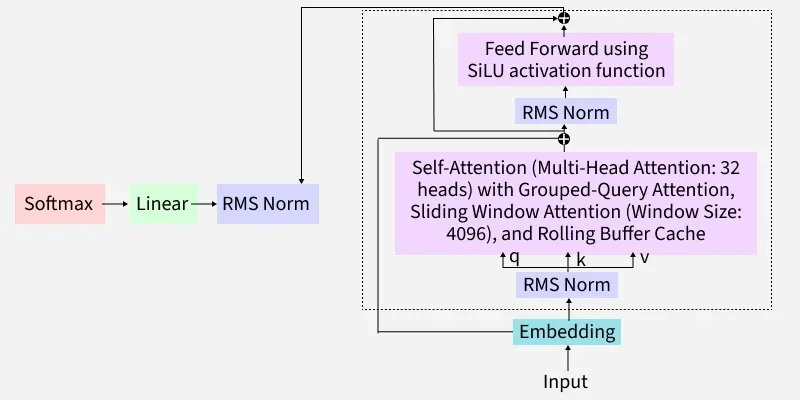
Mistral AI Architecture
- **Efficiency-Driven Design : Mistral AI’s models incorporate cutting-edge transformer architectures optimized for both speed and computational efficiency. Optimizations include sliding window attention mechanisms and use of sparse Mixture of Experts (MoE) layers. These designs allow handling of very large models while reducing inference latency and hardware costs critical for democratizing access to advanced AI.
- **Large Context Windows : Some Mistral models support exceptionally long input contexts, up to 128,000 tokens. This ability suits them for tasks requiring handling of extended documents, intricate multi-turn conversations or detailed reasoning across lengthy texts, surpassing many contemporary LLMs.
- **Multilingual and Multimodal Support : Their models cover dozens of natural languages and support over 80 programming languages, enabling versatile application in linguistics, coding and cross-cultural scenarios. Multimodal models like Pixtral also integrate image understanding alongside text, pushing the boundary of use cases.
- **Open Source Philosophy : Mistral AI strongly commits to transparency and developer empowerment by releasing many models under permissive licenses like Apache 2.0. This encourages community-driven development, research freedom and the ability to modify or fine-tune models to particular organizational needs.
Comparison with other models
| Model | Parameters | Context Window | Architecture / Features | Strengths | License / Access |
|---|---|---|---|---|---|
| **Mistral Large 2 | 123B (flagship) | Up to 128,000 tokens | Efficient transformer and sparse Mixture of Experts | Very large context, efficient, multilingual, coding support | Commercial and Open models |
| **Llama 3.1 | Up to 405B | Up to 128,000 tokens | Transformer with advanced MoE (128 experts) | Strong reasoning, coding, large context | Mostly open, commercial license for larger |
| **GPT-4 | ~100-175B (estimated) | Up to 32,768 tokens | Proprietary transformer, fine-tuned for safety | Leading language understanding, multimodal, commercial API | Closed source, API only |
| **Mixtral (Mistral AI) | Variants: 8×7B, 8×22B | Up to 64,000 tokens | Sparse Mixture of Experts | Research model, efficient MoE, scalable | Open source (Apache 2.0) |
**Industries Benefiting from Mistral AI
- **Finance: Automates reporting, enhances fraud detection and supports risk assessment.
- **Healthcare: Improves clinical documentation, patient engagement and medical research.
- **Customer Support: Powers AI chatbots and streamlines automated responses.
- **Education: Enables tutoring, content summarization and personalized learning support.
- **Software Development: Accelerates code generation, debugging and software optimization.
Use Cases and Applications
Mistral AI’s models serve a broad range of sectors and functionalities:
- **Automated Content Creation : AI-powered generation of articles, blogs, social media posts, marketing copy and creative writing. Mistral’s efficient models enable fast, high-quality content production for digital marketing and media companies.
- **Enterprise AI Solutions : Through APIs like Mistral Agents, companies can embed AI into critical business workflows such as process automation, decision support and document understanding, yielding operational efficiency gains.
- **Document Processing : Tools like **Mistral **OCR convert scanned PDFs and images into machine-readable text to facilitate search, indexing and further AI-driven analysis, streamlining workflows in legal, financial and administrative domains.