Planning in Artificial Intelligence (original) (raw)
Last Updated : 29 May, 2026
Planning in AI refers to the process of creating a sequence of actions that helps achieve a specific goal from an initial state. AI systems use planning techniques to analyze situations, evaluate possible outcomes, and determine the most effective path to success.
- Enables AI systems to adapt their actions when conditions or information change.
- Supports autonomous decision-making in robots, virtual assistants, and intelligent systems.
- Helps optimize tasks by selecting efficient and goal-oriented action sequences.
**Types of Planning
There are several types of planning approaches in AI, each suited to different tasks and environments:
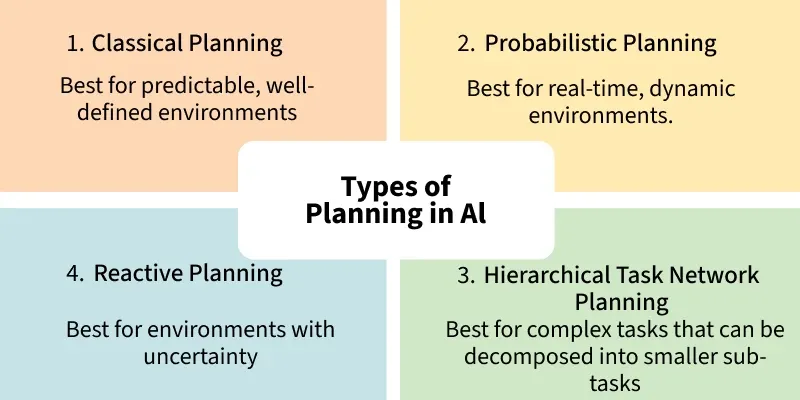
1. Classical Planning
Classical planning assumes a fully observable and deterministic environment where the AI agent has complete knowledge of the system and follows a fixed sequence of actions to achieve a goal.
**Forward State Space Planning (FSSP): Starts from the initial state and explores actions step-by-step toward the goal.
- Advantage: Guarantees a solution if one exists.
- Challenge: Can become computationally expensive.
- Example: Solving a maze from the starting point.
**Backward State Space Planning (BSSP): Begins from the goal state and works backward toward the initial state.
- Advantage: More efficient when the goal is clearly defined.
- Challenge: Backtracking may create inconsistencies.
- Example: Planning chess moves backward from a checkmate position.
2. **Probabilistic Planning
Handles environments with uncertainty where some actions might have unpredictable outcomes. Common models include Markov Decision Processes (MDPs) and Partially Observable Markov Decision Processes (POMDPs).
**Example: Autonomous vehicles navigating traffic where road conditions and other drivers' behaviors are uncertain.
3. **Reactive Planning
Focuses on dynamic, real-time responses rather than fixed plans. The AI agent continuously senses its environment and acts based on the latest information, ideal for rapidly changing situations.
**Example: A robot avoiding obstacles in an unknown environment or video game AI adapting to player actions.
4. **Hierarchical Task Network (HTN) Planning
Hierarchical Task Network (HTN) Planning breaks complex tasks into smaller sub-tasks and creates plans for each step. This approach simplifies large-scale problem solving where goals can be divided into manageable steps.
**Example: A robot assembling a product by breaking the task into subtasks like gathering parts, assembling and testing the product.
**Applications
- **Robotics: Helps robots navigate environments, avoid obstacles, and perform tasks autonomously. For example, warehouse robots plan collision-free paths.
- **Healthcare: Supports treatment planning by suggesting suitable therapies based on patient data and medical conditions.
- **Autonomous Vehicles: Enables self-driving cars to navigate roads, follow traffic rules, and avoid collisions.
- **Gaming: Allows non-player characters (NPCs) to plan strategies and react intelligently during gameplay.
- **Supply Chain Management: Optimizes logistics, transportation, and inventory management to improve efficiency and reduce costs.
**Advantages
- Improves efficiency by helping AI find optimal or near-optimal solutions while saving time and resources.
- Enhances adaptability by allowing systems to respond to new or unexpected situations.
- Supports autonomy in robots, virtual assistants, and automated systems for independent task execution.
- Enables informed decision-making across domains such as healthcare, logistics, and gaming.
**Challenges
- Computational complexity increases in large and dynamic environments, requiring significant time and processing power.
- Handling uncertainty is difficult when environments contain unpredictable conditions or outcomes.
- Scalability becomes challenging as the size of tasks, datasets, or variables increases.