Adrenal Gland (original) (raw)
Last Updated : 13 May, 2026
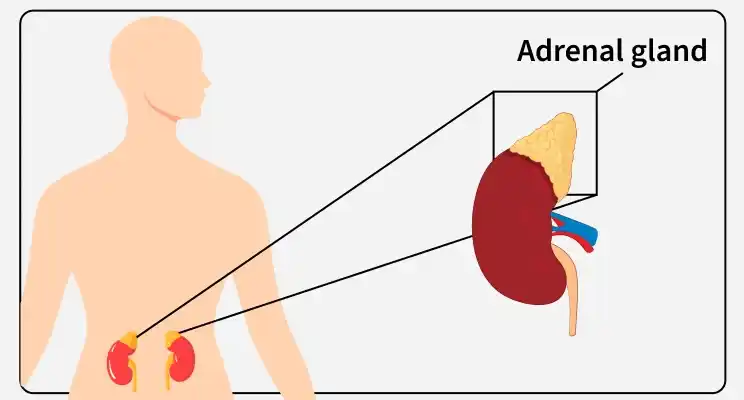
The adrenal glands are small, triangular-shaped endocrine glands located on top of each kidney. They are an essential part of the endocrine system and play a crucial role in maintaining the body’s internal balance (homeostasis). Despite their small size, adrenal glands produce a variety of hormones that regulate important functions such as metabolism, immune response, blood pressure, and the body’s response to stress.
**Characteristics of the Adrenal Gland
- The right adrenal gland is pyramidal in shape and lies above the right kidney, anteriorly related to the liver, and medially related to the inferior vena cava.
- The left adrenal gland is semilunar (crescent-shaped), anteriorly related to the stomach, pancreas, and spleen, and posteriorly, both glands are related to the diaphragm. The human body has two adrenal glands.
- Each gland measures about 5 × 3 × 1 cm, and the total weight is about 7–10 grams.
- It is covered by a fibrous capsule and surrounded by fat.
- It is yellowish in colour.
**Structure of the Adrenal Gland
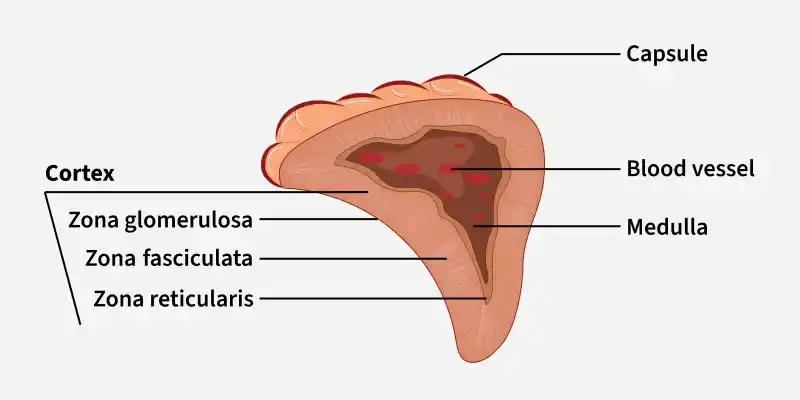
Each adrenal gland has two main parts:
**1. Adrenal Cortex (Outer Part)
It has three layers:
- **Zona glomerulosa: Secretes aldosterone (regulates salt and water balance).
- **Zona fasciculata: Secretes cortisol (regulates metabolism and stress response).
- **Zona reticularis: Secretes androgens (sex hormones).
**2. Adrenal Medulla (Inner Part)
- The adrenal medulla is controlled by the sympathetic nervous system, not by hormones.
- It secretes Adrenaline (epinephrine) and Noradrenaline (norepinephrine).
- Responsible for the fight-or-flight response.
**Hormones of the Adrenal Gland
- **Adrenaline: Increases heart rate and blood sugar during stress.
- **Noradrenaline: Prepares the body for action and maintains blood pressure.
- **Cortisol: Regulates metabolism and helps in stress response.
- **Aldosterone: Maintains water and electrolyte balance.
- **Androgens: Contribute to sexual development.
**Functions of the Adrenal Gland
- It maintains water and electrolyte balance.
- Regulates metabolism of carbohydrates, fats, and proteins.
- Helps in stress and emergency responses.
- Controls blood pressure.
- Contributes to sexual development.
**Disorders of the Adrenal Gland
- **Addison’s Disease: Decreased hormone secretion causing weakness and low blood pressure.
- **Cushing’s Syndrome: Excess cortisol causes weight gain and high blood pressure.
- **Pheochromocytoma: A tumour of the adrenal medulla causing excess adrenaline secretion.