Angiosperms Definition, Characteristics, Reproduction and Examples (original) (raw)
Last Updated : 9 Jun, 2026
Angiosperms, commonly known as flowering plants, are the largest and most diverse group of plants in the Plant Kingdom. They are characterised by the presence of flowers and seeds enclosed within fruits, which provide protection and aid in seed dispersal. Angiosperms are found in almost every habitat on Earth and exhibit remarkable adaptability to different environmental conditions. They are of immense ecological and economic importance as they provide food, oxygen, medicines, fibres, timber, and many other resources essential for life.
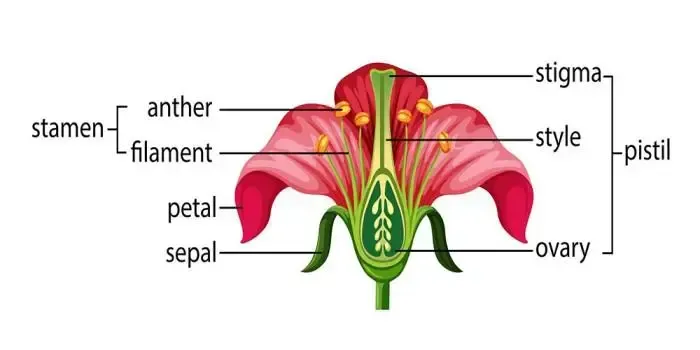
Reproductive Structures of Angiosperms
The flower is the reproductive organ of angiosperms and is composed of four floral whorls.
- **Calyx: The calyx consists of sepals that protect the flower during the bud stage.
- **Corolla: The corolla consists of petals, which are often brightly coloured and attract pollinating agents such as insects, birds, and animals.
- **Androecium: The androecium is the male reproductive whorl consisting of stamens. Each stamen contains an anther that produces pollen grains.
- **Gynoecium: The gynoecium is the female reproductive whorl consisting of one or more carpels. Each carpel contains an ovary, style, and stigma. Ovules are present within the ovary.
Characteristics of Angiosperms
- The most distinctive feature of angiosperms is the presence of flowers, which serve as their reproductive structures. Flowers facilitate pollination and fertilisation and ultimately develop into fruits containing seeds.
- The plant body of angiosperms is well differentiated into roots, stems, and leaves, each performing specialised functions necessary for growth and survival.
- Angiosperms possess a highly developed vascular system consisting of xylem and phloem tissues. The xylem contains vessels that efficiently transport water and minerals, while the phloem contains companion cells that assist in the transport of food materials.
- The reproductive organs are organised within flowers. The male reproductive organ is called the stamen, while the female reproductive organ is known as the carpel or pistil.
- Angiosperms are heterosporous plants because they produce two different types of spores. Microspores develop into pollen grains, which represent the male gametophyte, while megaspores develop into embryo sacs, which represent the female gametophyte.
- A unique characteristic of angiosperms is double fertilisation, a phenomenon found exclusively in flowering plants. During this process, one male gamete fuses with the egg cell to form a diploid zygote, while the other male gamete fuses with the polar nuclei to form a triploid endosperm.
- The seeds of angiosperms are enclosed within fruits, which provide protection and aid in seed dispersal.
- Another characteristic feature is the highly reduced gametophytic generation. The sporophyte generation is dominant, independent, and long-lived, whereas the gametophyte generation is microscopic and dependent on the sporophyte.
Classification of Angiosperms
Angiosperms are broadly classified into two major groups based on the number of cotyledons present in their seeds.

Monocotyledons (Monocots)
- Monocotyledons are flowering plants whose seeds contain a single cotyledon.
- The root system is generally fibrous or adventitious.
- Leaves usually exhibit parallel venation in which veins run parallel to one another.
- The vascular bundles in the stem are scattered throughout the ground tissue.
- Flowers are generally trimerous, meaning floral parts occur in multiples of three.
- Secondary growth is usually absent.
- Examples of monocotyledons include rice, wheat, maize, sugarcane, banana, bamboo, lily, orchid, and coconut.
Dicotyledons (Dicots)
- Dicotyledons are flowering plants whose seeds contain two cotyledons.
- The root system is generally a taproot system.
- Leaves usually exhibit reticulate venation, where veins form a network.
- The vascular bundles are arranged in a ring within the stem.
- Flowers are generally tetramerous or pentamerous, with floral parts occurring in multiples of four or five.
- Secondary growth commonly occurs due to the activity of cambium.
- Examples of dicotyledons include sunflower, rose, pea, mango, tomato, mustard, cotton, and bean plants.
Structure of an Angiosperm Plant
The body of an angiosperm consists of two major systems:
- **Root System: The root system develops from the radicle of the embryo and grows underground. It anchors the plant firmly in the soil, absorbs water and minerals, stores food, and conducts nutrients to the aerial parts of the plant.
- **Shoot System: The shoot system develops from the plumule and consists of stems, branches, leaves, flowers, fruits, and seeds. It performs photosynthesis, reproduction, transport of materials, and storage functions.
Life Cycle of Angiosperms
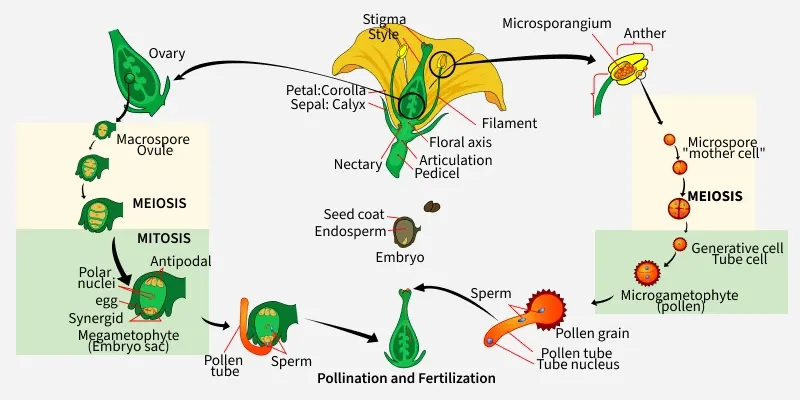
- Angiosperms exhibit a diplontic life cycle characterised by alternation of generations.
- The dominant phase is the diploid sporophyte, which is represented by the entire flowering plant.
- Within the flowers, specialised reproductive structures produce spores through meiosis.
- Microspores develop into pollen grains, while megaspores develop into embryo sacs.
- Pollination transfers pollen grains from the anther to the stigma.
- After pollination, the pollen grain germinates and produces a pollen tube that grows through the style toward the ovule.
- The male gametes travel through the pollen tube and participate in double fertilisation.
- The fertilised ovule develops into a seed, while the ovary develops into a fruit.
- The seed germinates under favourable conditions and develops into a new sporophytic plant, completing the life cycle.
Reproduction in Angiosperms
Reproduction in angiosperms occurs mainly through sexual reproduction.
- **Pollination: Pollination is the transfer of pollen grains from the anther to the stigma. Agents of pollination include wind, water, insects, birds, bats, and other animals. Pollination may be Self-pollination and Cross-pollination
- **Fertilisation: After pollination, the pollen tube carries male gametes to the ovule. One male gamete fuses with the egg cell to form the diploid zygote. The second male gamete fuses with the two polar nuclei to form the triploid primary endosperm nucleus. This process is known as double fertilisation and is unique to angiosperms.
- **Seed Formation: The fertilised ovule develops into a seed containing the embryo and stored food.
- **Fruit Formation: The ovary develops into a fruit that encloses and protects the seeds.
- **Germination: Under favourable environmental conditions, the seed germinates and develops into a new plant.
Economic Importance of Angiosperms
- Most food crops belong to angiosperms. Cereals, fruits, vegetables, pulses, nuts, and edible oils are obtained from flowering plants. Examples include rice, wheat, maize, potato, mango, banana, apple, and tomato.
- Many angiosperms provide valuable timber used in furniture, construction, and paper industries. Examples include teak, oak, mahogany, and eucalyptus.
- Several flowering plants provide fibres used in textiles. Examples include cotton, jute, flax, and hemp.
- Many medicinal plants belong to angiosperms and are used in traditional and modern medicine. Examples include neem, tulsi, cinchona, eucalyptus, aloe vera, and periwinkle.
- Tea, coffee, and cocoa are obtained from flowering plants and are widely consumed throughout the world.
- Numerous spices used in cooking are derived from angiosperms. Examples include pepper, cardamom, clove, cinnamon, turmeric, and ginger.
- Many angiosperms are cultivated for their attractive flowers and aesthetic value. Examples include rose, orchid, marigold, jasmine, hibiscus, and lily.