Auxin (original) (raw)
Last Updated : 3 Jun, 2026
Auxin is one of the most important plant growth hormones that plays a major role in regulating the growth and development of plants. It is primarily responsible for cell elongation, apical dominance, root initiation, and various growth responses to environmental stimuli such as light and gravity. Auxin is considered the first discovered plant hormone and is widely distributed in almost all parts of the plant body, especially in actively growing regions such as shoot tips, young leaves, developing seeds, buds, and root apices.
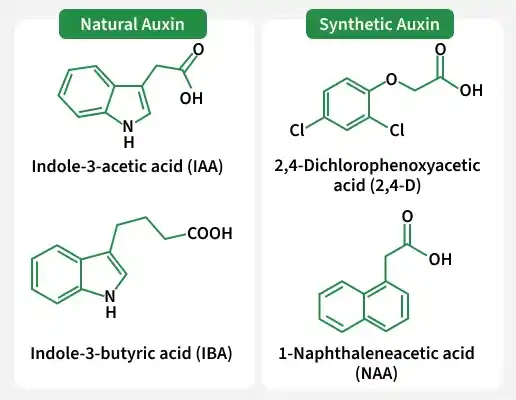
Chemically, the most common naturally occurring auxin in plants is Indole-3-acetic acid (IAA). Auxins may occur naturally within plants or may be artificially synthesised for agricultural and horticultural purposes. Since auxin regulates numerous growth activities, it is regarded as one of the most significant plant growth regulators in plant physiology.
Discovery and Nature of Auxin Hormone
- The discovery of auxin began through experiments conducted to study the bending of plant shoots toward light, a phenomenon known as phototropism.
- Charles Darwin and his son Francis Darwin observed that the tip of the coleoptile in grass seedlings was responsible for sensing light and controlling the bending movement.
- Later, the scientist Frits Went successfully isolated the growth-promoting substance from the coleoptile tips and named it “auxin,” which means “to grow.”
- Auxin is mainly synthesised in the apical meristems of shoots, young leaves, developing embryos, and growing seeds.
- After synthesis, it is transported to other parts of the plant where it regulates various growth activities.
- Auxin movement within plants is polar, meaning it generally moves from the apex toward the base of the plant.
- Auxin is present in both natural and synthetic forms. Natural auxins include Indole-3-acetic acid (IAA), while synthetic auxins include compounds such as Naphthalene Acetic Acid (NAA) and 2,4-Dichlorophenoxyacetic acid (2,4-D).
Commercial Use of Auxin Hormone
Auxins have several important applications in agriculture, horticulture, and plant tissue culture because of their ability to regulate plant growth and development.
- Auxins are used to promote root formation in stem cuttings during vegetative propagation.
- They are used in tissue culture to stimulate root development.
- Synthetic auxins are used as selective weed killers, especially for controlling broadleaf weeds.
- Auxins help prevent premature dropping of fruits and leaves.
- They are used to induce parthenocarpy, which is the development of seedless fruits.
- Auxins are used to improve flowering and fruit production in certain crops.
- They are applied during grafting to stimulate tissue healing and successful union.
Functions of Auxin Hormone
Auxin performs a wide range of physiological functions in plants and regulates many growth-related activities.
- **Promotes Cell Elongation: Auxin stimulates elongation of cells, especially in the stem region, by increasing the plasticity of the cell wall. This results in an increase in the length of the plant.
- **Maintains Apical Dominance: Auxin produced at the shoot apex suppresses the growth of lateral buds and maintains apical dominance. This ensures that the main shoot grows more actively than side branches.
- **Stimulates Root Formation: Auxin promotes the initiation and development of adventitious roots in stem cuttings, which is important for vegetative propagation.
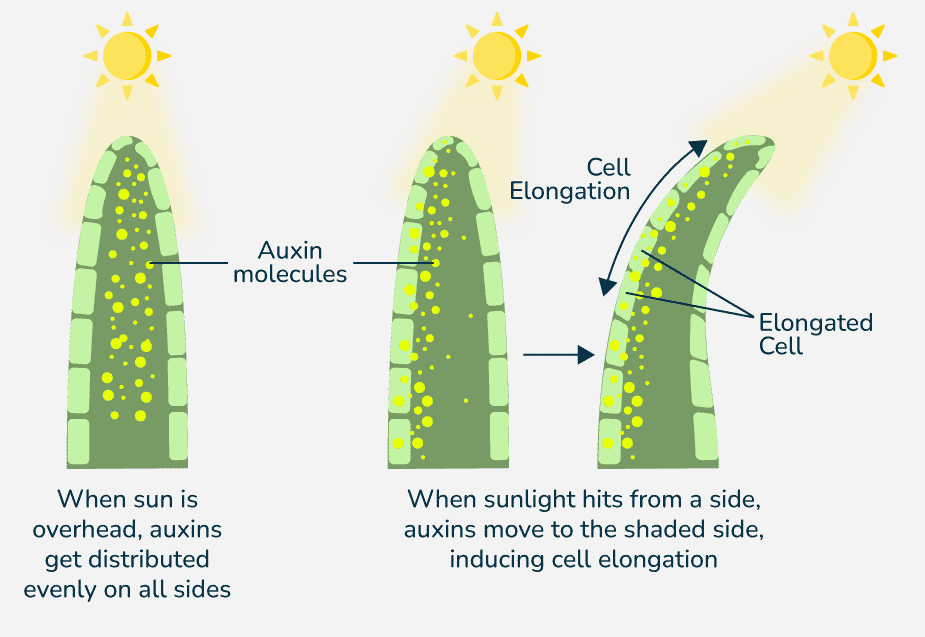
- **Controls Phototropism: Auxin regulates the bending of plant shoots toward light. It accumulates on the shaded side of the stem and promotes greater cell elongation there, causing the plant to bend toward the light source.
- **Controls Geotropism: Auxin helps roots and shoots respond to gravity. In roots, higher concentrations of auxin inhibit elongation, whereas in shoots it promotes elongation.
- **Promotes Fruit Development: Auxin stimulates the growth and development of fruits after fertilisation. It can also induce the formation of seedless fruits through parthenocarpy.
- **Prevents Premature Leaf and Fruit Drop: Auxin delays the formation of the abscission layer, thereby reducing premature shedding of leaves, flowers, and fruits.
- **Helps in Vascular Tissue Differentiation: Auxin promotes the differentiation of vascular tissues such as xylem and phloem during plant growth.
- **Stimulates Cambial Activity: Auxin stimulates the activity of vascular cambium and contributes to secondary growth in plants.
Advantages of Auxin Hormone
- It promotes healthy root development in plants.
- It helps increase crop productivity and fruit formation.
- Auxin is useful in vegetative propagation through stem cuttings.
- It helps prevent premature fruit drop.
- Synthetic auxins help control weeds effectively.
- Auxin supports proper plant growth responses to light and gravity.
- It assists in the production of seedless fruits.
Disadvantages of Auxin Hormone
- Excess auxin may inhibit root and shoot growth.
- High concentrations can cause abnormal plant growth.
- Synthetic auxins used as herbicides may damage non-target plants.
- Excessive auxin may lead to leaf curling and tissue injury.
- Improper use in agriculture may disturb normal plant development.