Crop Production Management (original) (raw)
Last Updated : 24 Mar, 2026
Crop production management is the process of growing and maintaining crops. The process involves preparing the soil, planting seeds, irrigating the crops, and protecting them from pests and diseases. It is aimed at maximising agricultural output while minimising resource usage and environmental impact. Crops are the plants of the same kind that are cultivated in the same place on a large scale.
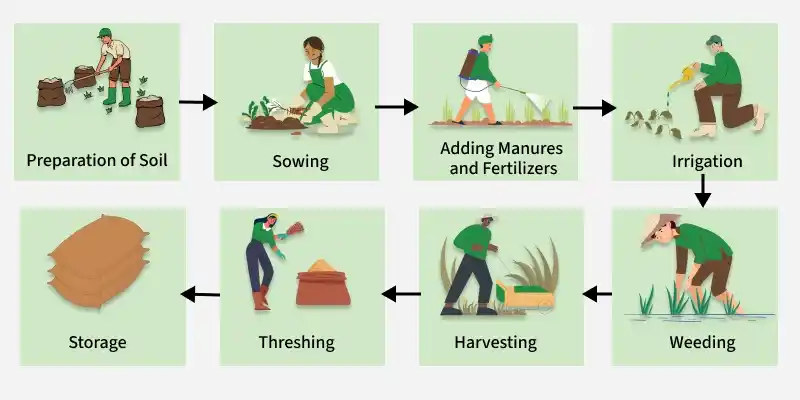
Methods for Crop Production Management
Crop production and management methods are referred to asagricultural practices****,** which include:
**1. Preparation of soil
- Soil preparation is the first step before crop production.
- Soil is prepared to make it suitable for sowing seeds and provides better conditions for plant growth.
- Soil clods/lumps are removed in this process. Loosened soil allows roots to breathe and easily penetrate the soil.
- Ploughing enhances the soil's ability to retain water and turns over the upper layer of the soil, bringing fresh nutrients to the surface.
**2. Sowing
Before sowing, seeds of good quality are selected and are put at a specific depth in the soil. The seeds sown should be disease and pathogen-free. An appropriate distance should be maintained between the seeds to avoid overcrowding of plants. The tools used for sowing seeds include:
- **Traditional tool: The seeds are filled into the funnel, passed down through two or three pipes having sharp ends. These ends pierce into the soil and place seeds there
- **Seed drill: It involves sowing with the help of tractors, and the seeds are sown uniformly at equal distances and depth. It ensures that seeds get covered by the soil after sowing to protect them from birds.
Seed sowing methods include Traditional/long-established methods, Dibbling, Broadcasting (throwing seeds), and Transplanting seedlings.
3. Adding Manure and Fertilisers
- Manures and fertilisers are the substances that are added to the soil in the form of nutrients for the healthy growth of plants.
- They provide essential nutrients such as nitrogen (N), phosphorus (P), and potassium (K), along with secondary nutrients like calcium, magnesium, and sulphur, which are important for plant growth and development.
- Manures, derived from organic sources like animal waste, compost, and crop residues, provide organic matter to the soil.
- This organic matter improves soil structure, water retention, and microbial activity, leading to more fertile soils.
- Fertilisers are chemicals that are rich in a particular nutrient.
- Fertilisers can be applied through various methods such as broadcasting, banding, foliar spraying, etc.
The difference between manure and fertilizer are:
| Features | Manure | Fertilizer |
|---|---|---|
| Source | Organic material from animal waste, compost, or decaying plants. | Synthetic or natural substances with essential plant nutrients. |
| Nutrient Release | Slow release over time as organic matter decomposes. | Immediate availability after application. |
| Impact on Soil | Enhances soil structure, improves water retention, and promotes microbial activity. | Does not contribute to soil health and may lead to degradation if overused. |
| Environmental | Generally eco-friendly, but can contribute to nutrient runoff. | Can cause pollution and soil degradation if misused. |
| Application | Requires larger quantities due to lower nutrient concentration. | Requires smaller quantities due to higher nutrient concentration. |
**4. Crop Irrigation
Crop irrigation is the process of artificially supplying water to crops to ensure their growth and productivity, especially in areas where rainfall is insufficient or irregular. Sources of irrigation include ponds, canals, tube wells, and Reservoirs. Irrigation can also provide nutrients to crops.
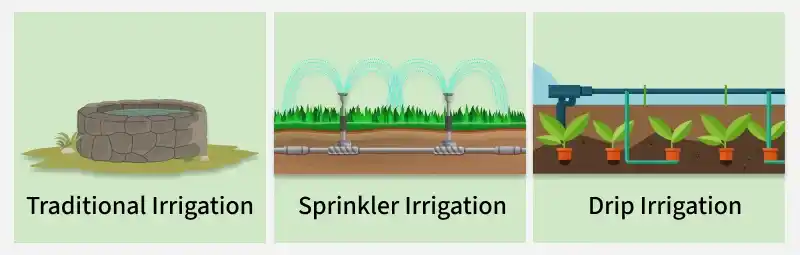
There are different types of irrigation systems****,** including:
- **Manual irrigation: This is a labour-intensive and time consuming irrigation method. Manual labour is used to distribute water using watering cans.
- **Drip irrigation: Drip irrigation is the most effective way to supply water and nutrients to crops. It provides water and nutrients directly to the root zone of the plant in the proper amounts and at the right time. Horticulture crops are mostly irrigated with drip irrigation.
- **Sprinkler Irrigation: Sprinkler irrigation is a technique for distributing irrigation water through pipes and spray heads to irrigate the whole soil surface.
5. Weed Management
Undesired/unwanted plants are called weeds, and they compete for nutrients with the main crop, reducing the main crop's nutrient intake and restricting its growth. Weed management involves methods to control the growth and spread of unwanted plants competing with crops for resources.
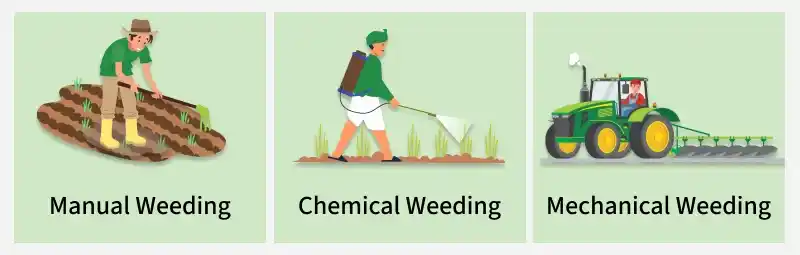
**Types of wedding are:
- **Manual weeding: It is a labour-intensive method of weeding. Weeds are removed with the help of hands or a khurpi from the field. It is an effective method, as they are removed along with the roots, which decreases the chances of emerging again.
- **Mechanical weeding: This method saves you a lot of time. Mechanical weeders are the instruments that are used to remove the weeds. Examples: Cono-weeder, Power tiller, Basket hoe
- **Chemical weeding: Herbicides/Weedicides are chemicals used to remove weeds. These are selective and non-selective. **Selective herbicides: These target only the weeds without affecting the main crop. Non-selective herbicides: These herbicides harm both the main crop and the weeds when applied. Hence, they should be used extremely carefully while using them.
**6. Harvesting
Harvesting occurs when the plant's edible parts have reached their desired maturity. Harvesting can be done by hand using a sickle or with the help of a machine called a harvester. Reaping is the act of harvesting grain or pulses by cutting them with a scythe, sickle, or reaper. The remaining portion of the stem that is left on the field after harvest is known as stubble.
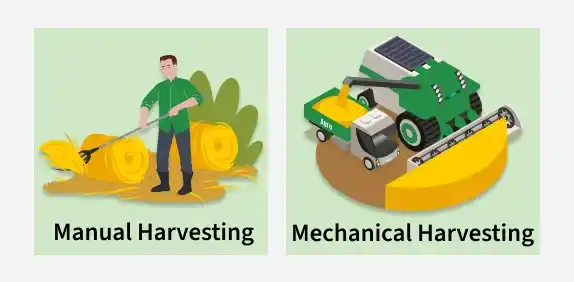
**Methods of Harvesting are:
- **Manual harvesting: Hand harvesting is a technique for manually or by hand picking grains, fruits, vegetables, leaves, etc.
- **Machine harvesting: Machine harvesting is the practice of gathering large quantities of grains with the aid of contemporary harvesters. A contemporary harvester can work in tandem with other massive gear to simultaneously cut and clean the grains.
7. Threshing
- Threshing is the process of separating the edible part of the grains from the straw.
- It is a step in preparing grain after reaping.
- Threshing can be done by hand, with the help of animals, or machines.
- It generally takes place in the field or on a threshing floor.
**8. Storage
- If the grains are to be preserved for prolonged periods, they must be carefully stored. They should be kept free of pests and moisture.
- Before storing the freshly harvested seeds, they should be dried. This helps to keep microbes and pests away.
- The grains are gathered, sorted, and kept in airtight metal containers or jute sacks.
- To prevent them from being damaged at home, dried neem leaves are applied.
- To keep pests and insects away, large quantities of grains are kept in granaries or silos with particular chemical treatments.
Key Points of Crop Production Management
Key points of crop production and management include:
- Preparation of soil by tilling and levelling is necessary. Ploughs and levellers can be used for this.
- Seed should be sown at the appropriate depth and distance for a good yield.
- Before seeds are planted, the soil should be loosened and aerated.
- Water should be applied at regular intervals.
- Manure and fertilisers should be used carefully.
- Unwanted and uncultivated plants called weeds should be removed.
- Proper storage of grains is necessary to protect them from pests and microorganisms.