NCERT Notes Class 8 Science Chapter 1: Crop Production and Management (original) (raw)
Last Updated : 23 Jul, 2025
**NCERT Notes for Class 8 Science Chapter 1: Crop Production and Management: Crop production and management is a crucial aspect of agriculture. It involves the methods and techniques used to cultivate crops and ensure their proper growth, to obtain maximum yield. The process of crop production and management involves various elements such as soil preparation, sowing, irrigation, fertilization, pest control, and harvesting. Farmers and agriculturalists employ various scientific methods and technologies to ensure optimal crop production and management.
**NCERT Class 8 Crop Production and Management: Effective crop production and management techniques are essential to ensure the highest possible yield while maintaining the quality of the crops. It is a vital aspect of agriculture as it plays a critical role in providing food and raw materials for various industries. In this regard, farmers and agricultural experts must constantly improve their knowledge and skills to ensure sustainable and profitable crop production and management practices. Through these notes, the students will be able to revise the NCERT Grade 8 chapter Crop Production and Management with ease.
Agricultural Practices
- Large-scale cultivation of the same kind of plants in one area is known as 'crop'.
- Crops are various kinds like grain, veggies & fruits which can be divided based on the season when they are grown. The climate of different areas can vary greatly, with differences in temperature, humidity, and precipitation levels.
- There are two widely seen crops: Kharif and Rabi.
- **Kharif Crops: Kharif Crops are usually sown during the rainy season from June to September and include staples such as paddy, maize, soybean, groundnut & cotton.
- **Rabi Crops: During the winter months (October to March) one can find Rabi crops like wheat, gram, pea, mustard, and linseed. In addition to these, some places also grow pulses & vegetables during the summer period.
Basic Practices of Crop Production
Farmers deploy a multitude of practices when cultivating crops, which is similar to the work done by gardeners and even hobbyists who grow plants in their homes. These practices unfold over time and include a variety of activities. These activities or tasks are referred to as agricultural practices. These are listed below:
- Preparation of soil
- Sowing
- Adding manure and fertilizers
- Irrigation
- Protecting from weeds
- Harvesting
- Storage
Preparation of Soil
- The process of turning and loosening the soil is a vital part of agriculture as it helps the roots go deep into the ground. This activity also makes it easier for them to breathe, which helps plants access the nutrients they need from the Earth.
- Loosened soil is beneficial to the farmer since it facilitates the growth of earthworms and microbes. These organisms further turn and loosen the soil, adding humus to it.
- Turning and loosening the soil is vital in farming, as only the shallowest layers of the earth contain the nutrients needed for plants to grow. This practice brings these essential elements to the top level, providing sustenance for crops.
- Tilling or ploughing refers to the activity of loosening and turning over the soil.
- Ploughing is a tedious task, but it's an essential part of cultivation. The plough itself can be made from wood or iron and the soil must sometimes be watered beforehand to soften it.
- Once complete, large chunks of dirt known as 'crumbs' may need to be broken down before you can continue further.
- Evenly leveling the land is beneficial both for sowing and irrigation. This task can be done utilizing a leveler. Some agriculturists may add manure to the soil before tilling to ensure proper distribution.
For more information read: Preparation of Soil
Agricultural Implements
Preparing the soil before sowing is essential to ensure high yields. Tools like plough, hoe, and cultivator are used for this purpose by breaking up the soil clumps.
**Plough
For many centuries, the use of a plough has been a key agricultural process. It involves applying fertilizers to the soil, getting rid of weeds, and preparing the land for planting.
- It is built of wood and is pulled by two bulls or other creatures, such as horses and camels.
- It has a ploughshare and a sturdy triangular iron strip.
- A plough usually consists of a long wooden shaft called a ploughshare, on one end of which there is a handle. The other end is attached to a beam that sits on the backs of two bulls.
- The plough can be easily driven by a man and a single pair of bulls.
- Iron ploughs are currently displacing native wooden ploughs in greater numbers.
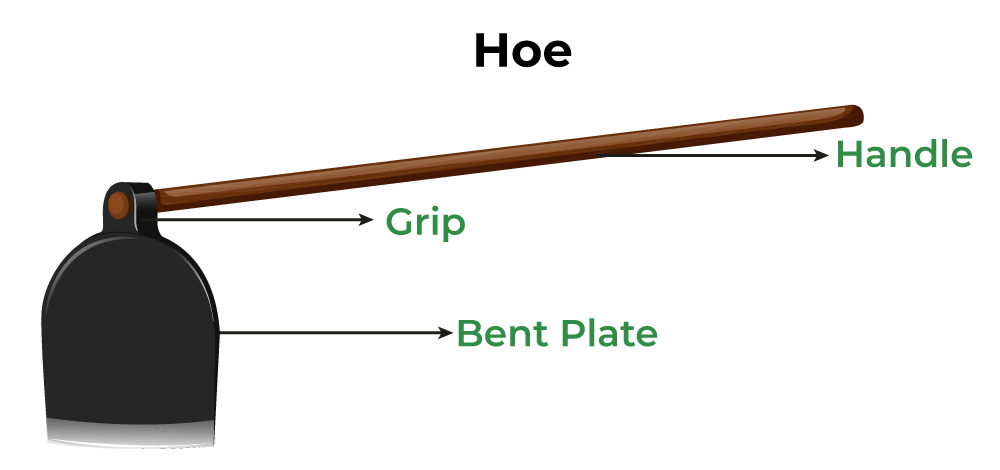
**Hoe
This straightforward tool is used to clear weeds from the soil and loosen it.
- It has a protruding wood or iron rod.
- One of its ends has an iron plate attached that is robust, wide, and bent; this plate functions as a blade.
- Animals are used to pull it.
**Cultivator: Modern farming methods often involve the use of a tractor-driven cultivator, which can significantly reduce both labor and time requirements.
For more information read: Agricultural Implements
Sowing
**Selection of Seeds: The production of crops depends heavily on **sowing.
- A good range of clean, healthy, and high-quality seeds are chosen.
- Farmers favor the adoption of high-yielding seeds.
- Damaged seeds become hollow and lighter as a result.
- Because of this, they float on water. This is a practical way to distinguish between healthy, excellent seeds and ones that have been harmed.
**Traditional tool
The classic seed-sowing implement has the shape of a funnel.
- The seeds are poured into the funnel and then dropped through two or three pipes with pointed ends.
- These ends pierce the ground and scatter seeds there.
**Seed drill
Today, tractors are utilized for sowing seeds using the seed drill.
- In this way, the seeds are uniformly sown at the same depth and spacing.
- These guard against avian consumption of seeds.
- Using a seed drill to sow cuts down on manpower and time.
- To ensure the plants are getting enough sunlight, nutrients, and water, it is essential to leave adequate space when planting.
- Overcrowding should be avoided as this can lead to stunted growth.
Adding Manure and Fertilisers
- Manure and fertilizers are the chemicals that are supplied to the soil in the form of nutrients for the healthy growth of plants.
- Mineral nutrients are provided to agricultural plants by the soil.
- The nutrients in the soil become depleted due to ongoing agricultural cultivation.
- In order to replace the soil's nutrients, manuring is carried out.
- Manure is an organic material created when plant or animal manure breaks down.
- Farmers throw manure from plants and animals in open pits and let it decay. As organic manure, the decomposed material is employed.
- Fertilizers are basically a concoction of various nutrients combined to give an enhanced composition.
- These are produced in factories and some commonly used fertilizers include urea, ammonium sulfate, superphosphate, potash & NPK (Nitrogen, Phosphorus, and Potassium).
- Farmers are now able to harvest crops like maize, wheat, and paddy with greater success thanks to the usage of fertilizers.
- The land is now less fertile due to the overuse of fertilizers. As a result of fertilizers, water is now being contaminated.
- In order to maintain the soil's fertility, we must either use organic manure in place of fertilizers or leave the land fallow (uncultivated) in between two crops.
- Manure application enhances the soil's water-retentive properties and texture. It provides new nutrients to the soil.
Another way to help maintain soil fertility is through crop rotation. This practice involves planting different crops in alternating seasons. For years, farmers in northern India have rotated legumes for fodder one season and wheat the next.
- You have already learned about Rhizobium bacteria in an earlier lesson.
- These microscopic entities exist on the roots of leguminous plants & they are responsible for fixing nitrogen from the air into the soil.
**Advantages of Manure:
- Organic manure is preferred over fertilizers. This is because it improves the soil's ability to retain water.
- By making the earth permeable, it facilitates the simple interchange of gases.
- It promotes the population of helpful bacteria. It makes the soil's texture better.
Irrigation
- Water is necessary for healthy growth and development.
- The roots of plants take in water. Minerals and fertilizers are absorbed in addition to water.
- Nearly 90% of plants are made of water. Because dry circumstances prevent seeds from germinating, water is necessary.
- Each component of the plant receives nutrients that have been dissolved in water.
- The crop is also shielded by water from both hot air currents and frost.
- Fields must be routinely watered to keep the soil moist for wholesome crop growth.
- Irrigation is the process of regularly supplying crops with water. Depending on the crop, the soil, the season, and the amount of irrigation needed, different times and frequencies are used.
**Traditional Methods of Irrigation
Wells, tubewells, ponds, lakes, rivers, dams, and canals are some of the water sources used for irrigation.
- These techniques involve either using cattle or human effort.
- There are a number of conventional methods, including the following: (i) moat (pulley system), (ii) chain pump, (iii) dhekli, and (iv) rahat (lever system).
For elevating water, pumps are frequently utilized. These pumps are powered by diesel, biogas, electricity, and solar energy.
**Modern Methods of Irrigation
Modern methods of irrigation help us to use water economically. The main methods used are as follows:
- **Sprinkler System: When there is insufficient water, uneven land is where this approach is most useful.
- At regular intervals, the revolving nozzle-topped perpendicular pipes are connected to the main pipeline.
- Water escapes from the rotating nozzles when water is permitted to flow under pressure via the main pipe with the aid of a pump.
- For lawns, coffee plantations, and a variety of other crops, sprinklers are particularly useful.

- **Drip system: Drop by drop, the water falls into this system just next to the roots, hence the name drip system.
- Watering trees, gardens, and fruit trees, is the optimum method.
- There is zero water waste. In areas with insufficient access to water, it is a blessing.

Also read: Irrigation
Protection from Weeds
- In a field, several undesired plants may naturally grow alongside the crop known as **weeds.
- Weeding is the process of eliminating weeds.
- Weeds compete with crop plants for resources like light, space, water, and nutrients, hence weeding is important.
- Some weeds can even prevent harvesting and provide a risk of poisoning both humans and animals.
- Before planting crops, tilling aids in uprooting and eliminating weeds, which may then dry out and combine with the soil.
- The manual removal process occasionally involves physically removing weeds by uprooting or cutting them close to the ground.
- Khurpi assistance is used to do this. In order to remove weeds, a seed drill is also employed.
- The use of weedicides, such as 2,4-D, is another method of controlling weeds.
- With the appropriate amount of water dilution, the weedicides are applied to the fields using a sprayer.
- Weedicides are sprayed on weeds during their vegetative growth, which occurs before they flower and produce seeds.
- During the spraying of these chemicals, the farmers should use a piece of cloth to protect their mouths and nose.
For more information read: Protection from weed
Harvesting
- **Harvesting is the act of cutting a crop once it is fully grown.
- In our nation, harvesting is either carried out by hand with a sickle or by a machine known as a harvester.
- Grain seeds must be distinguished from chaff in the harvested crop via threshing.
- Threshing is done with the use of a device called a "combine," which is actually a harvester and a thresher.
- Stubs left in the field after threshing are disposed of by burning. This leads to air pollution.
- Winnowing is used by small-scale farmers to separate the grain from the chaff.
- At the time of harvest, certain festivals are celebrated in India to mark the completion of the process.
- **Pongal, Baisakhi, Holi, Diwali, Nabanya, and Bihu are some of the harvest festivals.
Storage
- If the harvested grains are to be stored for a longer period of time, they must be protected from moisture, pests, rodents, and microbes.
- Freshly harvested grains (seeds) that are not dried before storing risk becoming spoiled or infected by microorganisms, rendering them unusable or incapable of germination.
- As a result, the grains are adequately dried in the sun before being stored to lower their moisture content.
- By doing this, bacteria, fungi, and insect pests are kept at bay.
- Jute bags or metal bins are used by farmers to store crops.
- To keep them safe from rats and insects, enormous quantities of grains are stored in granaries and silos.
- For preserving grains at home, neem leaves that have been dried are utilized.
Food from Animals
- Animal husbandry refers to the practice of raising animals on a big scale.
- Cod liver oil is obtained from fish which is rich in vitamin D.