Class Cyclostomata (original) (raw)
Last Updated : 18 Feb, 2026
Cyclostomata are unique jawless fishes belonging to the class Agnatha. Cyclostomata include lampreys and hagfishes and have a soft body. They get their name because of their round mouth. Cyclostomata are found in different aquatic environments. They are also known as jawless fish due to rudimentary jaw development.
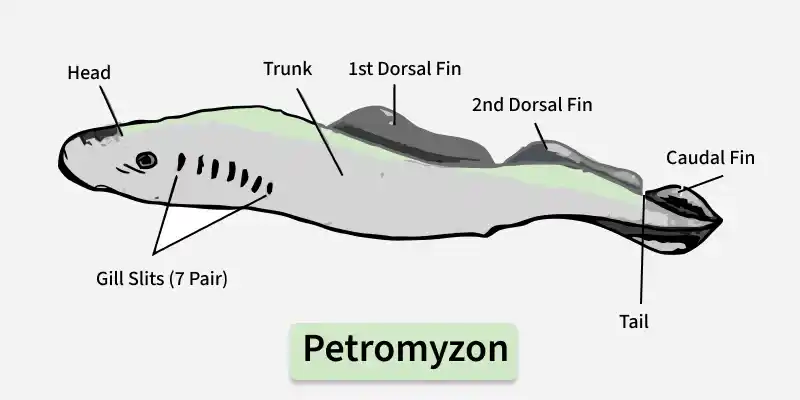
Cyclostomata have 6-14 pairs of gills and a cartilaginous skeleton. They can be found in both marine and freshwater and thus they are adaptable to many conditions. Cyclostomata are different from fish in many ways, such as they do not have paired fins or true jaws.
Characteristics of Class Cyclostomata
The following points describe the characteristics of Cyclostomata:
- Cyclostomata are the only vertebrates without true jaws. The body is round and elongated like an eel.
- The fins are not paired.
- The median fins have cartilaginous fin rays.
- Not paired appendages.
- The skinis soft and smooth, and it has no scales.
- The sexes are different.
- Some species of hagfish are believed to be hermaphrodites.
- The spleen is not present.
- Exoskeletons do not exist. The cartilaginous endoskeleton does not include any bones.
- The notochord is present throughout their lives.
- The nostril is single and median.
- Five to sixteen pairs of gills are present.
- The heart has two chambers. The brain is visible. The lateral line is a sensory organ.
- Cranial nerves are found in around eleven pairs.
- The two mesonephric kidneys are part of the excretory system.
- The digestive system does not have a stomach.
**Examples: Maxine and Petromyzon
Classification of Class Cyclostomata
The following outlines the classification of Class Cyclostomata:
| Kingdom | Animalia |
|---|---|
| Phylum | Chordata |
| Group | Craniata/Euchordata |
| Sub-Phylum | Vertebrata |
| Division | Agnatha |
| Class | Cyclostomata |
Sub-Divisions of Class Cyclostomata
Cyclostomata is a primitive class of jawless vertebrates under the phylum Chordata. Members of this class are eel-like, scaleless, and have a circular, suctorial mouth without jaws.
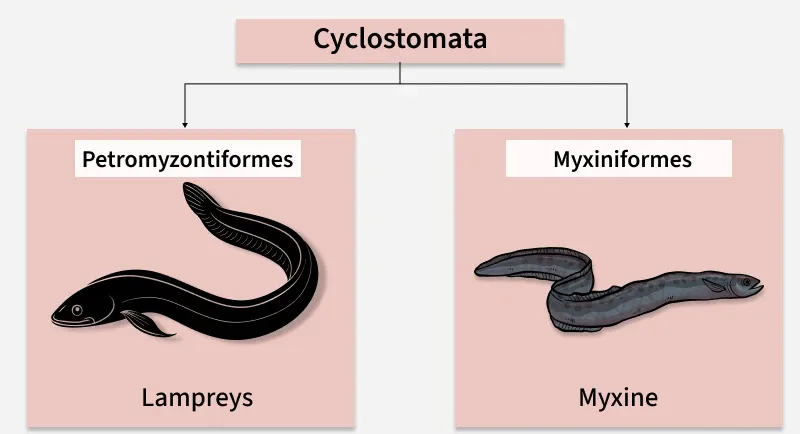
The cyclostomata class is divided into two main subdivisions based on their structure and mode of life:
**1. Petromyzontiformes
This group includes lampreys or eel-like forms.
- Found in both marine and freshwater habitats
- Show indirect development
- Possess a ventral mouth and dorsal nostril
- Have a well-developed dorsal fin
**Examples: _Lampetra, _Petromyzon
**2. Myxiniformes
This group includes hagfishes.
- Found in marine habitats
- Buccal cavity absent
- Dorsal fin absent or poorly developed
- Produce few but relatively large eggs
**Examples: _Paramyxine, _Myxine
Habitat of Class Cyclostomata
Cyclostomata are adaptable animals that inhabit a variety of aquatic environments.
- They are primitive yet specialized organisms with strong resilience.
- They are believed to have originated during the Devonian period.
- They can survive under a wide range of environmental conditions.
- They are found in both marine and freshwater habitats.
Class Cyclostomata VS Class Pisces
The following table lists the differences between cyclostomata and fish:
| Cyclostomata | Pisces |
|---|---|
| It has a rudimentary pancreas. | It has a well-developed pancreas that performs its functions |
| It has a small brain. | Fish have a developed brain. |
| Cyclostomata have an incomplete cranium. | Fish have a developed cranium. |
| Cyclostomata have a single nostril in the middle. | Fish have paired nostrils. |
Functions of the Class Cyclostomata
The following are the functions of cyclostomata:
- They are necessary for the nutrient cycle, which maintains the balance of ecosystems.
- They act as indicators of environmental health.
- They also regulate the aquatic system by controlling the population of fish.
Examples of Class Cyclostomata
- Hagfish (Myxine)
- Japanese Lamprey
- Atlantic Hagfish
- European River Lamprey
- Pacific Lamprey
Conservation Concerns of Class Cyclostomata
Cyclostomata face several conservation challenges due to environmental and human activities.
- Habitat degradation caused by pollution and human alteration of waterways is a major concern.
- Over-exploitation of certain species can threaten their populations.
- Conservation efforts should promote eco-friendly practices and increase public awareness of the ecological importance of lampreys and hagfish.
- Addressing these issues can help ensure the protection and sustainability of cyclostome species.