Ecosystem (original) (raw)
Last Updated : 18 Dec, 2025
An ecosystem can be defined as a unit of ecological studies that includes all the interactions between living organisms and their surrounding non-living environment, and was first coined by the ecologist Arthur Tansley.
Ecosystems are made up of both biotic (or alive) and abiotic (or non-living) components. All living things, including plants, animals, and microorganisms, depend on non-living substances to survive and maintain the equilibrium of the natural environment.
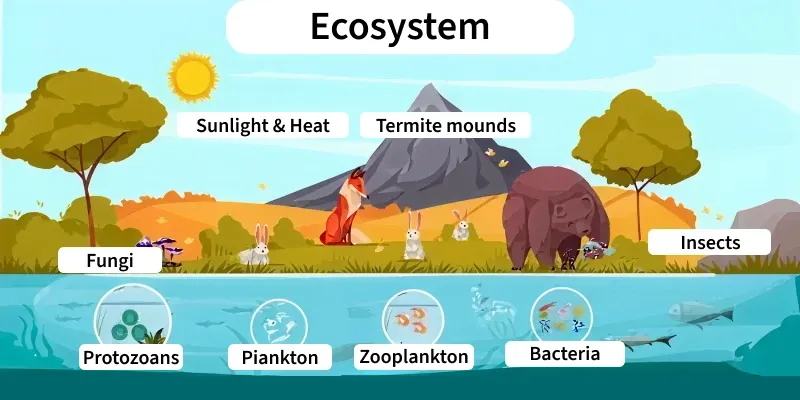
Components of an Ecosystem
The structure of an ecosystem consists of two main components: biotic and abiotic components. The biotic component interacts with the abiotic components to maintain the flow of energy. The energy is distributed in the environment.
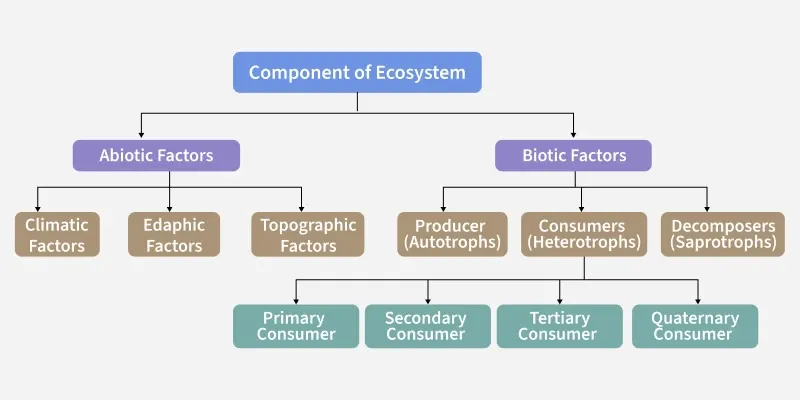
Biotic Components
Plants, animals, microorganisms, aquatic plants, and all other living creatures are the biotic components of the ecosystem. These biotic components can be classified into:
- **Producers: All autotrophs, like plants, phytoplankton, etc., that can produce their food using sources like the sun, water, carbon dioxide, or any other chemical elements, belong to this category.
- **Consumers: All heterotrophs, primarily animals, that are dependent on the producers or other organisms are called consumers. These consumers are subdivided into the following groups:
| Types of Consumers | Description | Examples |
|---|---|---|
| 1. Primary consumer (Herbivores) | All herbivores that directly depend on plants | Cows, goats, rabbits, and sheep |
| 2. Secondary consumer (Carnivore and Omnivore) | These organisms are primary consumers | Frog, Crow, Small fish, Spiders |
| 3. Tertiary consumer (Top Carnivores) | All animals that depend on secondary-level organisms for their food | Snake, Fox, Large fish (e.g., tuna) |
| 4. Quaternary consumer (Apex predators) | Those animals that depend on the tertiary-level organisms for their food | Lion, Tiger, Eagle, Shark |
- **Decomposers: All microorganisms, such as bacteria and fungi, that depend on decaying and dead matter for food fall under this category. It contributes to environmental cleanup and ecosystem nutrient recycling. These nutrients support plant development and subsequently ecosystem maintenance.
Abiotic Components
It involves all the non-living things present in the environment. These abiotic components function together to enable the ecosystem's energy and nutrition cycles. All the abiotic factors are essential factors that determine the number and type of organisms present in a region. It is classified into three categories:
- **Climatic Factors: These are related to weather conditions and environmental climate. Examples: temperature, humidity, air, light, and water.
- Edaphic Factors: These factors are related to soil properties. Example: Soil type (clay, loam, sandy), Soil pH, Nutrient content, Moisture, and Texture and structure
- **Topographic Factors: These factors are related to the physical features of a habitat. Examples: Altitude, Slope, Direction of mountain slopes, and Aspect (orientation).
Functional Aspects of an Ecosystem
The ecosystem's function is to maintain its various parts working together. It is a natural process of the transfer of energy in different biotic and abiotic elements of the world. Ecosystems maintain all the important ecological processes, including nutrient cycling. Ecosystems have different functional units, which are:
**1. Productivity:
The rate of biomass production is called productivity. It is expressed in terms of g m–2 yr –1 or (kcal m–2 ) yr –1 to compare the productivity of different ecosystems. It is categorised into two types:
- **Primary productivity: the production of biomass or organic matter per unit area by plants during photosynthesis. It is expressed in (gm–2 ) or energy (kcal m–2 ).
- **Secondary productivity: the rate of formation of new organic matter by consumers.
**2. Decomposition:
Decomposition is the breakdown of complex organic matter by decomposers into inorganic components such as carbon dioxide, water, and nutrients****.**
| Steps of Decomposition | Description |
|---|---|
| 1. Fragmentation | Detritivores (e.g., earthworms) break down detritus into smaller particles |
| 2. Leaching | Water-soluble inorganic nutrients go down into the soil horizon and get precipitated as unavailable salts. |
| 3. Catabolism | Bacterial and fungal enzymes degrade detritus into simpler inorganic substances |
| 4. Humification | It led to the accumulation of a dark coloured amorphous substance called humus that is highly resistant to microbial action. |
| 5. Mineralisation | The humus is further degraded by some microbes, and the release of inorganic nutrients occurs. |
3. **Energy flow:
The flow of energy in the ecosystem is always in one direction or unidirectional. Even though producers tend to absorb 100 of % sun's light energy in their capacity, they only pass on 10% of that energy to the next trophic level, and then only 10% of that energy is passed into the next level.
**Food Chain and Food Webs: The cycle of energy starts with solar energy. The chain of energy transfer from one level to the topmost level is known as the food chain. Plants absorb solar energy and synthesise their food. Later on, herbivores feed on the plants for energy. Similarly, carnivores and omnivores feed on them for energy. The interconnected food chain is known as the food web. In nature mostly food webs are more common instead of the food chains.
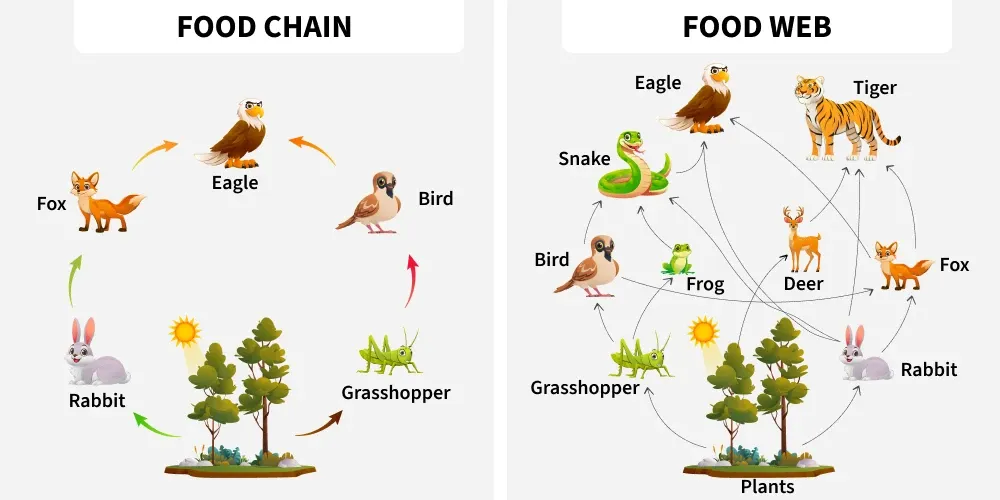
Food Chain vs Food Web
**Ecological Pyramids: These are the graphical representations of the number, energy, and biomass of the trophic levels of an ecosystem. Charles Elton postulated the ecological pyramid in 1927. The base of the ecological pyramid denotes the producers of that particular ecosystem. Then it is followed by the consumers and the top decomposers.

4. Biogeochemical Cycle****:**
It is also known as the nutrient cycle and includes all the phenomena that ensure that all the basic elements of nutrients, like carbon, nitrogen, and phosphorus, that are absorbed by living organisms from the environment, are returned to the environment. This process involves the transfer of nutrients between abiotic and biotic factors and vice versa. It includes the carbon cycle, nitrogen cycle, water cycle, phosphorus cycle, etc.
Types of Ecosystem
An ecosystem can be small or large, there are two types of ecosystems:
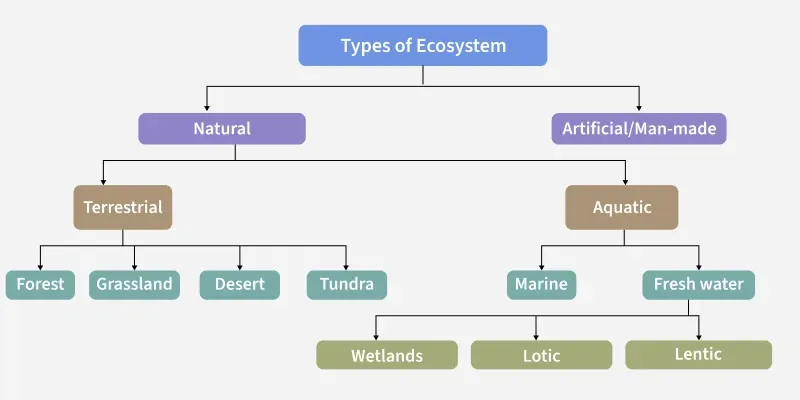
Aquatic Ecosystems
Oceans, rivers, seas, lakes, springs, and other water bodies are aquatic biomes. The bulk of the Earth's surface is covered by water. Two-thirds of the earth's surface is made up of oceans, seas, the intertidal zone, reefs, the seabed, and rock pools. This ecosystem includes plants, fish, amphibians, coral reefs, huge sea creatures, and insects.
There are 2 types of aquatic ecosystems:
- Freshwater Ecosystem
- Marine Ecosystem
Freshwater Ecosystems
A freshwater ecosystem has low salinity levels, providing a good environment for a variety of plants and animals. The sizes of freshwater resources range from small ponds to very large rivers. Freshwater resources vary from one another in terms of how they travel.
**Freshwater Ecosystem Types: Based on the region, the three main categories of the freshwater environment are:
**Lotic
- In a lotic freshwater ecosystem, the water bodies travel in one direction.
- Numerous rivers and streams start at their sources and meet rivers or oceans at their mouths as they travel toward their destinations.
**Lentic
- All non-flowing (still) waterways, such as ponds, swamps, bogs, lagoons, and lakes, are lentic ecosystems.
- Due to the saturation of the underlying land, water will temporarily remain on the earth's surface.
- Every lentic system has multiple areas with different biological environments, animals, and plants; the system behaves and adapts in different ways.
**Wetlands
- Wetlands contain water and are home to vascular plants.
- Wetland environments are more often known as marshes, swamps, and bogs. Because soil and water are so close together, wetlands are highly productive.
- The plant species found in wetlands are referred to as hydrophytes since they have adapted to the area's moist and humid climate.
- Wetland ecosystems contain hydrophyte plants such as cattails, pond lilies, and sedges. Various amphibians, reptiles, birds, shrimp, shellfish, and other animal species find refuge in wetlands.
Marine Ecosystems
Aquatic environments with high levels of dissolved salt are marine ecosystems. These comprise the deep ocean, the open ocean, and the coastal marine ecosystems. Each of these has unique biological and physical properties. The ecosystem's exposure to the sun, the amount of oxygen and nutrients that are dissolved in the water, the distance from land, the depth, and the temperature are all significant abiotic factors.
Terrestrial Ecosystem
A terrestrial ecosystem refers to an ecosystem of diverse land surfaces. Forests, deserts, grasslands, tundra, and coastal regions are all examples of terrestrial ecosystems. These terrestrial ecosystems are climate-dependent.
**Forests
- A type of terrestrial ecosystem that is covered in trees, creating several canopy layers. A variety of animal species live in dense tree cover and tropical rainforests.
- Forests are home to about 300 million different plant and animal species.
- A forest is a type of ecosystem that includes tropical rainforests, plantation forests, and temperate deciduous forests.
**Grasslands
- It has a dry environment that permits relatively little vegetation.
- Primarily, different species of grasses are what define the grassland ecosystem.
- In this environment, grass and herbs predominate.
- The ecosystem of grasslands is significant to the animal kingdom.
**Tundra
- Tundra has extreme environmental conditions like those of the polar region.
- The location is typically windy, blanketed in snow, and devoid of trees.
- Its environment is constantly covered in absolutely frozen dirt.
- Small ponds are formed when the snow melts. Some lichens can flourish in such ponds.
**Deserts
- Deserts are unproductive land surfaces with extreme temperature swings and inadequately maintained species.
- One of the driest land regions on the globe.
- A desert receives an extremely small amount of rainfall. Because of this, there is less vegetation.
- The desert ecosystem's plants and animals have learned the skill of surviving extreme environments.
Ecosystem Diversity
Ecosystem diversity refers to the variety of different habitats and communities found in a particular area, along with the various interactions between them.
- These ecosystems include forests, grasslands, deserts, rivers, and oceans, each supporting a unique array of plants, animals, and microorganisms.
- The diverse range of ecosystems contributes to the overall health and stability of the environment, providing essential services like air and water purification, soil fertility, and climate regulation.
- Ecosystem diversity is crucial for maintaining biodiversity, as it ensures the survival of a wide range of species and helps ecosystems adapt to environmental changes.
- Protecting and conserving ecosystem diversity is essential for preserving the delicate balance of nature and ensuring the well-being of both wildlife and humans.