Diffusion (original) (raw)
Last Updated : 23 Jul, 2025
**Diffusion in biology is the movement of particles like ions and molecules from a region of higher concentration to a region of lower concentration. Diffusion is a type of passive transport and is important for the proper functioning of the cell because it maintains the gradient across the cell membrane. Diffusion finds application in various fields. In biology, it governs the movement of the particles across the cell membrane, in industries or chemistry, it influences reactions, heat transfer, and materials manufacturing.
Table of Content
- What is Diffusion in Biology?
- Types of Diffusion
- Factors Affecting Diffusion
- Causes of Diffusion
- Examples of Diffusion
- Significance of Diffusion in Biology
- Difference Between Diffusion and Osmosis
What is Diffusion in Biology?
Diffusion is the process of movement of solutes and molecules from a higher concentration to a lower concentration across the membrane. This process is caused by the intrinsic kinetic energy of particles, resulting in random motion. When the particles interact and collide, they tend to spread evenly in the available space, finally leading to a state of equilibrium, that is, no net directional movement. It is an important process in living beings.
The diffusion material can be any state of matter (solid, liquid, or gas). Molecules move against the electrochemical gradient. It is important in the cell, as it helps the cell to function properly and carry out various processes. The process of diffusion in biology is influenced by various factors like temperature, concentration gradients, particle size, and the characteristics of the medium. It helps us understand how substances mix and spread, for example,
- **Diffusion in Water: When a food color is added to water, the whole water changes into the color of food color due to diffusion
- **Diffusion in Air: When we spray perfume on one side of the room, its fragrance spreads throughout the room.

Diffusion
**Types of Diffusion
Diffusion can be classified mainly into two types: Simple and Facilitated Diffusion.
**Simple Diffusion
Simple Diffusion is defined as substances directly moving through a semi-permeable membrane without any aid of transporters. For the process to take place, some conditions must be fulfilled i.e., the solute should be non-polar and have a low molecular weight of 10000 kDa. **Example: Nutrition in small bacteria, Movement of Carbon dioxide, water, and oxygen in the cytoplasm.
**Facilitated Diffusion
Facilitated diffusion is defined as the substances moving through the semi-permeable membrane from a region of higher concentration to a region of lower concentration with the help of transport proteins. These proteins form channels or carriers to allow the passage of the molecules.
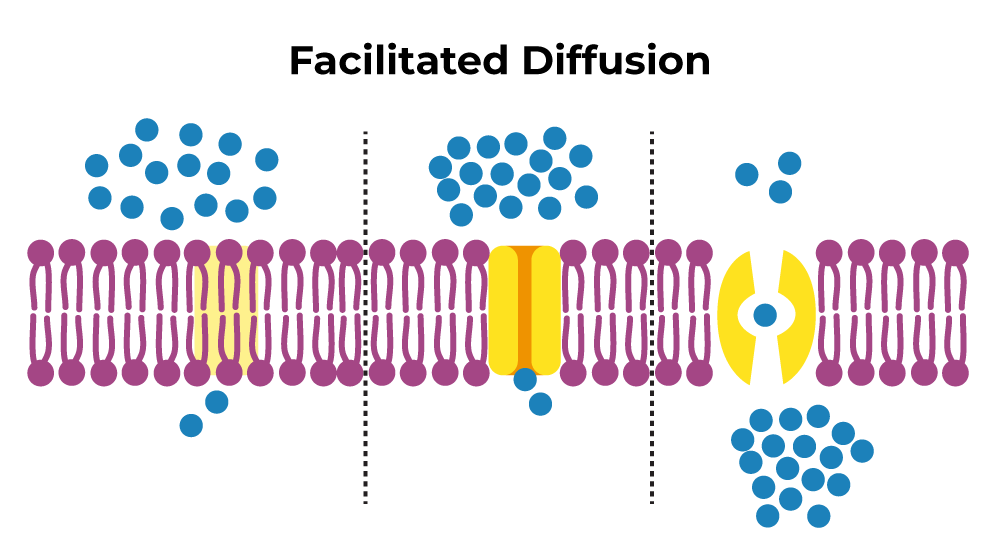
Facilitated diffusion is further classified into two types there are:
- **Dialysis is a type of facilitated diffusion in which a selective membrane that allows only specified molecules or atoms to pass through it.
- **Osmosis is another type of facilitated diffusion in which the movement of water molecules occurs through a semi-permeable membrane. It happens due to a difference in solute concentration on either side of the membrane, which causes the movement of water from an area of lower solute concentration to an area of higher solute concentration.

Diffusion vs Osmosis
**Types of Osmosis
- **Endosmosis: It is defined as the movement of solutions into the cell.
- **Exosmosis: It is defined as the movement of solutions out to the cell.
**Factors Affecting Diffusion
Some factors that affect the rate and extent of diffusion are as follows:
- **Size of the particles, as smaller particle diffuse faster than large particle as it gets less resistance.
- **TemperatureThe temperature
- Viscosity and density influence the rate of diffusion.
- Surface area and the distance the particles need to travel.
- Availability of specialized transport proteins.
- Solubility of the particle in the medium.
Causes of Diffusion
The diffusion process is a natural process that occurs due to the inherent kinetic energy of the particles. Any liquid or gas undergoes the diffusion process as the particles collide and move randomly. It continues till the state of equilibrium is achieved, i.e., where particles are evenly distributed, with the least concentration differences.
Examples of Diffusion
The examples of the diffusion are as follows:
- **Adding salt to the water: Add salt to the water and the particles of the salt mix and spread evenly in the water through the process of diffusion.
- **The scent of perfume: On opening a bottle of perfume in one corner of a room, the scent of perfume spreads gradually in the entire room due to diffusion.
- **Respiration: During the respiration, cells use oxygen for the production of energy, and waste carbon dioxide diffuses out of cells in the bloodstream.
- **Mixing of tea or coffee: When we add sugar to a cup of tea or coffee, the sugar particles mix and dissolve due to the process of diffusion.
- **Transfer of heat in a pan: Onheating a pan, the heat from the burner diffuses through the pan, making the entire pan hot.
**Significance of Diffusion in Biology
The significance of diffusion can be outlined as follows:
- Cells depend on the process of diffusion to transport various molecules like glucose, oxygen, and ions across the membranes, carrying cellular processes.
- It occurs in various biological processes absorption of nutrients in cells, gas exchange in lungs, etc.
- In chemical industries and chemical labs, it facilitates the mixing of reactants, allowing chemical reactions.
- The process of diffusion occurs in plants. They absorb nutrients and water from the soil through the process of diffusion.
- Diffusion affects the movement of ions in the neurons and generates electrical charge.
- In the process of respiration, the carbon dioxide gas is diffused out through the cell membrane into the blood.
Difference Between Diffusion and Osmosis
The difference Between Diffusion and Osmosis is as follows:
| **Features | **Diffusion | **Osmosis |
|---|---|---|
| **Definition | Movement of particles from high to low concentration due to random motion and kinetic energy | Movement of solvent (usually water) across a semipermeable membrane from low solute concentration to high solute concentration |
| **Type of Movement | Particles of various substances move | Mainly involve water molecules |
| **Medium | Can occur in gases, liquids, and solids | Typically occurs in liquids (like water) |
| **Membrane Presence | May or may not involve a membrane | Involves a semi-permeable membrane |
| **Solute Presence | Can involve the movement of any type of particle | Involves the movement of solvent (usually water) |
| **Direction | From areas of high concentration to low concentration | From areas of low solute concentration to high solute concentration |
| **Biological Significance | Facilitates various cellular processes, like nutrient transport | Vital for maintaining cell turgidity, balancing fluid levels |
Also Read: Difference Between Osmosis and Diffusion
Conclusion - Diffusion
In conclusion, diffusion in biology is the movement of particles down the concentration gradient i.e. from areas of high concentration to low concentration. Diffusion is crucial for maintaining cellular functions, and supporting various biological processes like respiration and nutrient absorption. Understanding the factors and types of diffusion, along with its significance in highlights its essential role in the natural world and human activities.
**Also Read: