Osmosis and Osmotic Pressure (original) (raw)
Last Updated : 23 Jul, 2025
A solution is a homogeneous mixture of two or more particles with particle sizes smaller than one nanometer. Sugar and salt solutions in water, as well as soda water, are common examples of solutions. In a solution, all of the components appear as a single phase. There is particle homogeneity, which means that the particles are evenly dispersed. This is why a full bottle of soft drink tastes the same.
The component that dissolves the other component is known as the solvent. Solute refers to the component(s) that are dissolved in the solvent (s). In general, the solvent is present in greater proportion than the solute. The solute amount is less than the solvent amount. Solutes and solvents can exist in every state of matter, including solids, liquids, and gases. A liquid solution is composed of a solid, liquid, or gas dissolved in a liquid solvent. Solid and gaseous solutions are represented by alloys and air, respectively.
Osmosis
Osmosis is the process of moving solvent molecules from a low solute concentration area to a high solute concentration area through a semipermeable membrane. Eventually, an equilibrium between the two sides of the semipermeable membrane is formed (equal solute concentration on both sides of the semipermeable membrane). Because the semipermeable barrier only allows solvent molecules to pass through, no solute particles can pass through.
Note: Osmosis is discovered and named by the French physiologist Henri Dutrochet. He also invented osmometer, a device used to measure osmotic pressure.
Factors Affecting Osmosis
- **Concentration Gradient: The difference in concentration of solute between two regions affects the rate of osmosis.
- **Temperature: Higher temperatures can increase the rate of osmosis by providing more energy to solvent molecules.
- **Pressure: Osmotic pressure itself is a direct result of the concentration gradient and the pressure applied.
- **Membrane Permeability: The type of membrane and its permeability to solvent molecules also affects osmotic flow
**Osmosis in Plants
**Root Absorption of Water:
- Osmosis allows plants to absorb water from the soil through the roots.
- The root cells contain a higher concentration of solutes than the surrounding soil, creating a concentration gradient.
- Water moves from the soil (lower solute concentration) into the root cells (higher solute concentration) via osmosis.
**Role in Turgor Pressure:
- Osmosis contributes to maintaining turgor pressure within plant cells.
- Water influx into vacuoles creates internal pressure, keeping the cell rigid and supporting plant structure.
- Turgor pressure helps plants maintain their shape and resist wilting, especially in non-woody plants.
**Water Transport in Plants:
- Osmosis drives the movement of water from the roots to the leaves.
- Water enters the xylem through osmosis, and capillary action helps it move upward against gravity.
- Osmosis plays a key role in the water transport system, ensuring the plant’s hydration and nutrient distribution.
Osmotic Pressure
Osmotic Pressure is the least pressure required if applied to a solution, the inward flow of solvent molecules across the semipermeable membrane is stopped. It is a colligative property that is regulated by the concentration of solute particles in the solution.
Osmotic Pressure Formula,
The Dutch chemist Jacobus van't Hoff proposed this link between a solution's osmotic pressure and the molar concentration of its solute. which is as follows:
**∏ = iCRT
Where,
**∏ is the osmotic pressure,
**i is the van’t Hoff factor,
**C is the molar concentration of the solute in the solution, (C=n/V; where n is the number of moles and V is the volume.)
**R is the ideal gas constant,
and T is the temperature in Kelvin
It should be noted that this equation only applies to solutions that act like perfect solutions.
**Osmotic Pressure in Solutions of Different Concentrations:
- Osmotic pressure increases with the concentration of solute particles in a solution.
- The more solute particles present, the higher the osmotic pressure, as the solution will draw more solvent molecules through the semipermeable membrane to reach equilibrium.
- In a dilute solution (low concentration), the osmotic pressure is lower compared to concentrated solutions, where more solute particles exert greater osmotic pressure.
**Hypertonic, Hypotonic, and Isotonic Solutions:
**Hypertonic Solution:
- A solution with a higher solute concentration compared to the cell’s internal environment.
- Osmotic pressure is higher in the solution, causing water to leave the cell, leading to cell shrinkage or plasmolysis.
**Hypotonic Solution:
- A solution with a lower solute concentration compared to the cell’s internal environment.
- Osmotic pressure is lower outside, leading to water entering the cell, causing the cell to swell and potentially burst (lysis).
**Isotonic Solution:
- A solution with the same solute concentration as the cell’s internal environment.
- No net movement of water occurs, as the osmotic pressure is equal on both sides of the cell membrane, maintaining cell size and shape.
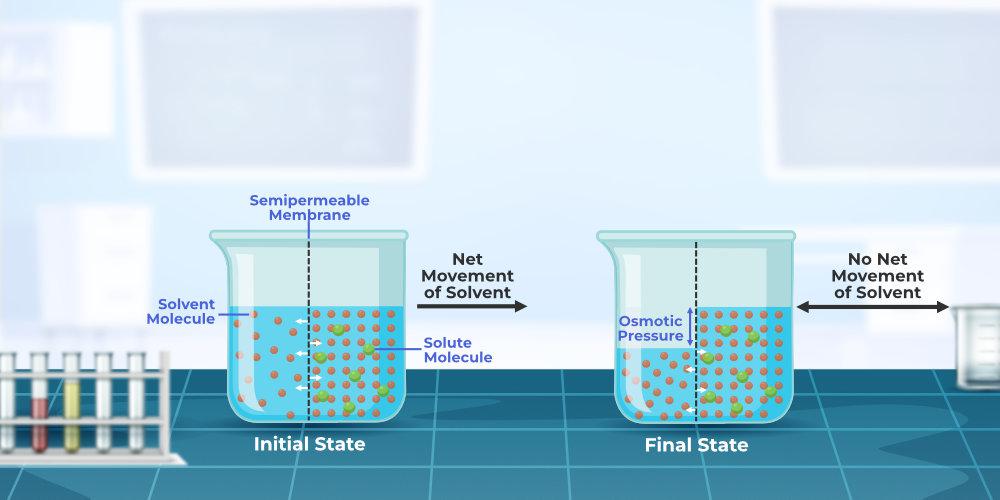
Process of Osmosis
Reverse Osmosis
The minimal pressure required to stop the passage of the solvent across the semipermeable membrane is referred to as osmotic pressure. When a pressure greater than the osmotic pressure is applied to the solution side (the side with a high solute concentration), the solvent particles on the solution side move through the semipermeable membrane to the area with a low solute concentration. Reverse osmosis refers to the flow of the solvent through the semipermeable membrane in the opposite direction.
Application of Reverse Osmosis
- Electronic component manufacturers require the finest quality water possible. Reverse osmosis is commonly used to remove the majority of contaminants from a water supply before it is introduced into a polishing ion exchange system. Reverse osmosis increases the life of the ion exchange beds while lowering the overall cost of producing huge volumes of high-quality water.
- Depending on the nature of the chemical production process, the maker of chemicals requires varied grades of water. In some circumstances, reverse osmosis water will yield satisfactory product water on its own, and it is utilized as a pre-treatment when greater qualities are required.
- In this business, reverse osmosis has been used successfully to not only purify water for use in plating solution makeup water and drag out baths but also to concentrate important plating metals in the waste stream for recycling in a closed-loop process.
- On a small and large scale, reverse osmosis is widely utilized in the desalting sea or brackish water for potable consumption. Because of its low energy requirements, the technique is particularly appealing in this application.
Types of Osmosis
There are two types of Osmosis that take place in the cells of animals as well as plants, those are as follows:
**Endosmosis
When a substance is immersed in a hypotonic solution, the solvent molecules migrate into the cell, creating turgidity (swollen) or deplasmolysis. This process is called Endosmosis.
Exosmosis
When a material is immersed in a hypertonic solution, the solvent molecules escape the cell, causing flaccidity or plasmolysis. This process is called Exosmosis.
Effect of Osmosis on Cells
In biological, systems osmosis is very essential as many biological membranes are semipermeable. For example in an animal cell, if surrounded by a hypertonic environment (outside the cell is higher water concentration) then due to osmosis water leaves the cell and the cell shrinks, opposite to it if surrounded by the hypotonic surroundings (outside the cell with lower water concentration) then water diffuses into cells and causes the cell to swell. Animal cells can only live if it is surrounded by an isotonic solution. The same effect of hypertonic and hypotonic solutions can be seen in plants cell.
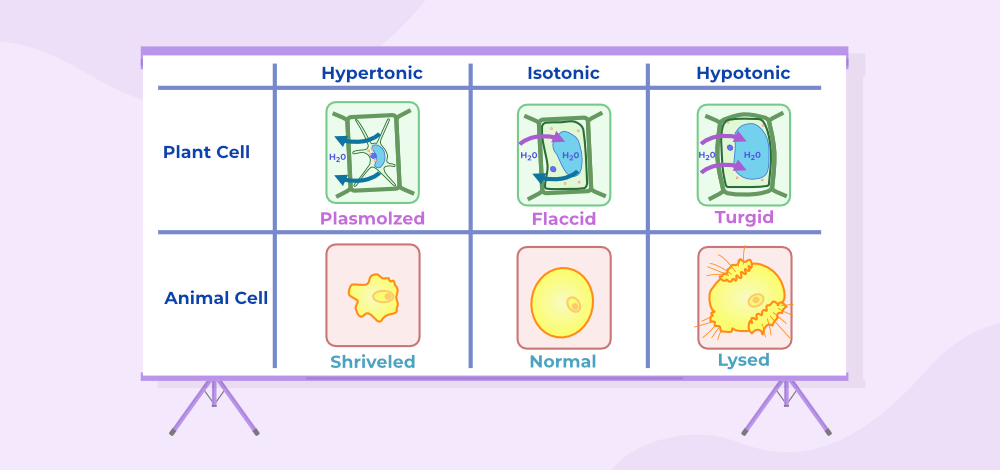
Difference between Osmosis and Diffusion
Osmosis can seem like diffusion but there are a lot of differences between both which are as follows:
| Osmosis | Diffusion |
|---|---|
| It is only applicable to liquid media. | It can be found in a variety of liquids, gases, and even solids. |
| A semipermeable membrane is required. | Doesn't require a semi-permeable membrane. |
| This is determined by the number of solute particles dissolved in the solvent. | It is affected by the presence of other particles. |
| Water is required for particle mobility. | The mobility of particles does not require the use of water. |
| Only the solvent molecules can diffuse. | Solute and solvent molecules can both disperse. |
| Particles can only flow in one direction. | The movement of particles occurs in all directions. |
| The entire process can be stopped or reversed by applying extra pressure to the solution side. | This process cannot be halted or reversed. |
| This only happens amongst solutions that are similar in nature. | Occurs between solutions that are similar and solutions that are dissimilar. |
| Only water or another solvent goes from a high-energy or concentration zone to low energy or concentration region. | Any substance can migrate from a location of high energy or concentration to a region of low energy or concentration. |
**Significance of Osmosis
- Nutritional supply and the discharge of metabolic waste products are both affected by osmosis.
- It is in charge of absorbing water from the earth and transporting it to the plant's higher portions via the xylem.
- It maintains the equilibrium of water and intercellular fluid levels in a living organism's interior environment.
- It keeps the turgidity of cells.
- It is the method by which plants maintain their water content in the face of continual water loss owing to transpiration.
- This process regulates water transport from cell to cell.
- Osmosis causes cell turgor, which regulates plant and plant component mobility.
- Osmosis is also responsible for the dehiscence of fruits and sporangia.
- Higher osmotic pressure protects plants against drought damage.
**Examples of Osmosis
There are a lot of examples of Osmosis in nature as Osmosis is a very essential part of life. Some of the examples are as follows:
- The process through which water is absorbed from the soil is also because of osmosis as water rushes into the roots because plant roots have a higher concentration than soil.
- Osmosis also impacts the plant's defense cells. The guard cells enlarge and the stomata open as water enters the plant cells.
- A freshwater or saltwater fish dies as a result of water entering or departing the animal's cells when placed in water with different salt concentrations.
- Humans suffering from cholera are also affected by osmosis as the overpopulation of bacteria in the intestines reverses the absorption flow and prevents the intestines from absorbing water, resulting in dehydration.
Solved Examples - Osmotic Pressure
Question 1: Calculate the osmotic pressure of 5% solution of cane sugar (sucrose) at the temperature of 15° Celsius.
**Solution:
m = molecular mass of sucrose (C12H22O11) = 342 amu
w = 5g
V = 100 mL = 0.1 litre
we know, R = 0.0821 L⋅atm⋅K−1⋅mol−1,
T = (15 + 273) = 288 K
and as glucose is the non-ionic compound and doesn't dissociate to give any ions in the solution, it's van't Hoff factor is 1.
Rearranging ∏ = iCRT, we get ∏V = w/m ⋅RT,
∏ = 5/342×1/0.1 × 0.082 × 288 = 3.453 atm
Question 2: The solution containing 10 g of an organic non-ionic compound per liter showed an osmotic pressure of 1.16 atmosphere at 0° Celsius. Calculate the molecular mass of the compound (S = 0.0821 L⋅atm⋅K−1⋅mol−1)
**Solution:
As compound is non-ionic, it's van't Hoff factor is 1.
Applying the equation m = w/∏V ⋅RT
Given w = 10 g, P = 1.18 atm, V = 1 litre, S = 0.0821 L⋅atm⋅K−1⋅mol−1 and T = 273 K.
m = 10/1.18×1 × 0.0821 × 273 = 189.94 amu