Morphology and Anatomy of Frogs (original) (raw)
Last Updated : 30 Jan, 2026
Frogs are tailless, carnivorous amphibians commonly found in India and many other parts of the world. In India, the common frog is scientifically known as _Rana tigrina. Frogs are vertebrates belonging to the phylum Chordata and the class Amphibia. Being cold-blooded animals, their body temperature varies with the surrounding environment. To protect themselves from extreme climatic conditions, frogs undergo aestivation during summer and hibernation during winter. They also possess the ability to camouflage, allowing them to change the colour of their skin to blend with their surroundings.
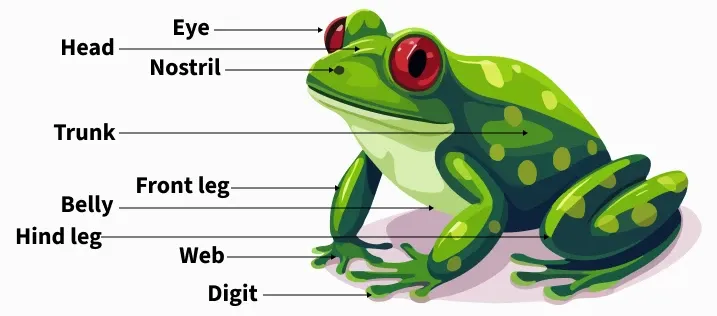
Morphology of a Frog
Adult frogs lack tails, even though their larvae do. A mature frog has a thick body that is divided into the head and trunk. A pair of nostrils, a pair of projecting eyes, a membrane (ear), squishy, moist skin, and webbed limbs are other outward characteristics.
- Frogs often have slippery, wet, and highly porous skin that allows them to breathe and absorb water. As a result, frogs' moist skin serves as an organ of respiration.
- The skin is a glandular organ that secretes mucus and poisons to alert animals to potential predators. According to secretions, the skin's colour can range from brown to green to vibrant hues.
- Frogs' forelimbs and hind limbs work together to help them move around. Frogs exhibit sexual dimorphism because they are unisexual.
- Vocal sacs and the copulatory pad on the forelimbs are characteristics of male frogs that set them apart from female frogs. These physical traits are absent in female frogs.
- Since frogs produce mucus, their skin is wet and slippery. Typically, the dorsal side of the body is olive green with dark, erratic dots. On the ventral side, the skin is uniformly light yellow.
- The body of a frog is divided into the head and trunk. Two nostrils are present above the lips. The eyes are large and protected by a nictitating membrane, which covers them in water. A tympanum is present on each side of the head and acts as the ear.
- Both the forelimbs and the hindlimbs are useful for walking, leaping, and digging. Five digits are on the rear limbs.
- The forelimbs are smaller and less muscular than the hind limbs. Four digits make up the forelimbs. Swimmable digits are advantageous.
- In frogs, sexual dimorphism is present. Male frogs have vocal sacs that produce sound and a copulatory pad on the first digit of the forelimb.
Anatomy of a Frog
Frogs have a well-developed body plan with structures that support their physiological functions. All of the organ systems, including the respiratory, circulatory, excretory, nervous, and reproductive systems, are housed in the body cavity and perform tasks that are nearly identical to those of the human body systems.
Respiratory system
- The amphibian breathes through its skin and its lungs, respectively, in two different ways.
- The skin serves as the body's respiratory system in aquatic ecosystems, where dissolved oxygen is diffused.
- The term for this is cutaneous respiration.
- They breathe through their skin and lungs simultaneously while on land.
- Air entering through the nostrils travels through the buccal cavity and into the lungs during pulmonary breathing.
- However, they only utilise their skin to breathe while they sleep in the summer and winter.
Circulatory system
- Frogs have a strong, muscular heart with two atria and only one ventricle as its three chambers.
- Food, air, and other chemicals are transported throughout the body by the network of blood arteries with the assistance of blood and lymph.
- Blood cells and plasma make up the blood.
Excretory system
- The primary excretory substance of the ureotelic frog is urea.
- They have a distinct urinary system made up of a urinary system, cloaca, ureters, and two kidneys.
- The nephron, a structural component of the kidneys, would play a role in filtering blood and also helps in the excretion of waste products.
Digestive system
- The digestive tract of the frog is made up of the alimentary canal and its auxiliary organs.
- Frogs have small intestines because they are carnivorous.
- Beginning in the oral cavity, the alimentary canal travels through the pharynx, food pipe, stomach, and the intestines, like the small and large intestines, and later the rectum, and finishes up at the cloaca.
- As the foodstuff materials move through the different sections of the gastrointestinal system, they gradually begin to be processed or digested.
Control and coordination
- In frogs, regulation and coordination are carried out by the endocrine and neurological systems working together.
- Metamorphosis and other regulating processes are carried out by the hormones that these glands secrete.
Reproductive system
- Both female and male frogs have a reproductive system that produces the gametes needed for reproduction.
- The sperm produced by the male frog's testes are released through the cloaca.
- The ovaries would be in pair female frog create an ovum, which is then sent to an oviduct that leads to the cloaca.
- A typical route for excretion as well as for reproduction would be the cloaca.
- Almost two thousand to three thousand eggs are laid at a time, and they are externally fertilised.
Significance of Frogs
Frogs hold their importance in multiple areas, including ecology, culture, and scientific studies. These importances are discussed below.
- **Bioindicators: Forgs are very sensitive to the changes in their enviroment particularly regarding the quality of water, and hence act as important bioindicators.
- **Pest control: Frogs consume insects and help in pest control. By doing this, they aid in agriculture and maintain ecological balance.
- **Serve as Food: Frogs are essential components of the food chain; they serve as prey for various predators, contributing to biodiversity.
- **Scientific Research: Frogs are widely studied during research in genetics, development, and evolution. Infact they are widely studied in medicine for their antimicrobial skin secretion.
- **Cultural importance: Frogs also have cultural and symbolic importance in folklore and myths, representing transformation and fertility.