Ecology (original) (raw)
Last Updated : 10 Dec, 2025
Ecology is the study of the interactions between different species and their surroundings. The Greek terms "Oikos" and "Logos" (which translate to "home, habitat, or place of residence) are the roots of the English word "ecology." German zoologist Ernst Haeckel first used the word "ecology" in 1866.
All living things and their surroundings are interconnected. Living things modify how they function in response to environmental changes. These kinds of linkages between species and their interactions with the natural world are the subject of ecology.
**Types of Ecology
Ecology can be divided into various categories. The various ecological types are listed below:
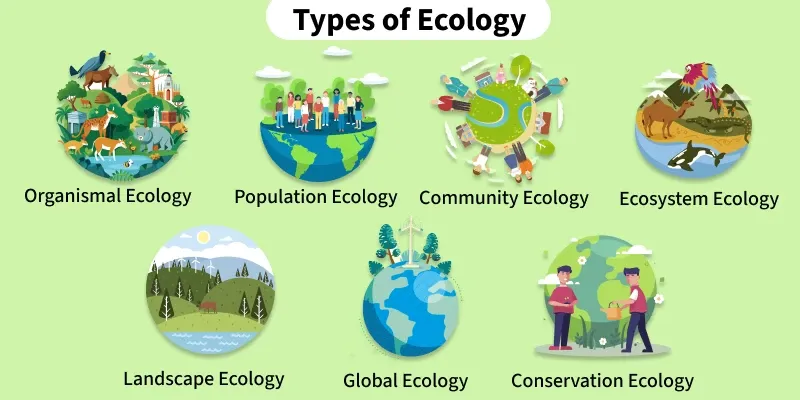
1. Organismal Ecology
The study of an individual organism's behaviour, morphology, physiology, etc., in response to environmental stresses is known as organismal ecology. It examines the interactions between certain species and biotic and abiotic elements. Ecologists study how organisms adjust to these living and non-living elements of their environment.
2. Population Ecology
It deals with variables that affect and change the genetic makeup and number of organisms in a population. Ecologists research population size, population growth, and any other interactions with the population.
It focuses on how interactions between living things alter community structure. An ecological community is made up of two or more populations of various species that are localised in one place.
4. Ecosystem Ecology
It covers the entire ecosystem, including the investigation of both living and non-living elements and how they interact with the outside world. This field of study investigates ecosystem functioning, relationships, etc.
5. Landscape Ecology
It addresses the flow of materials, organisms, energy, and other ecological byproducts. The influence of human activity on the structures and functions of the landscape is highlighted by landscape ecology.
6. Global Ecology
It focuses on how the ecosystems, land, atmosphere, and oceans of the world interact. It aids in understanding global interactions and the impact they have on the world as a whole.
7. Conservation Ecology
Conservation Ecology is a branch of ecology that focuses on protecting, managing, and restoring biodiversity, natural habitats, and ecosystems.
It aims to prevent the loss of species, maintain ecological balance, and ensure the sustainable use of natural resources.
**Objectives of Ecology
A significant objective of ecology is to comprehend how biotic elements of an ecosystem interact and depend on one another. Additionally, it discusses how the biotic and abiotic components of the ecosystem interact. Objectives of ecology are to study:
- The connections between the various creatures in an ecosystem.
- The effects of temporal variations on an ecosystem's biotic elements.
- Changes in an organism's behaviour that occur in the environment.
- Structural and functional adjustments are made by an organism in response to environmental changes.
- Biological productivity and energy flow in natural systems.
Biotic and Abiotic Factors
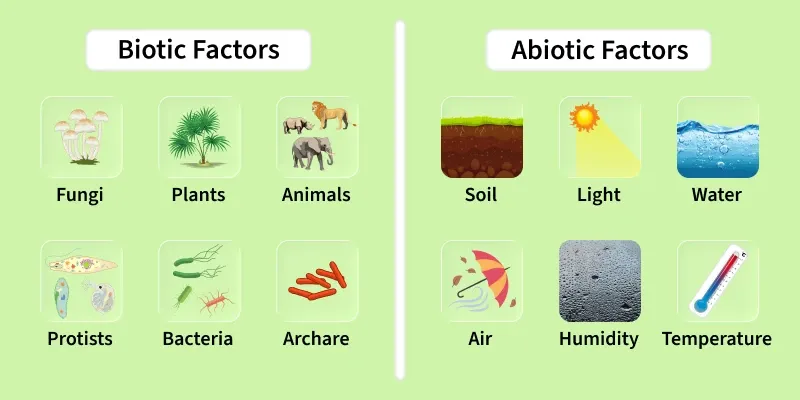
Ecology is mainly divided into the factors that are biotic and abiotic. Ecology is the study of the interaction between living and non-living things.
**Biotic Components
All of the organisms in the environment are affected by biotic factors. An ecosystem's structure is impacted by its presence and the biological waste products it produces.
- All living things, including people, fungi, and bacteria, as well as animals and plants, are considered to be biotic factors.
- Each species' ability to reproduce and to meet basic needs like food involves interactions between many biotic variables.
- **Typical Biotic Factors: All the living things found in an ecosystem are examples of biotic resources.
- Among them are the following: producers, consumers, decomposers, and detritivores.
Abiotic Components
Abiotic factors are any chemical or physical elements that are not living and are found in the lithosphere, hydrosphere, and atmosphere. These elements have a substantial effect on the persistence and procreation of species within an environment.
- Autotrophic species, for instance, may not be able to exist without enough sunlight.
- Every organism is impacted by this effect, which cascades up the food chain.
- **Typical Abiotic Factors: Abiotic factors in an ecosystem include air, water, temperature, humidity, altitude, soil pH, type, etc.
- Salinity, oxygen, pH, flow velocity, depth, and temperature of the water are also abiotic factors in an aquatic ecosystem.
**Hierarchy of Ecology
Every single living thing that exists in the natural world is a part of ecology. The ranking of these individuals is referred to as the ecological hierarchy. In order to comprehend how organisms interact with their environments, ecology can be studied at a variety of levels.

Beginning with the easiest level and working up to the most difficult, these levels are in the following order:
- **Organism: A living being that can act or function independently is referred to as an organism.
- **Population: A population is a group of creatures belonging to the same species that coexist in the same area and communicate with one another.
- **Community: All the populations of numerous species that live in the same area and interact make up a community.
- **Ecosystem: An ecosystem is made up of all of the living things (all populations) in a certain area, as well as the inanimate elements of the surrounding environment.
- **Biome: The terrestrial element of the biosphere is split up into enormous regions known as biomes. Climate, flora, animal life, and the general kind of soil are used to identify biomes.
- **Biosphere: The region on Earth where life can exist and flourish is called the biosphere. It is the area of the planet that is capable of supporting life.
**Importance of Ecology
The significance of ecology is demonstrated by the following factors:
**1. Environmental protection
- Ecology enables us to comprehend the impact of our actions on the ecosystem.
- The environment and the land have deteriorated as a result of a lack of ecological knowledge. A few species have also become extinct or are in danger as a result of it.
- Examples include mammoths, white sharks, and dinosaurs. We can thus defend them against harm and danger by studying the environment and living things.
**2. Resource Distribution
- Ecology enables us to understand which resources are essential for the existence of various organisms.
- Because of our dependence on fossil fuels, humans have significantly increased their carbon footprint.
- Ecology enables us to consider this issue from various angles and to come to well-informed conclusions about how to address it.
**3. Conservation of Energy
- Energy is necessary for all living things to thrive and flourish.
- The overuse of energy sources like light, food, and radiation as a result of a lack of ecological understanding causes the depletion of these resources.
- A proper understanding of ecological requirements helps to conserve energy for future uses by minimising the excessive use of energy resources.
**4. Disease and Pest Control
- Microbial organisms are a key component of ecological studies.
- They play roles in the environment that are just as important as those of plants, animals, and other life forms.
- Some bacteria require detailed research to prevent the rapid spread of diseases in humans.
- Understanding microbes—from viruses to parasitic worms—is essential for controlling the problems they create.
- Studying these organisms helps maintain ecosystem balance by preventing outbreaks that can affect humans, animals, and other species.
**5. Increases Environmental Awareness
- The major objective is to establish a balance in every ecosystem, and in order to do this, a lot of study and work must be done.
- Every time ecology makes progress in an area, it increases understanding among the general public and fosters a more eco-aware perspective on the world.
- People are increasingly receptive to living sustainably and want to do their part to protect the environment.
**Examples of Ecology
Examples of ecology include the following:
- **Plant ecology: It investigates how plants interact with their biotic and physical surroundings. Plants must obtain their light, water, and nutrient needs directly from the environment because they are sessile, photosynthetic organisms.
- **Human Ecology: It focuses on how people and the environment interact. It highlights the negative effects that humans have on the environment and provides information on how we might better ourselves for the benefit of both people and the ecosystem.