Gymnosperms (original) (raw)
Last Updated : 15 Jan, 2026
Gymnosperm comes from the Greek words "gymnos"(naked) and "sperma"(seed), subsequently known as "Bare seeds." Gymnosperms are seed-delivering plants, yet unlike angiosperms, they produce seeds without fruits. These plants grow on the outer layer of scales or leaves, or at the end of stalks framing a cone-like design. The fossil record suggests that they started during the Palaeozoic period, a long time ago.
**Classification of Gymnosperms
The stem of gymnosperms can be stretched or unbranched. The thick fingernail skin, needle-like leaves, and depressed stomata diminish the pace of water loss in these plants.
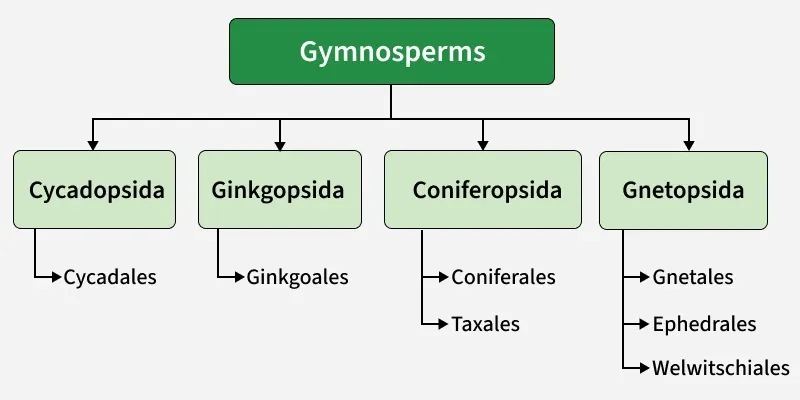
The gymnosperms are divided into:
1. Cycadopsida
- Cycads are dioecious (meaning: individual plants are either all male or female).
- Cycads are seed-bearing plants, and most of the individuals are presently extinct.
**Examples: Cycas, Zamia, Zamiaceae.
2. Ginkgopsida
- Only one group, Ginkgophyta, is still living, while all the remaining members of this group are extinct.
- Ginkgo trees are characterized by their large size and fan-shaped leaves.
3. Coniferopsida
- Gnetophytes are additionally relics from an earlier time. Today, just three individuals from this family exist.
- Gnetophytes typically comprise tropical plants, trees, and shrubs.
- They show the phenotype of colourful leaves that are covered with a soft coating.
**Example: Ephedra, Gnetum.
4. Gnetopsida
- These are the most commonly known species among the gymnosperm family.
- They are evergreen; consequently, in winter, they don't shed their leaves.
- These are essentially described by male and female cones with structures like a needle.
**Examples: redwood trees, junipers, cypress trees, tidy trees, and hemlocks.
**Characteristics of Gymnosperms
Mentioned below are the characteristics of gymnosperms:
- Perennial, evergreen, and woody plants are present in colder areas.
- Gymnosperms usually have needle-like leaves.
- Sporophylls are aggregated to form cones. These are separate male and female cones.
- Xylem lacks vessels, and the phloem lacks companion cells.
- The plant body is saprophytic and is differentiated into roots, stems, and leaves.
- Leaves are generally spirally arranged. They may be whorled as in Cedrus or opposite and decussate as in Gnetum.
- Vegetative methods of reproduction are rare in gymnosperms.
- Pollination is direct, i.e., pollen grains come in contact in direct contact with the ovule.
- All gymnosperms are wind-pollinatedbecause the stigma is absent in gymnosperms.
- The number of cotyledons in a seed is one or two, as in Cycas, or many as in Pinus.
**Life-Cycle of Gymnosperms
The life cycle of gymnosperms is both haploid and diploid, i.e., they reproduce through the alternation of generations. They have a sporophyte-predominant cycle. The gametophyte stage is relatively short. The reproductive organs are usually present in the form of cones.
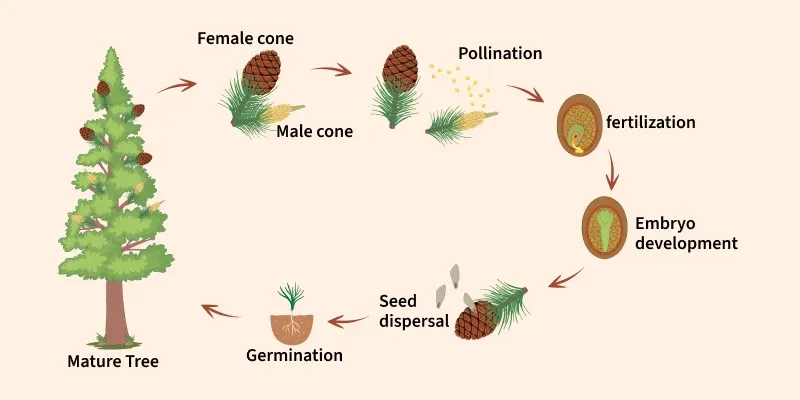
The life cycle of gymnosperms is different from that of angiosperms because gymnosperms do not produce flowers or fruits. Instead, they produce cones and seeds that are usually exposed. The life cycle of gymnosperms is an essential process that ensures the continued growth and reproduction of these plants.
Angiosperms Vs Gymnosperms
The difference between Gymnosperms and Angiosperms is given below:
| **Angiosperm | **Gymnosperm |
|---|---|
| These are seed-producing flowering plants whose seeds are enclosed within an ovary. | These are seed-creating non-blossoming sows whose seeds are unenclosed. |
| Their seeds are enclosed inside an ovary, ordinarily in an organic product. | Their seeds are uncovered and not enclosed, which are tracked down on scales, leaves, or as cones. |
| The lifecycle of these plants is seasonal in light of the fact that they die on during pre-winter/fall. | These plants are evergreen in nature. |
| These are available in blossoms and can be unisexual or sexually open. | These are available as cones and are unisexual. |
| Multiplication relies upon the creatures for spread. | Here, Reproduction is relying upon the wind for spread. |
| These have triploid tissue. | These have a haploid tissue. |
**Uses of Gymnosperms
Gymnosperms are monetarily significant as they are a decent source of food. The seeds of gymnosperms are broadly utilised as consumable assortments of staple food. These kinds of plants incorporate ginkgo, pinus, cycas, and so forth. Gymnosperms are additionally significant sources of starch and are utilised in the development of sago.