Pollen Grains (original) (raw)
Last Updated : 20 Mar, 2026
Pollen grains are minute structures of varying size and shape that contain the androecium, the male reproductive organ of a flower. Pollen grains are also called microgametophytes. The formation of pollen grains occurs through the process of microsporogenesis and consists of a protective outer layer called the exine, which contains the male gametes. The function of pollen grains is to transport male gametes to the female reproductive organs for fertilization and seed production.
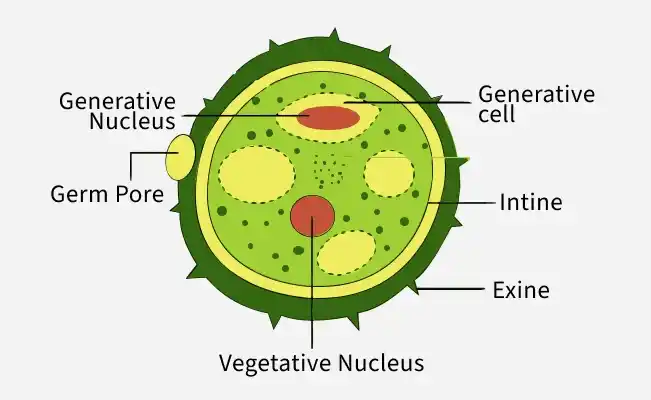
A pollen grain is a microscopic structure produced by the male reproductive organs of flowering plants, known as anthers. It aids in the fertilization and sexual reproduction of flowering plants. They usually appear as fine dust and are transported by various means, like water, air, and insects, to the female structure where fertilisation takes place.
Structure of Pollen Grain
Understanding the structure of a pollen grain is essential for comprehending the pollen grain's role in plant reproduction. Pollen grains are of different shapes and sizes depending on the species to which it belongs. The scientific study of living and fossil pollen grains is known as palynology.
**1. Exine
- Outermost layer.
- Made primarily of sporopollenin, a durable polymer.
- Protects during transport.
- Exhibits unique patterns aiding in species identification.
**2. Intine
- Inner layer beneath the exine.
- Composed of cellulose and pectin.
- Surrounds the cytoplasm containing generative and tube cells.
**3. Cytoplasm
Contains two types of cells:
**Generative Cell:
- Smaller cell
- Divides to form two sperm cells.
**Vegetative Cell:
- Larger cell
- Elongates to form the pollen tube.
**4. Germinal Apertures
- Specialised structures present in the thin regions of the exine.
- Facilitate pollen germination and pollen tube growth.
Formation of Pollen Grain
The formation of pollen grains begins with a process called microsporogenesis. In gymnosperms, a pollen grain is formed in the microsporangia of the male cone. In angiosperms, it is produced in the anthers of flowering plants.
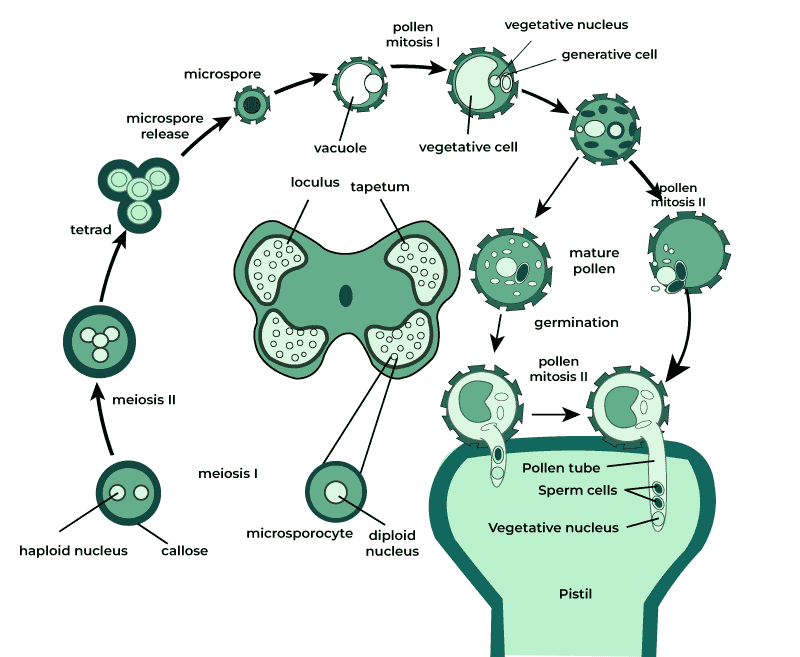
The process of formation of a pollen grain is as follows:
- The sporogenous tissue in the anther differentiates into pollen mother cells.
- Each pollen mother cell undergoes meiotic division to form a microspore tetrad (four haploid microspores).
- The microspores separate from each other.
- Each microspore develops into a pollen grain.
- The nucleus of each microspore divides mitotically to form a vegetative cell and a generative cell.
- As the anther matures and dries, a large number of pollen grains are formed.
- The pollen grains are released through dehiscence.
**Function of Pollen Grains
Pollen grain may appear as insignificant yellow dust, but it contains male gametes and forms an important link in the reproductive cycle of plants.
- The pollen grain is essential for reproduction in both gymnosperms, plants that produce male cones, and also in angiosperms, flower-producing plants.
- It transfers the male gametes (male reproductive cells) to the ovule (female reproductive cells) in the embryonic sac, for fertilisation of the egg that develops into a seed.
- Helps in maintaining genetic diversity within the plant population.
- Pollen grains are rich in nutrients. Pollen tablets are used as food supplements.