Heredity (original) (raw)
Last Updated : 9 Apr, 2026
Heredity is the biological process through which traits and characteristics are transmitted from parents to their offspring. It forms the basis of inheritance and explains why individuals resemble their parents, yet are not exactly identical. Heredity also plays a key role in generating variations among organisms, which are essential for evolution over time.
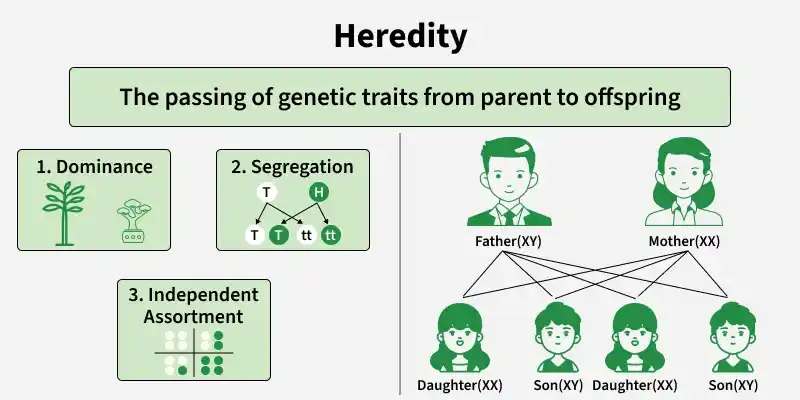
The transmission of these traits is controlled by genes, the fundamental units of heredity, which carry genetic information from one generation to the next. Examples of inherited traits include eye colour, hair type, skin colour, and height.
Inheritance of Traits
- The characteristics that are inherited from the parents are termed traits.
- An Inherited Trait is a particular genetically determined feature that distinguishes a person from another, the traits are inherited from one generation to other and this is the cause of the variations in population.
- For example, the colour of skin and eyes in humans. The set of genes is responsible for a particular character in a trait.
Basic Features of Heredity
- The basic concepts of heredity, derived by Gregor Mendel during his studies in the mid-19th century, became the foundation for the modern science of genetics.
- The transmission of traits from parents to their children is carried through genes, the functional units responsible for heredity in all living organisms.
- Many characteristics are influenced by more than one gene; they are referred to as polygenic. Many genes exist in multiple alleles throughout a population. The polygenic and multiple allelic nature of many traits gives a large potential for variability among hereditary characteristics.
- Heredity is the sum of all biological processes by which particular characteristics are transmitted between different generations.
- The sex cells or the gametes form the bridge across which heredity must pass between the generations, and are usually invisible to the naked eye.
Mendel’s Contribution to Heredity
Gregor Johann Mendel, referred to as the 'Father of genetics, was an Austrian Monk. He framed this law of Inheritance using his scientific and mathematical knowledge. Mendel did this experiment to understand the concept of heredity. His work laid the foundation of modern genetics. He used pea plants for his experiment as he found them easy to grow, and they had a greater number of visible characteristics like tall/short, inflated/constricted pod shape, violet/white flower, and round/wrinkled seeds.

Important Traits
During his experiment, Mendel found that genes are the factors that control the expression of traits. Genes are present in pairs for a specific trait, and they are termed alleles. Depending on the expression of traits, the genes could be either dominant or recessive.
- **Dominant Traits: The traits that express themselves in the offspring in every possible combination and can be seen by the naked eye are called Dominant traits. In Mendel's experiment, the tall trait in the pea plants tends to express more than the small trait. Therefore, the tall trait of plants is said to be dominant over the small trait.
- **Recessive Traits: A trait that is not expressed in the presence of a dominant allele is known as a Recessive trait. A recessive trait is expressed in an offspring when it is contributed by both parents. So, the recessive trait is present in an organism but cannot be seen due to the presence of the dominant trait.
- **Phenotype: The morphological expression of a single character that is observable physically is termed a phenotype. Examples - are tall or short, round or wrinkled seeds, the colour of a flower, etc.
- **Genotype: The genetic constitution of the allele pair for a specific trait is termed the genotype. Example - Tt or tt or TT.
Mendel was a mathematician, so he used statistics to record the traits in each generation by using a statistical method known as a Punnett square for predicting the possible genotype and phenotype in the offspring.
Allelic Relations
- The genes are present as a pair for a specific trait. An Allele is a variant form of a gene. It is one or two more forms of a DNA sequence (a single base or a segment of bases) at a particular genomic location.
- Generally, an individual inherits two alleles, one from each parent, for any given genomic location where such variation exists. If the two alleles are the same, the individual is homozygous for that allele, and if the alleles are different, the individual is heterozygous.
- Allelic heterogeneity refers to multiple mutations that occur in the same gene. Genetic variants determine phenotypic variability. Characterisation of these allelic variations may open largely uncharted territory in genomics for biomedical research and may eventually lead to the discovery of the causative genes of common hereditary diseases and their functional actions.
Monohybrid cross
- A monohybrid cross is the hybrid of two individuals with homozygous genotypes. Only one character is considered. In this cross, Mendel showed the inheritance of dominant and recessive characters.
- E.g. If a Round seed (RR) is crossed with a wrinkled seed (rr), we get 3 Round seeds and 1 wrinkled seed at the end of the F2 generation. The ratio of characters, arising after the cross at the end of the F2 generation, is called the monohybrid ratio. In this case, the monohybrid ratio is 3:1. For the cross below, the shape of the seed is considered.

Monohybrid cross
Dihybrid cross
- A dihybrid cross is a cross between two individuals with two observed traits that are controlled by two distinct genes. In this cross, two characters are considered. The ratio of characters arising at the end of the F2 generation is known as the dihybrid ratio.
- E.g. If a plant with a Round green pea (RRyy) is crossed with a plant having a wrinkled and yellow pea (rrYY), the first generation would have all-around yellow peas (RrYy). While crossing the same for an F2 generation, the result had greater variations, and the new combinations were Green Round, Yellow round, yellow wrinkled and green wrinkled. Thus, the dihybrid ratio is 9:3:3:1.

Dihybrid cross
Sex Determination
- The process of determining the sex of an individual, based on the composition of the genetic material, is called sex determination. There are various mechanism that determines the sex of newborn organisms.
- In humans, the sex of a newborn child is determined by the genes inherited from the parents. There are generally 22 pairs of chromosomes in humans, and one pair of chromosome is the sex chromosome, which determines the sex traits.
- In humans, the presence or absence of the Y chromosome determines the sex of an individual. Females have a perfect pair (XX), and males have a normal and a short (XY) chromosome.
- All gametes formed by females are similar, i.e. have X chromosomes. Males have two types of sperm, i.e. half with an X chromosome and the other half with a Y chromosome. The sex of the baby will depend on fertilisation. There are two possibilities.

Sex Determination.
Relation between Heredity and Evolution
- The most fundamental aspects of biology are heredity and evolution, which are connected by inheritable features. These two terminologies assist us in learning and comprehending how the life cycle on Earth works. Both concepts are interrelated to one another, and there can be no evolution without heredity.
- The transmission of properties from parent organisms to offspring is known as heredity. The evolution of a species is the outcome of changes in these specific inherited features over many generations that improve survival and reproduction chances. In other words, inheritable traits connect evolution to heredity.
- Over several generations, the frequency of an inherited trait changed. Since genes determine characteristics, we can assume that over generations, the frequency of particular genes in a population has changed. This is how evolution takes place in an organism.
Significance of Heredity
- Heredity is considered an important factor in influencing the development of personality. It focuses on the transfer of half of his or her genes to the offspring.
- Heredity is the essential factor by which the offspring acquire the personalities, behaviours and characteristics of their parents and grandparents. These characteristics are passed through sexual or asexual reproduction.
- Heredity is the study of how parents pass down traits to their children through genes. The research conducted on heredity has helped in generating information in terms of various aspects of the theories of heredity.
- It indulges the interest of an individual towards acquiring positive traits, as it will be an important contribution in bringing about improvements in their overall quality of life.
- Both parents contribute half of their genes, with a different set of genes passed to different offspring. This creates diversity and variations among the offspring.