Mendelian Inheritance (original) (raw)
Last Updated : 18 Dec, 2025
Mendelian inheritance is an explanation for how distinct units or genes pass on traits or personalities from one generation to the next. The theory was first put out by the Austrian monk Gregor Johann Mendel, who has been considered the "Father of Genetics" in recognition of his work. He established the laws of dominance, segregation, and independent assortment as three ways to explain the idea of inheritance.
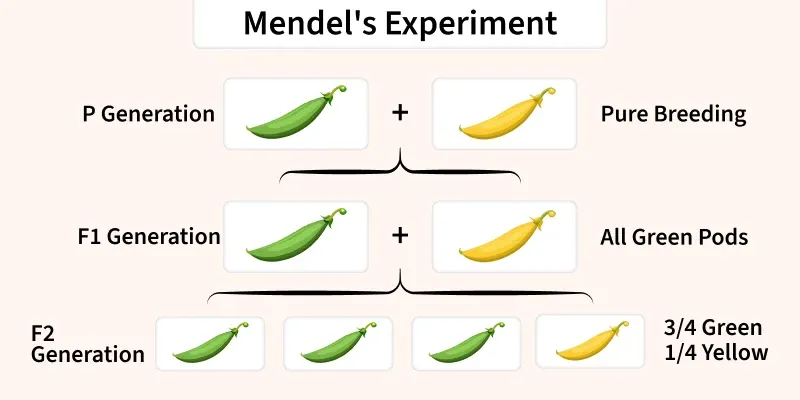
In one experiment, he crossed-fertilised plants of smooth, golden peas with peas that were wrinkled and green and showed:
- This initial cross produced the first generation (F1) of peas, all of which were smooth and yellow.
- But when two smooth, yellow peas from this first generation were crossed to create a second generation (F2), the outcome was a 3:1 ratio of 75% smooth, yellow peas and 25% wrinkled, green peas.
- According to the results, the genes responsible for smooth, yellow peas are dominant, whereas the genes responsible for wrinkled, green peas are recessive.
Characteristics of Mendelian inheritance
According to Gregor Mendel's generalisations, there are several laws known as Mendelian inheritance. Characteristics of Mendelian inheritance are given below:
- Mendel's methodical and precise breeding experiments on pea plants led him to formulate theories on how genetic traits are passed from parents to offspring.
- Gregor Mendel was able to explain how genetic traits are handed down from generation to generation via years of research with the common pea plant.
- Mendel largely chose peas for his tests because he could easily regulate how they were fertilised by spreading pollen with a little paintbrush from plant to plant.
- He would occasionally carry pollen to and from flowers on the same plant (self-fertilisation) or from grows on different plants (cross-fertilisation).
- In a two-part work titled Experiments on Plant Hybridisation in the 1860s, he presented and published his findings. His important discoveries established the foundation for genetics.
- He was able to develop the fundamental generalisations that served as the foundations of Mendelian inheritance, also known as Mendel's Principles of Heredity, by breeding and testing around 5,000 pea plants. He discussed the so-called "laws of inheritance" put out by Mendel, including the Law of Segregation, the Law of Independent Assortment, and the Law of Dominance.
Concepts of Mendel's Inheritance
Gregor Mendel developed three important inheritance concepts as a result of the findings of this and further studies.
- Factors that are handed down to offspring—now known as genes—determine the inheritance of each characteristic.
- For each attribute, a person receives one 'factor' from each parent.
- Even if a characteristic does not manifest in a particular person, it can nonetheless be passed on to the following generation.
Mendel’s laws of inheritance
Mendel described three laws of inheritance are described below:
- **Law of Segregation: Mendel's first law asserts that genes are passed down from generation to generation as independent, unique units.
- **Law of Independent Assortment: According to the law of independent assortment, sex cells with various combinations of these genes indiscriminately fuse with sex cells produced by the other parent.
- **Law of Dominance: The dominance law states that two inherited traits are affected differently depending on which allele is dominant.
Importance of Mendelian Inheritance
- It enables us to identify unusual combinations in the hybrid progeny and to estimate their occurrence.
- The law of independent assortment contributes to the validation of the idea of genes.
- Mendelian principles make it simple to understand how new features originate.
- The qualities can be carefully chosen to create new plant species with desirable properties.
- It enables plant and animal breeders to create superior offspring.
Mendel gives terms related to Mendelian inheritance are given below:
- **Traits: These are the characteristics that are transferred onto upcoming individuals by the carrier of distinct components from the parent species.
- **Genes: These are distinct units that each appear independently in their progeny.
- **Alleles: One pair from each parent is passed on to the progeny when two alternative pairings of a gene are present.
- **Genotype: This term describes the particular arrangement of alleles for a certain set of genes. An uppercase letter "D" stands for a dominant gene, which displays its phenotypic traits more strongly than a lowercase letter "d" for a recessive gene.
- **Phenotype: The visual characteristics of an organism, such as colour, length, form, etc., that are the outcome of gene expression.