Hormones (original) (raw)
Last Updated : 25 May, 2026
Hormones are chemical messengers produced by endocrine glands in very small quantities and released directly into the bloodstream. They regulate and coordinate various physiological activities of the body, such as growth, development, metabolism, reproduction, and behaviour. By maintaining proper communication between different organs, hormones help the body maintain internal balance and homeostasis.
Types of Hormones
Different types of hormones are produced in the body to regulate various functions. They are organised as follows:
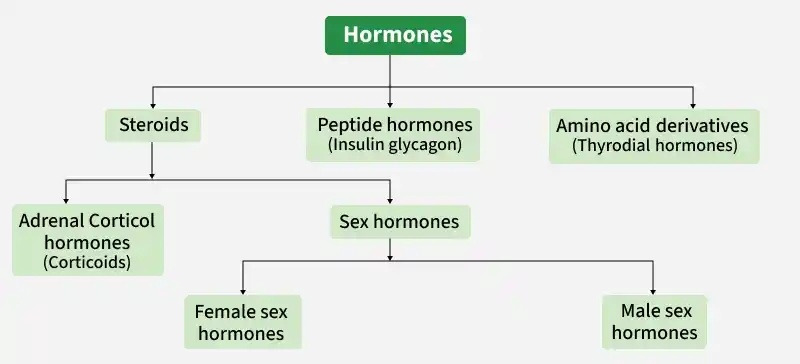
**1. Steroid Hormones
Steroid hormones are lipid-soluble hormones derived from cholesterol. Examples include testosterone, estrogen, progesterone, and cortisol.
**2. Peptide Hormones
Peptide hormones are made up of amino acids and are water-soluble. Since the plasma membrane is made of a phospholipid bilayer, peptide hormones cannot freely pass through it and therefore act through membrane receptors.
3. Amino Acid Derivatives
Derived from single amino acids (tyrosine or tryptophan) and can be water-soluble or lipid-soluble. For example: Adrenaline, Thyroxine, Melatonin
Characteristics of Hormones
- Hormones are chemical substances that act as messenger molecules in the bloodstream.
- Hormones carry chemical messages from endocrine glands to target organs or tissues.
- Hormones act only on target cells that possess specific receptors for them.
- These chemical messages aid in the activation and deactivation of cellular processes that regulate stress, appetite, growth, sleep cycles, blood sugar, sex drive, and sexual function.
- Hormones play a critical role in the proper functioning of the human body. They regulate organ functions and influence their growth, reproduction, and sexual characteristics.
- Furthermore, hormones influence how the human body stores and uses energy, as well as the volume of fluids and the level of sugar and salt in the blood.
- As a result, a small amount of hormone can cause a significant reaction in the human body.
- The endocrine system consists of endocrine glands and the hormones they secrete.
**Human Endocrine System and Its Hormones
The pituitary gland is often called the “master gland” because its hormones regulate the activity of several endocrine glands, including the thyroid gland, adrenal glands, testes, and ovaries.
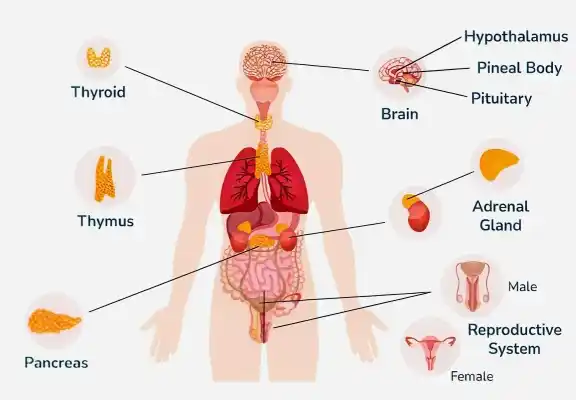
Given below are the hormones secreted by the human endocrine system:
| **Endocrine Glands | **Hormones |
|---|---|
| **Pituitary Gland | Growth Hormone (GH)Prolactin (PRL)Thyroid Stimulating Hormone (TSH)Adrenocorticotropic Hormone (ACTH)Follicle-Stimulating Hormone (FSH)Luteinizing Hormone (LH)Antidiuretic Hormone (ADH)Oxytocin |
| **Thyroid Gland | Thyroxine (T4)Triiodothyronine (T3)Calcitonin |
| **Parathyroid Glands | Parathyroid Hormone (PTH) |
| **Adrenal Glands | CortisolAldosteroneEpinephrine (Adrenaline)Norepinephrine (Noradrenaline)Androgens |
| **Pancreas | InsulinGlucagonSomatostatinPancreatic Polypeptide (PP) |
| **Pineal Gland | Melatonin |
| **Thymus | Thymosin |
| **Ovaries (in females) | EstrogenProgesterone |
| **Testes (in males) | Testosterone |
Functions of Hormones
The bloodstream is where hormones are released into the bloodstream to act as chemical messengers. Blood transports them to various organs and tissues of the body. Hormones bind to receptors once they reach their target site. After binding to receptors, hormones trigger specific responses in target organs or tissues.
Hormones perform the following important functions:
- Mood and cognitive function regulation.
- Development and growth.
- Regulation of metabolism and body temperature.
- Controlling hunger and thirst.
- Starting and maintaining sexual development and reproduction.