Human Nervous System (original) (raw)
Last Updated : 9 Apr, 2026
The Human Nervous System is a network of specialised cells and tissues that includes the brain, spinal cord, and a complex network of peripheral nerves. It is responsible for receiving, transmitting, and processing information within the body. The nervous system functions to enable communication between different parts of the body and allows organisms to interact with their environment.
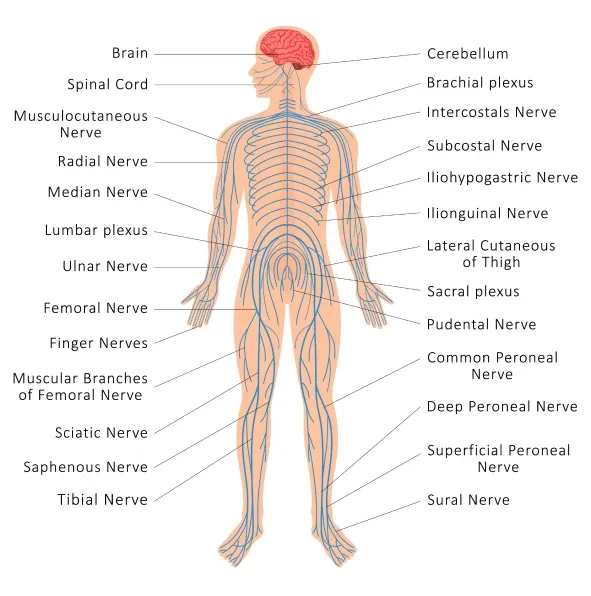
The electrical signals are carried throughout the brain, spinal cord, and various parts of the body, enabling communication through the nerves. There are three primary types of nerves based on their function:
- **Sensory Nerves: These nerves carry sensory information from the body to the central nervous system. They help us perceive sensations such as touch, temperature, pain, and other sensory experiences.
- **Motor Nerves: Motor nerves transmit signals from the central nervous system to muscles and glands, enabling voluntary and involuntary muscle movements and controlling glandular secretions.
- **Mixed Nerves: These nerves contain both sensory and motor fibres, allowing for two-way communication. Most nerves in the body fall into this category, enabling the coordination of sensory input and motor output.
Neurons
The basic unit of the nervous system is a neuron, which is responsible for transmitting information throughout the body. It helps in communication between different parts of the body, including the brain, spinal cord, and other organs. The diagram of a neuron consisting of a dendrite, an axon and a cell body is shown below:

Neurons consist of a cell body, dendrites, and an axon. They are defined as follows:
- **Cell Body: The cell body is the central part of a neuron that contains the nucleus and other cellular components, and acts as the control centre for the neuron's activities.
- **Dendrites: Dendrites are the branched extensions of a neuron that receive signals from other neurons or sensory receptors, facilitating the transmission of information to the cell body.
- **Axon: The axon is a long, slender projection of a neuron that carries electrical signals away from the cell body, enabling communication with other neurons or a target cell.
Types of Nervous System
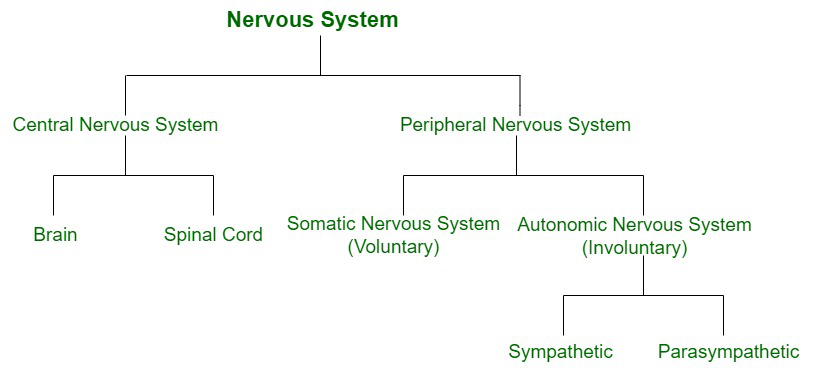
The nervous system consists of two parts:
- **Central Nervous System - consists of the brain and spinal cord
- **Peripheral Nervous System - comprising all the nerves
The flow chart of the nervous system is given below:
Central Nervous System
The central nervous system (CNS) forms an important part of the human nervous system, consisting of the brain and spinal cord. It acts as the command centre, processing information from the body and coordinating various functions, including thought, sensation, memory, and emotion. It maintains homeostasis and enables communication between different parts of the body.
Brain
The brain is enclosed within the cranium (or skull) for protection, and acts as the control centre of the body. It is responsible for various functions such as memory, emotion, sensory processing, and the coordination of voluntary and involuntary actions.

The human brain is composed of three major parts:
**1. Forebrain: The forebrain is the anterior and largest part of the brain, which is responsible for advanced cognitive functions and sensory processing. The forebrain consists of the cerebrum, thalamus and hypothalamus.
- **Cerebrum - It is divided into two halves: the right and left cerebral hemispheres. They are covered by layers of cells called the cerebral cortex, which are responsible for major functions like memory and communication.
- **Thalamus - Coordinates sensory and motor signalling, memory and consciousness
- **Hypothalamus - Maintains homeostasis of the body. It also secretes hypothalamic hormones that regulate various body processes.
**2. Midbrain: The midbrain is a central part of the brainstem located between the forebrain and the hindbrain. It relays sensory and motor signals, regulating arousal and attention, and coordinating visual and auditory reflexes.
**3. Hindbrain: The hindbrain is the posterior part of the brain, located near the base of the skull. It is responsible for various functions like balance, coordination, breathing, and regulating essential bodily processes. It consists of the pons, cerebellum, and medulla.
- **Pons: It consists of fibre tracts that interconnect different parts of the brain.
- **Cerebellum: It provides additional space for many more neurons and helps in coordinating and regulating many processes.
- **Medulla: It has centres that control respiration, cardiovascular reflexes, and gastric secretions.
Spinal Cord
The spinal cord is a long, cylindrical bundle of nerve tissue that runs down the vertebral column (spine) and transfers sensory information to the brain and carries motor signals from the brain to the body. It plays an important role in reflexes and basic motor functions, and it serves as a key link between the peripheral nervous system and the central nervous system.

Peripheral Nervous System
The peripheral nervous system (PNS) consists of a network of nerves and ganglia. The PNS connects the CNS to the rest of the body, enabling communication between the central nervous system and sensory organs, muscles, glands, and other tissues. It has two main divisions:
- **Sensory (Afferent) fibres. It carries sensory information from the body and external environment to the CNS. It receives stimuli such as touch, temperature, pain, and sensory input from organs.
- **Motor (Efferent) fibres: They transmit motor commands from the CNS to muscles, glands, and other effector organs. It controls voluntary movements (somatic nervous system) and involuntary processes (autonomic nervous system), such as heart rate, digestion, and glandular secretions.
The peripheral nervous system (PNS) can be classified into two major divisions:
- **Somatic Nervous System (SNS): It is responsible for voluntary movements and sensory perception. It receives sensory information from the body's sensory receptors (skin, joints, muscles) and transmits it to the central nervous system (CNS).
- **Autonomic Nervous System (ANS): The ANS is responsible for involuntary functions that help regulate the internal environment of the body to maintain homeostasis.
Functions of the Nervous System
Functions of the Nervous System are as follows:
- The nervous system helps in reflex action
- It helps with memory and learning
- Voluntary control
- Maintains involuntary functions like heartbeat
- The nervous system also helps in maintaining homeostasis.