Human Skeletal System (original) (raw)
Last Updated : 28 May, 2026
The Skeletal system provides structural support, protects our internal organs, and facilitates movement. The skeletal system of humans is primarily formed by bones, cartilage, ligaments, and tendons— all of these work together to provide support, protection, and movement to the human body.
The skeletal system also takes part in hormone regulation and the storage of essential minerals. It contributes to blood cell production and maintains mineral balance. It can be divided into two main parts: the axial skeleton and the appendicular skeleton.
The axial skeleton consists of bones that lie along the central axis of the body, while the appendicular skeleton consists of the bones that connect limbs to the axial skeleton and enable movement.
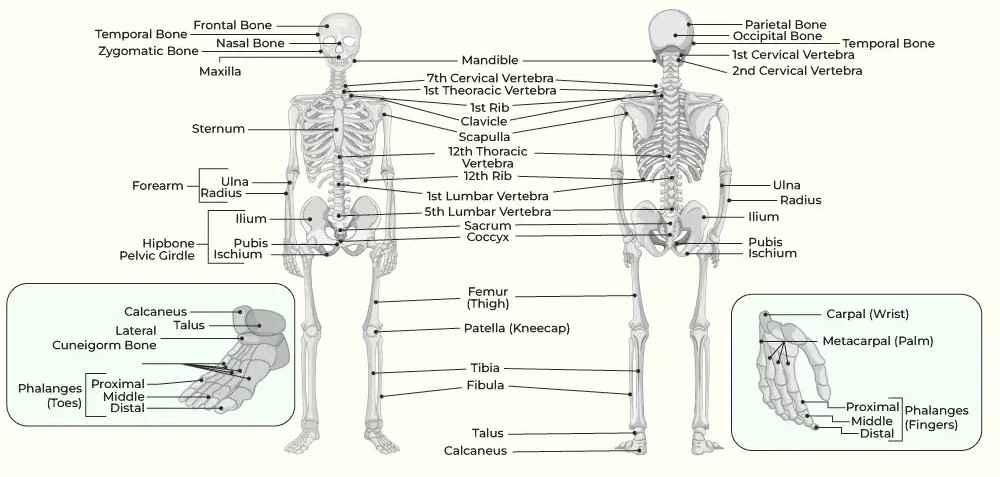
Axial Skeleton
The axial skeleton is primarily responsible for protecting vital organs and supporting the body's weight. It consists of the skull, vertebral column, sternum, and ribs. The skull protects the brain and sensory organs such as the eyes, nose, and ears. The vertebral column provides support, flexibility, and protection for the spinal cord. The rib cage surrounds the thoracic cavity and protects vital organs like the heart and lungs.
1. Skull
The human skull consists of 22 bones: 8 cranial bones and 14 facial bones. The ear ossicles and hyoid bone are associated bones of the skull region.
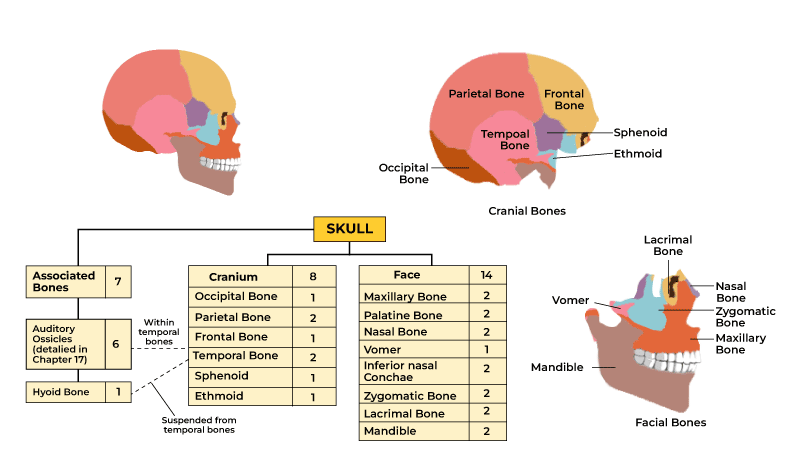
**Cranial Bones
- **Frontal Bone: The frontal bone protects the front side of the brain. It constitutes the forehead and the upper part of the eye orbits.
- **Parietal Bones: There are two parietal bones, one on each side of the skull. They form the roof of the cranial cavity.
- **Temporal Bones: The temporal bones are located on the sides of the skull above the ear. They protect the sides of the brain.
- **Occipital Bone: The occipital bone is situated at the back of the skull. It contains the largest opening of the human body, known as the foramen magnum, through which the spinal cord passes. Two condyles are present in the occipital bone, which makes the human skull dicondylic.
- **Sphenoid Bone: The sphenoid bone is present at the base of the skull. It forms the floor of the cranium. It protects the lower part of the brain and houses the pituitary gland in its depression known as _Sella Tursica.
- **Ethmoid Bone: The ethmoid bone is located between the eye sockets and forms part of the nasal cavity.
**Facial Bones
- **Maxilla: The maxilla is the upper jawbone. It contains the upper teeth.
- **Mandible: The mandible is the lower jawbone. It is the only movable bone in the skull. It contains the lower teeth and plays an important role in chewing and speaking.
- **Zygomatic Bones: The zygomatic bones are also known as cheekbones. They are located on the sides of the face. They form the cheek prominence during smiling and also form part of the eye sockets.
- **Nasal Bones: The nasal bones are small, rectangular bones that form the bridge of the nose.
- **Lacrimal Bones: The lacrimal bones are the smallest facial bones and are present in the eye orbits. They help in tear drainage through the lacrimal canal.
- **Vomer Bone: The vomer bone is a thin, flat and triangular bone present in the midline of the nasal cavity. It is a part of the nasal septum, which divides the nasal cavity into two halves.
- **Palatine Bones: The palatine bones form the roof of the buccal cavity by forming the posterior part of the hard palate.
- **Inferior Nasal Conchae: These are the bony ridges in the nasal cavity that are richly supplied with blood vessels. They add moisture to the air and warm it.
**Ear ossicles
There are three pairs of ear ossicles present in the middle ear. They help in intensifying or amplifying sound waves. These are Malleus (Hammer), Incus(Anvil) and Stapes(Stirrup). The stapes is the smallest bone of the human body. The stapedius muscle is the smallest in the human body, also found in the ear and associated with the stapes bone.
**Hyoid Bone
It is a U-shaped bone. It does not form any joints. It provides a surface for the attachment of the tongue muscle.
2. Vertebral Column
The vertebral column is an S-shaped structure essential for bipedal locomotion. It provides support and protects the spinal cord.
The vertebral column consists of 33 vertebrae during early development. In adults, some vertebrae fuse, resulting in 26 bones. These vertebrae are classified into five regions:
- 7 **Cervical vertebrae are present in the neck region.
- 12 **Thoracic vertebrae are present in the thoracic region. In these vertebrae, two additional attachment sites are present on each vertebra for the ribs.
- 5 **Lumbar vertebrae are present in the upper abdominal region. They are the strongest and thickest.
- **The sacrum is formed by the fusion of 5 vertebrae and is present in the pelvic region.
- The **coccyx is formed by the fusion of usually 4 vertebrae and represents the vestigial tailbone. It is vestigial as it was the tailbone of ancestors.
**Vertebral formula in adults- C7 T12 L5 S(5) Co(4)
**Vertebral formula in embryo- C7 T12 L5 S5 Co4
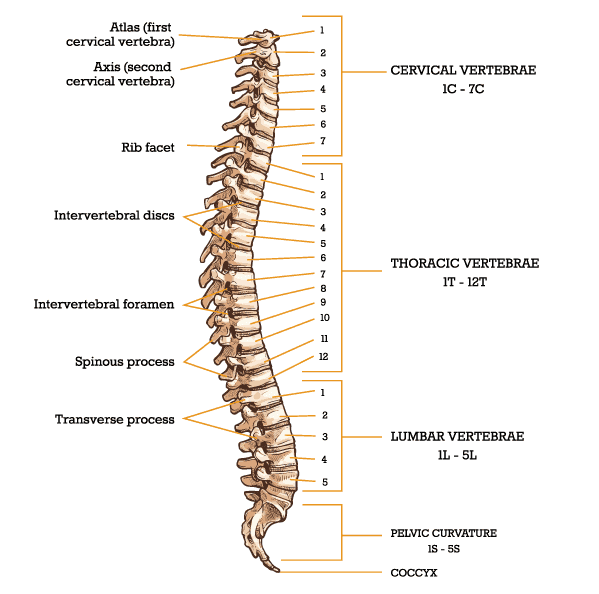
**Curves of the vertebral column
The vertebral column is S-shaped. Lumbar and Cervical curves develop after birth. These curves develop during the crawling stage of a baby. The lumbar curvature helps maintain balance during bipedal locomotion.
3. Ribs and Sternum
The ribs and sternum, along with the vertebral column, form the rib cage, which protects the thoracic cavity. There are 12 pairs of ribs, attached to the thoracic vertebrae at the back and the sternum at the front. Ribs are attached to the sternum using hyaline cartilage. The sternum, or breastbone, is a dagger-shaped, flat bone located in the centre of the chest. It is present on the ventral side and helps protect organs in the thoracic cavity.
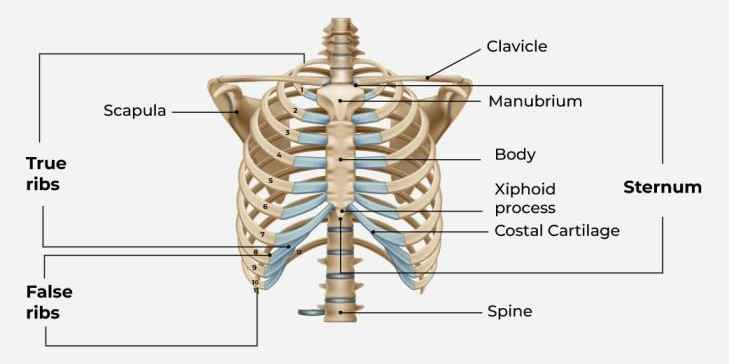
12 pairs of ribs can be classified into 3 types:
- **True Ribs- True ribs are also called vertebrosternal ribs as they are attached to the vertebral column dorsally and sternum ventrally. The first to Seventh pairs of ribs belong to this category.
- **False Ribs- They are also known as vertebrochondral ribs, as they are attached to the vertebral column dorsally and the cartilage of the seventh pair ventrally. The eighth to Tenth pairs of ribs belong to this category.
- **Floating Ribs- They are also known as vertebral ribs as they are attached to the vertebral column dorsally and are free ventrally. The eleventh and Twelfth pairs of ribs belong to this category.
Appendicular Skeleton
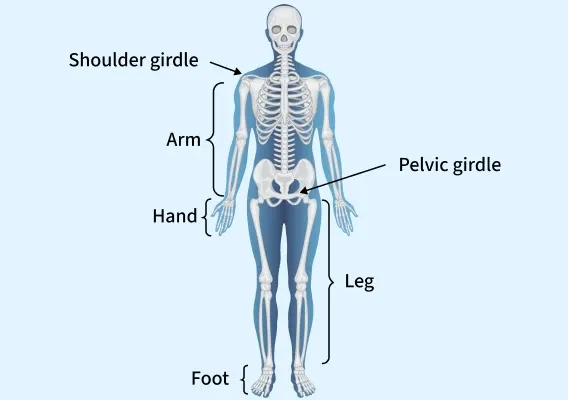
The appendicular skeleton facilitates movement and locomotion. It comprises the bones of the limbs and the girdles that attach them to the axial skeleton. It includes the pectoral (shoulder) girdle, which anchors the upper limbs and the pelvic girdle, which supports the lower limbs. The bones of the upper and lower limbs are also included in the appendicular skeleton, enabling various movements.
1. Pectoral Girdle
The pectoral girdle is also called the shoulder girdle. It connects the forelimbs to the axial skeleton and provides mobility to the arms. It consists of four bones- two clavicles and two scapulae.
- The scapula, also known as the shoulder blade, is a flat and triangular bone. It consists of the body, spine, acromion process, coracoid process and glenoid cavity. The acromion process is responsible for the formation of the shoulder with the clavicle bone, the Coracoid process is responsible for the attachment of muscles, and the Glenoid cavity is responsible for the articulation of the head of the humerus by the ball and socket joint.
- The clavicle, also known as the collarbone, is an S-shaped bone. It has two ends, namely, the dorsal and ventral ends. The Dorsal end of the Clavicle is attached to the acromion process of the scapula, while the ventral end is attached to the sternum.
2. Forelimbs
Bones of the Forelimbs allow intricate movements and dexterity. The forelimbs are composed of:
- The humerus is the long bone of the upper arm. The ‘funny bone’ sensation is caused by the ulnar nerve near the elbow.
- The radius and Ulna are present in the forearm or lower arm. The radius is present on the thumb side, while the ulna is present on the little finger side. The elbow is formed by the junction of the radius, ulna and humerus.
- 8 Carpals are present in the wrist. They are very irregular in shape, like pebbles, and slide over each other.
- 5 Metacarpals are present in the palm.
- 14 Phalanges are present in fingers. Two are present in the thumb and three in each finger. The digit formula is 2,3,3,3,3.
3. Pelvic Girdle
The pelvic girdle, also known as the hip girdle, connects the lower limbs to the axial skeleton and provides support for the body's weight.
- It consists of two coxal bones. These two bones are joined by a cartilaginous joint, known as the Pubic Symphysis. It opens at the time of delivery, resulting in a broader hip region in females after childbirth.
- The coxal bone is formed by the fusion of three bones during the embryonic stage. These bones are the Ilium (the largest), Ischium, and Pubis(the smallest).
- In the region of Ischium, the Obturator Foramen is present, which is formed by the ischium and pubis. It is a hole through which blood vessels, nerves, ducts, etc., go from the upper body to the lower body.
- The acetabulum is formed by all three bones and is responsible for the attachment of the femur.
4. Lower Limbs
Bones of the lower limbs enable walking, running, and various other movements. The lower limbs consist of:
- The femur is the thickest, strongest, and longest bone of the human body. It is present in the thigh. The head of the femur articulates with the acetabulum of the hip girdle.
- The tibia is the main weight-bearing bone of the leg. Tibia, also known as the shin bone, is the second-longest and strongest bone of the body.
- 7 Tarsals are present in the ankle.
- 5 Metatarsals are present in the foot.
- 14 Phalanges are present in the toe, having a digit formula similar to that of the fingers of the Forelimbs.
Disorders of the Skeletal System
Several disorders are associated with the skeletal system that can impact its structure, function, and overall health.
1. Osteoporosis
Osteoporosis is a condition that is characterised by low bone density, decreased bone mdensity and increased porosity of bones. It occurs primarily in older individuals and postmenopausal women due to a lack of oestrogen, because oestrogen has a very big role in the deposition of calcium in bones. It can also occur due to Parathormone-Calcitonin imbalance. Adequate calcium intake, regular exercise, and a healthy lifestyle can prevent osteoporosis.
2. Arthritis
Arthritis refers to the inflammation of joints, which can cause pain, stiffness, and limited mobility. It can be treated by medication, physical therapy, and lifestyle modifications.
There are three types of arthritis.
- **Osteoarthritis- It occurs due to inflammation in the articular cartilage of long bones.
- **Rheumatoid arthritis- It is an autoimmune disorder and occurs due to inflammation of the synovial membrane, leading to increased synovial fluid. Also, rheumatoid arthritis, abnormal, inflamed tissue called pannus develops in the synovial membrane and damages joints.
- **Gout- It occurs due to the accumulation of uric acid crystals in joints.