Meiosis (original) (raw)
Last Updated : 30 Jan, 2026
When a single cell divides into two or more cells, we say that cell division has occurred. The single cell that divides itself is known as a parent cell or parental cell. The resulting cells from the parent cell are known asdaughter cells. A cell cycle can be defined as the sequence of events in which a cell synthesises the other constituents of cells by duplicating itself and eventually dividing itself into daughter cells.
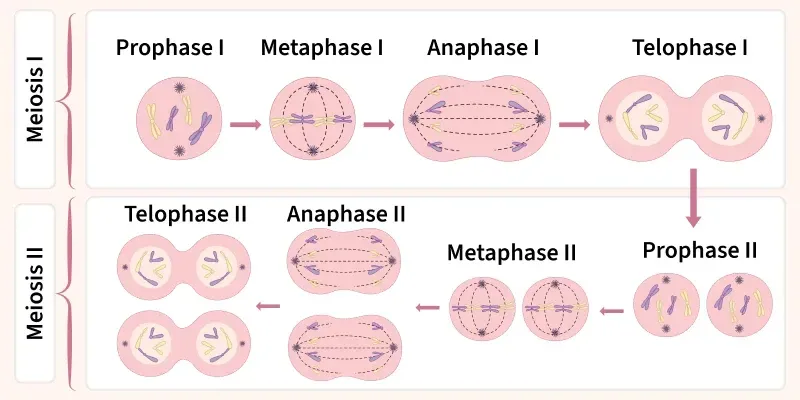
This diploid cell forms 4 haploid daughter cells, each having only half the number of chromosomes.
It takes place in 2 divisions:
- **Meiosis - I: In this chromosome number is reduced to half, which is why this division is known as reductional division.
- **Meiosis - II: In this chromosome numbers remain the same till the end of the division, which is why this division is known as equational division.
**Meiosis I
In this chromosome number is reduced to half, which is why this division is known as reductional division.
**Prophase I
It is further divided into five stages that are:
- **Leptotene: This word is made up of two words that are "leptos" and "tene", and their meanings are "thin" and "thread". In this stage, you will observe that a thin thread of chromatin fibres will appear, and they will get condensed by dehydration. Here, the nuclear membrane remains undamaged, and chromosomes appear thread-like and are made up of two sister chromatids.
- **Zygotene: During this chromosomes will get paired, then this whole process of association is known as synapsis. Now, there will be the formation of a bivalent (a pair of synapsed chromosomes forms a complex called a bivalent).
- **Pachytene: Crossing of two non-sister chromatids of homologous chromosomes takes place in this stage. While this crossing there will be the exchange of genetic material; this is an enzyme-mediated process, and the enzyme involved in this process is known as recombinase. By the end of this stage, the recombination of chromosomes will be completed.
- **Diplotene: In this stage, nuclei and the nuclear membrane will start disappearing. Homologous chromosomes will separate in this stage. Chiasmata(X-shaped structure) will be formed.
- **Diakinesis: chiasmata will terminate.
**Metaphase- I
- Pairs of chromosomes align themselves on the equator of the cell.
- The spindle fibres at each pole of the cell are attached to each chromosome of each pair.
- Centrioles are now at the opposite poles of the cell.
**Anaphase- I
- A pair of chromosomes will be appressed by the spindle fibres.
- Now one chromosome will be at one pole of the cell, and another chromosome will be at the opposite pole.
- In this stage, sister chromatids will stay together.
**Telophase- I
- Chromosomes have completed their whole moment and reach the poles of the cell.
- Around each set of chromosomes, there will be a formation of a membrane to create two nuclei.
- The nuclear membrane and nucleolus will reappear.
**Cytokinesis
Each parent cell will now divide itself to form haploid daughter cells.
**Interkinesis
- The stage between the telophase-I and prophase-II.
- No DNA replication will take place.
- Chromosomes will elongate in this stage
**Meiosis II
In this chromosome numbers remain the same till the end of the division, which is why this division is known as equational division.
**Prophase- II
- Two daughter cells are formed will have condensed chromosomes that are visible in an X-shaped structure, which can be seen under a microscope.
- Duplication of centrioles takes place.
- Spindle fibres will be formed again
**Metaphase- II
- Pairs of chromosomes align themselves on the equator of the cell.
- Centrioles are now at the opposite poles of the cell.
- The spindle fibres at each pole of the cell are attached to each chromosome of each pair.
**Anaphase- II
- The pair of chromatids is now pulled to opposite poles of the cell due to the action of the spindle.
- Now, these chromatids will become individual chromosomes.
**Telophase- II
- Chromatids will reach to poles and decondense themselves.
- The nuclear membrane and nucleolus will reappear.
- Nuclei of four haploid cells are formed.
**Cytokinesis
Each daughter cell at meiosis I will divide itself to form new daughter cells. Basically, two haploid daughter cells will convert themselves into four haploid cells.