Cell Division (original) (raw)
Last Updated : 24 Apr, 2026
Cell division is a biological process through which a single parent cell splits to form new daughter cells. It is essential for growth, development, reproduction, and the repair of tissues in living organisms.
Types of Cell Division
Depending on the purpose, cells divide through two major processes, mitosis and meiosis, each serving a distinct role in the life cycle.
- **Mitosis or Equational Division: In which a parent cell divides to form two genetically identical daughter cells.
- **Meiosis or Reductional Division: Inwhich a cell divides to form four daughter cells, each containing half the chromosome number.
Phases of the Cell Cycle
The cell cycle is the series of phases a cell goes through to grow and divide.
The cell cycle comprises two phases:
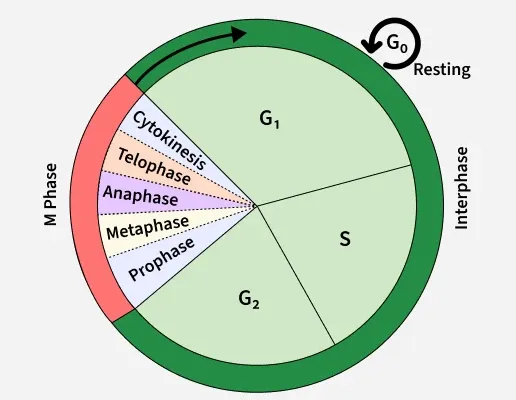
**Interphase
Interphase is called the "resting phase" of the cell cycle, but studies show active synthesis of RNA, protein, and genetic material occurring during this phase.
The interphase further comprises the following phases:
- **G1 Phase (Gap 1): Cells mainly grow during this phase, but do not undergo DNA replication. It performs normal functions.
- **S phase (Synthesis): DNA synthesis occurs, resulting in the replication of the genetic material.
- **G2 phase (Gap 2): The cell continues to grow, synthesising proteins and preparing for mitosis or meiosis.
- **Quiescent Stage (G0): Some cells, like nerve cells, do not undergo cell division, so they exit the G1 phase. They remain in the G0 stage, which is an inactive stage.
M Phase (Mitosis Phase)
Mitosis is the process in which a cell divides to form two genetically identical daughter cells.
Stages of Mitosis
This phase is further divided into the following four stages -
- **Prophase
- **Metaphase
- **Anaphase
- **Telophase
**Cytokinesis
Cytokinesis is the final stage of cell division where the cell's cytoplasm divides. In this process -
- A cleavage furrow forms in animal cells or a cell plate in plant cells.
- The cell membrane pinches inward, separating the two daughter cells.
- Organelles and cytoplasm are distributed to ensure each daughter cell is functional.
- Finally, two genetically identical daughter cells with complete cellular components are formed.
Meiosis
Meiosis occurs in reproductive cells to produce gametes. Cell division by meiosis includes two cycles of division, Meiosis I and Meiosis II, each with specific functions are given below:
**Meiosis I: The chromosome number is halved as homologous chromosomes separate. Crossing over occurs during Meiosis I, where genetic material is exchanged between homologous chromosomes.
**Meiosis II: The haploid cells produced in meiosis I undergo further division to form four haploid daughter cells. Genetic recombination that occurs during meiosis results in offspring with a combination of genetic material from both parents. This process ensures genetic diversity.
Stages of Meiosis
There are basically 2 stages of Meiosis are Meiosis I and Meiosis II.
**1. Meiosis I
It consists of the following phases:
- **Prophase I: Chromosomes condense, and homologous chromosomes (one from each parent) pair up in a process called synapsis. Crossing-over occurs, where genetic material is exchanged between homologous chromosomes.
- **Metaphase I: Homologous chromosome pairs align at the cell's equator, known as the metaphase plate.
- **Anaphase I: Homologous chromosomes separate and move to opposite poles of the cell.
- **Telophase I: Chromosomes reach the poles, and the cell undergoes cytokinesis, resulting in two daughter cells, each with half the original chromosome number.
**2. Meiosis II
It consists of the following phases:
- **Prophase II: Chromosomes condense again in the haploid cells.
- **Metaphase II: Chromosomes align at the metaphase plate in each haploid cell.
- **Anaphase II: Sister chromatids of each chromosome are pulled apart and move to opposite poles.
- **Telophase II: Chromatids reach the poles, and the cells undergo cytokinesis, producing four haploid daughter cells, each genetically distinct.
**Mitosis vs Meiosis
The Difference Between Mitosis and Meiosis is as follows:
| **Characteristic | **Mitosis | **Meiosis |
|---|---|---|
| **Purpose | Growth, repair, and asexual reproduction | Sexual reproduction, producing gametes |
| **Number of Divisions | One division (Mitosis) | Two divisions (Meiosis I and Meiosis II) |
| **Chromosome Number | chromosome number remains the same | chromosome number is reduced by half. |
| **Daughter Cells | Two genetically identical cells | Four genetically unique haploid cells |
| **Crossing Over | Rarely occurs | Occurs during Meiosis I |
| **Homologous Chromosomes | No pairing of homologous chromosomes | Homologous chromosomes pair and exchange genetic material |
| **Role in Genetic Diversity | Limited, as offspring are genetically identical | Essential for genetic diversity in offspring |
| **Examples | Somatic cell division | Gamete formation in sexual reproduction |