Muscular System (original) (raw)
Last Updated : 30 Dec, 2025
The muscular system is a vital body system that allows movement, maintains posture, and helps in various life activities. It is made up of muscles that work together to move different parts of the body, support internal organs, and produce heat.
The muscular system plays an essential role in activities such as walking, breathing, digestion, and maintaining balance in the body.

Features of the Muscular System
- The muscular system is a complex of tissues comprising highly elongated and contractile cells called myocytes.
- The myocytes together form the muscle fibres that serve as the units of locomotion and movement in the body.
- Muscle fibres are highly contractile and can contract up to one-third of their total length. This allows them to bring out the contraction of muscles.
- Themuscular system forms around 40- 50% of the body mass and primarily contains three types of muscles that are differentiated in structure, function, and shape.
- The primary function of the muscular system is contraction. By contracting and relaxing, they allow a wide range of movement of the different parts of the body and its organs.
- This maintains all physiological functions essential for living, like breathing, digestion, etc.
**Also Read: Anatomy & Physiology of Human Skeletal System
Types of Muscle
Muscles can be categorised into three types based on structure and function. These categories are skeletal muscles, smooth or visceral muscles, and cardiac muscles. The structure and function of these muscle types are as follows.

1. Skeletal Muscles
Skeletal muscles are also known as striated or voluntary muscles. They form a significant part of the musculoskeletal system and are responsible for the locomotion and movement of body parts.

The functions of Skeletal muscles are given below:
- These muscles are cylindrical and are characterised by the presence of multiple nuclei and striations.
- Striations are caused by a repeating unit in the muscle fibre called the sarcomere. Sarcomeres have alternating thick filaments of myosin that give a dark band (red) and a thin filament of actin that gives a light band (white).
- This alternating dark and light band gives rise to the striated appearance of skeletal muscles.
- Skeletal muscles are attached to the bones by tendons.
- These muscles are under conscious control and are responsible for voluntary movements such as walking, running, and lifting.
- They are vital in providing structural support and maintaining posture. These muscles are also responsive to neural signals in response to external stimuli.
Also Read: Difference Between Ligaments and Tendons
2. Smooth Muscles
Smooth muscles are also called non-striated, visceral, or involuntary muscles. These muscles do not have any striations in their fibres and are spindle-shaped, with only one nucleus per myocyte.
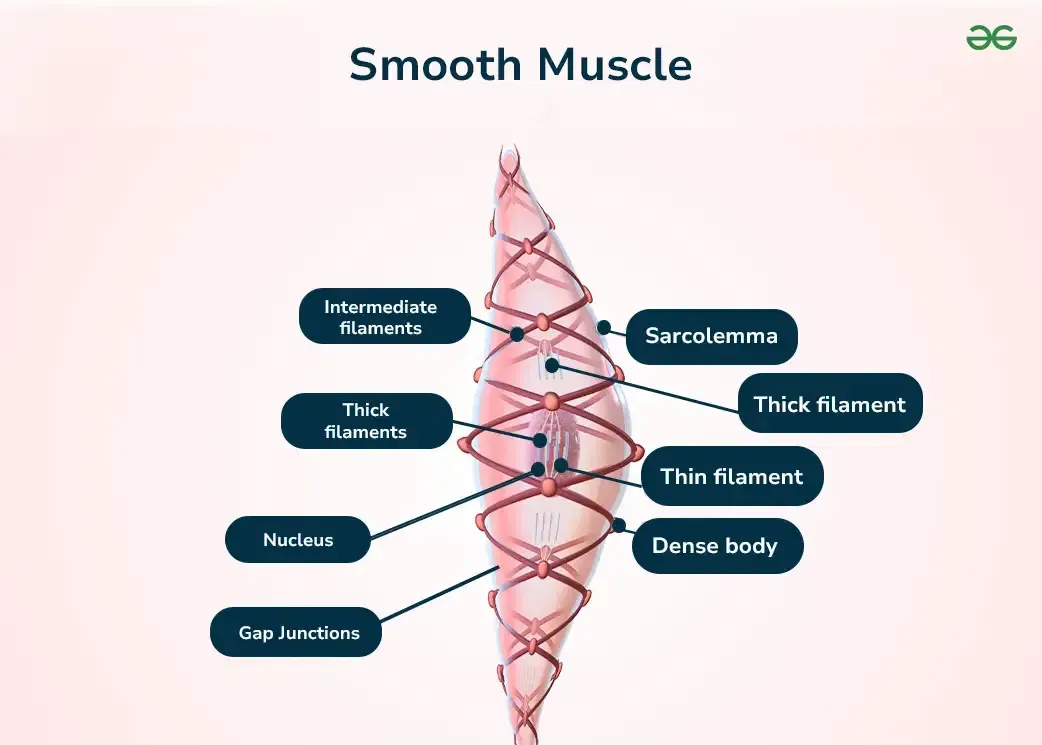
Functions of Smooth muscles are given below:
- Smooth muscles are found in the walls of internal organs, such as the stomach, intestines, and blood vessels.
- Smooth muscles are involuntary and operate without conscious control. They perform tasks regulated only by internal nervous signalling and not external stimuli.
- They have essential roles in digestion, like swallowing, blood vessel constriction, and other internal organ movements.
3. Cardiac Muscles
Cardiac muscles are involuntary muscles. The cells of the cardiovascular muscles, also known as cardiomyocytes, are striated.
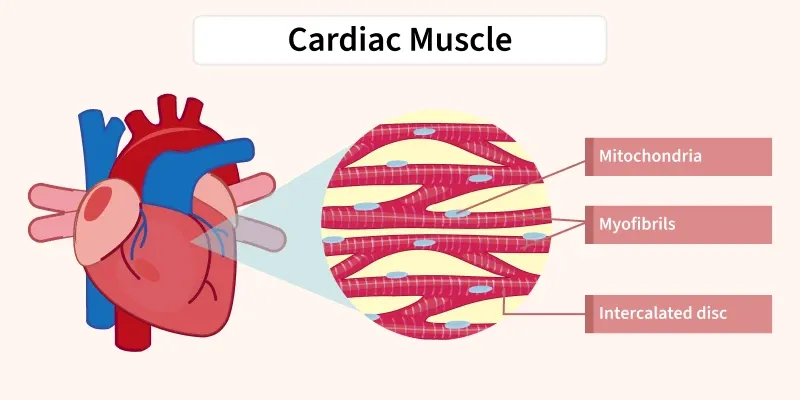
The functions of cardiac muscles are given below:
- Cardiac muscles are found only in the heart.
- They can be identified by the branched appearance of their fibres, striated and uninucleated fibres.
- These muscles are unique as they possess striations like skeletal muscles but work involuntarily like smooth muscles.
- They maintain the rhythmic pumping of blood throughout the circulatory system.
**Also Read: Difference Between Cardiac Muscle And Skeletal Muscle
Functions of the Muscular System
The muscular system contributes to almost all physiological activities. The most essential functions of the muscular system are:
- **Movement: The muscular system enables movement as skeletal muscles contract and relax under conscious control to produce multiple movements. These movements range from fine motor skills like writing to powerful contractions involved in weightlifting.
- **Maintaining Posture and Stability: All body muscles work together to maintain posture and stability. They support the skeleton, prevent the body from collapsing under weight, and help move the bones to different positions for everyday activities like sitting, walking, running, or eating.
- **Temperature Regulation: As muscles work, they generate heat, especially during exercise or exposure to cold environments. Muscles produce extra heat to keep the body warm by shivering or burning fat.
- **Protecting Internal Organs: Smooth muscles within the walls of organs serve as a layer of insulation for the internal organs, protecting them from damage and shock. These muscles also work involuntarily to achieve functions like digestion, excretion, respiration, etc.
- **Maintain Heartbeat and Blood Flow: Cardiac muscles work involuntarily to pump blood to all regions of the body, which is necessary for survival.
Diseases of the Muscular System
The muscular system is susceptible to injury and diseases like any other body organ system. The common diseases of the muscular system are:
- **Muscle Strains and Sprains: Overuse or improper use of muscles can lead to strains or sprains. Common injuries, like stretching or tearing muscle fibres or ligaments, cause pain and limited motion.
- **Tendonitis: A strain in the tendons that attach muscles to the bone can also cause pain and discomfort.