Animal Husbandry (original) (raw)
Last Updated : 27 Apr, 2026
Animal husbandry is the practice of raising animals and selective breeding. It is the science of animal management and care, in which animal genetic features and behaviour are developed for human profit. For many farmers, animal husbandry is their principal source of income. Because animals provide us with a range of high-nutritional food products, they require specific care and attention.
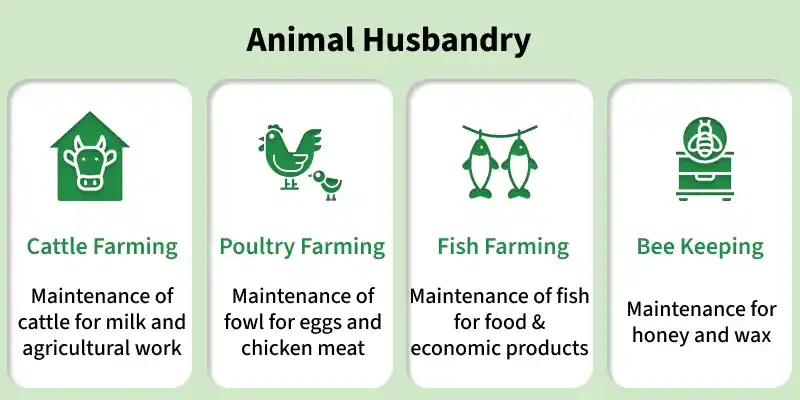
Commercial animal breeding is carried out to address rising food demand. Animal dairy products, high in protein, such as those from cows, buffaloes, and goats. Animals that produce milk are referred to as milch animals. Furthermore, we have alternative nutrient sources in the form of aquatic species. Seafood has a lot of nutrients. They are high in a range of nutrients, including fat, protein, vitamins, and minerals.
The animal husbandry department oversees animal care, breeding, and administration, among other things. The animals are born, raised, and housed on a farm or in a special area set aside for them. Poultry, dairy farms, apiculture, and aquaculture are all examples of animal husbandry.
Types of Animal Husbandry
1. Cattle Farming
Cattle farming, also referred to as livestock farming, involves the rearing and management of cattle. The cattle involved in this practice are primarily cows and buffalo. These animals are raised with great care given to their health and nutrition. The ultimate goal is to optimise milk production and utilise their strength for agricultural labour.
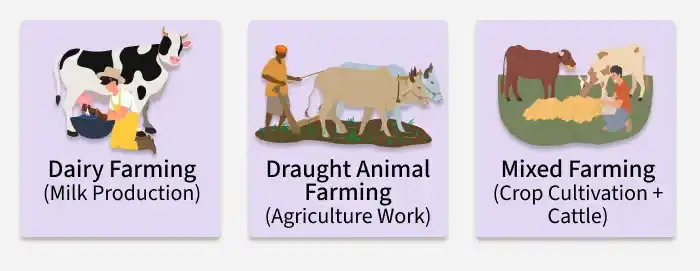
Features of Cattle Farming are given below:
- **Purposes of Cattle Farming: Milk Production (Milch animals, predominantly cows, are bred for milk production) and Draught Labour (Draught animals, including both cows and buffaloes, are utilised to perform tasks which require physical strength).
- **Cattle species in India: Bos indicus (cows) and Bos bubalis (buffaloes).
- **Cattle Breeds for Milk Production: Exotic Breeds (Like Jersey, Brown Swiss that are selected for long lactation) and Indigenous Breeds(Like Red Sindhi, Sahiwal show excellent resistance to diseases).
- **Cattle Farm Management: Shelter, Nutrition, and Healthcare are the most important components of cattle farm management.
- **Cattle Feed: Roughage (High-fibre feed sources such as hay, silage and grazing pasture provide essential nutrients and promote rumen function), Concentrates (which are low in fibre and contain relatively high levels of proteins and other nutrients), and Micronutrients (Feed additives containing essential micronutrients like vitamins, minerals, and amino acids).
- **Cattle Diseases: Parasitic infection, Infectious Diseases, and Vaccination.
2. Poultry Farming
The raising and breeding of domesticated birds for their meat and eggs, such as chickens, geese, ducks, turkeys, and some species of pigeons, is known as poultry. From small to huge scales, anything is possible.
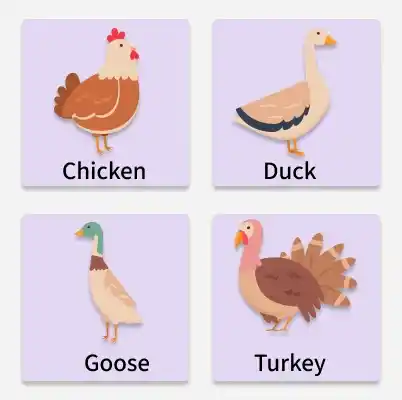
Features of Poultry Farming are given below:
- **Purposes of Poultry Farming: Egg Production and Meat Production.
- **Poultry Breeds: Exotic Breeds( Breeds selected for high egg-laying capacity and fast growth), Indigenous Breeds( Local breeds that show better disease resistance and adaptability), and Improved Breeds( Developed by cross-breeding indigenous and exotic breeds to combine high productivity with disease resistance).
- **Poultry Farm Management: Housing, Nutrition and Healthcare.
- **Poultry Feed: Energy-rich feed, Protein-rich Feed, and Minerals.
- **Poultry Diseases: Bacterial, Viral and Parasitic Infections.
3. Fish production
Fish farming is the practice of commercially growing fish in regulated tanks or ponds. Fish and fish protein are becoming increasingly popular. Fish farms raise salmon, catfish, cod, and tilapia, among other things.
- **Capture Fishery: When fish are captured from their natural sources, it is called a capture fishery.
- **Culture Fishery: When fish are cultivated in man-made water bodies (marine as well as freshwater)
- **Inland Fishery: When fish are cultivated in inland freshwater bodies like lakes, ponds, rivers, and water tanks are called inland fisheries.
- **Freshwater Fishery: When fish are cultivated exclusively in freshwater, it is called a freshwater fishery.
- **Marine Fishery: When fish are cultivated from marine water bodies like the sea or the ocean, it is called marine fishery.
- **Pisciculture: When only commercially important animals like tuna, salmon, etc. are specifically cultivated in fish farms, it is called culture fishery.
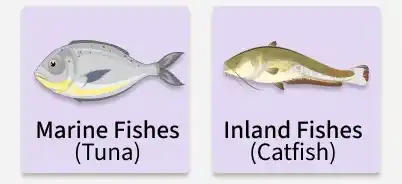
**Marine Fisheries
Some of the most common and important
Marine water species of fish are: Bombay duck (Harpodon sp), Mackerel (Rastrelliger), Eel (Anguilla sp.), Flying Fish (Exocoetus sp.), Hilsa (Hilsa sp.), Ribbon Fish (Trichiurus sp.), Pomfret (Stromateus sp.), Tuna (Thunnus sp.), Salmon (Aluitheronema sp.), Seer Fish (Scomberomorus sp.), and Sardine (Sardinella sp.).
**Inland Fisheries
Some of the most common and important freshwater species of fish are: Rohu (Labeo rohita), Mangur (Clarias batrachus), Calbasu (L. calbasu), Singhi (Heteropneustes fossilis), Catla (Catla catla), Malli (Wallago attu), Singhara (Mystus seenghala), and Mirgala (Cirrhinus mrigala).
4. Bee Keeping
Apiculture refers to the practice of raising honey bees. As a result, it requires caring for and managing honey bees to produce honey and wax. Honey has incredible medicinal properties and can aid in the treatment of ulcers, blood sugar management, digestive disorders, coughs, and sore throats. Apiculture provides a safe environment for bees to work and live. Bees are necessary for us as well since they pollinate our food sources.
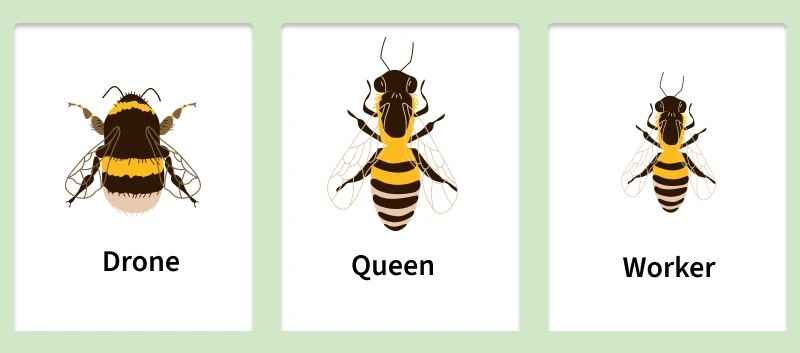
Honeybee Varieties Used for Bee Keeping
The scientific name of the honey bee is Apis indica. In India, both indigenous and exotic varieties of honeybees are used for the commercial production of honey.
- **Indigenous Varieties of Honeybees: Apis cerana indica F. (Indian bee), Apis dorsata F. (Rock bee), and Apis floraeF. (Little bee).
- **Exotic Varieties of Honeybees: Apis mellifera (European or Italian bee) and Apis adamsoni (South African bee).
Roles of Animal Husbandry in Human Welfare
Animal husbandry is used in various ways in the day-to-day life of humans in the following ways:
- **Dairy Products: Milk and milk products such as butter, cheese, yoghurt, and cottage cheese are primarily produced by dairy animals such as cows, sheep, and goats.
- **Meat: Because of their great nutritional content, several animals such as chickens, goats, ducks, pigs, and buffalo are utilised for meat.
- **Land Management: The dry shrubs that are prone to fire are chewed up by numerous animals, which helps to restrict the spread of weeds on agricultural land. That decreases the risk and injury that can occur in extreme circumstances.
- **Fibre: Wool and leather are fibre by-products from sheep and camels, respectively. When these animals are raised in large numbers, the products are readily available.
- **Manure: Animal husbandry is also important since the excreta, bones, and blood of animals can be composted and utilised as manure or fertilisers. These can be strewn throughout fields to boost agricultural yield.
- **Labour: Animals are useful for ploughing fields, performing military duties, and moving products from one location to another.
Advantages of Animal Husbandry
Animal husbandry is used by humans in day-to-day life. Animal Husbandry gives so many advantages, which are:
- Animal Husbandry helps the animal by getting proper food, shelter, and protection from diseases.
- Animal husbandry employs so many people.
- Animal husbandry helps in the proper disposal of animal waste and keeps the environment clean.
- Animal husbandry also helps in making a better breed of an animal via animal breeding.