Diagram of Nephron (original) (raw)
Last Updated : 21 Aug, 2025
The nephron is the key functional unit of the kidney, responsible for filtering blood, removing waste, and maintaining fluid balance. This article explores the structure and function of the nephron, with a focus on its key components: the glomerulus, Bowman’s capsule, proximal and distal tubules, and the loop of Henle.
The accompanying diagram will provide a clear visual representation, helping to simplify the complex processes of filtration, reabsorption, and secretion. This overview seeks to deepen your knowledge of the nephron’s essential role in maintaining the body’s overall health.
Nephron Definition
The nephron is the kidney's functional unit, responsible for producing urine by removing waste and excess substances from the blood.
What is a Nephron?
The word ****"nephron"** comes from the Greek word **nephros, which means "kidney". Each human kidney contains approximately one million nephrons, which work together to regulate fluid balance, remove waste, and maintain electrolyte levels, ensuring the body’s overall homeostasis.
A nephron is the essential structural and functional unit of the kidney, responsible for filtering blood and producing urine. They are the tiny structures consisting of a renal corpuscle and a renal tubule, which play a key role in the filtration and processing of blood to form urine. These units are known as nephrons.
**Also Read; Anatomy of Kidney - Regulation of Kidney Function
**Do You Know ?
A unique fact about nephrons is that they have the remarkable ability to filter and process about **180 liters of blood every day, yet only about **1 to 2 liters of urine are produced, thanks to the highly efficient reabsorption process in the renal tubules.
Structure of Nephron
The nephron, a key functional unit of the kidney, is responsible for filtering blood and producing urine.
Its length ranges from **35 to 55 mm and consists of two main parts: **the renal corpuscle and **the renal tubule.
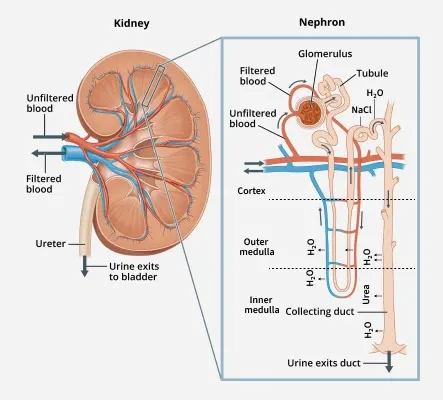
Structure of Nephron
The renal corpuscle includes the Bowman's capsule, a cup-shaped structure that surrounds the glomerulus, a cluster of tiny blood vessels.
The renal tubule extends from the renal corpuscle and plays a important role in reabsorbing water and essential nutrients while eliminating waste products. Together, these structures efficiently maintain the body's fluid and electrolyte balance.
Renal Tubule
- The renal tubule is a long, coiled structure that follows the renal corpuscle in each nephron.
- It plays a important role in filtering blood and processing waste into urine. The renal tubule is responsible for reabsorbing useful substances and secreting waste products.
- The Proximal Convoluted Tubule (PCT) is the first segment of the renal tubule where the majority of water, glucose, and other essential nutrients are reabsorbed.
- The Loop of Henle is a U-shaped section of the renal tubule that helps conserve water and salts, playing a crucial role in concentrating urine.
- The Distal Convoluted Tubule (DCT) plays a role in further regulating electrolyte balance and pH by secreting ions and absorbing additional water.
Renal Corpuscle
The renal corpuscle is the initial part of the nephron, responsible for the filtration of blood. It consists of two main structures: the **Bowman's capsule and the glomerulus. This is where the process of blood filtration begins, separating waste and excess substances from the bloodstream.
- The Bowman's capsule is a double-walled, cup-like structure that surrounds the glomerulus.
**The Bowman's capsule consists of three distinct layers:
- **Outer Parietal Layer: This layer is composed of epithelial cells with tiny pores, approximately **12nm in diameter.
- **Middle Basement Membrane: A selectively permeable layer that regulates the passage of substances.
- **Inner Visceral Layer: Made up of large nucleated cells known as podocytes, which have finger-like projections called pedicels.
- The glomerulus is a network of tiny capillaries that filters blood, allowing small molecules to pass through while retaining larger ones like proteins and blood cells.
- The renal corpuscle filters blood to form a filtrate, which will be further processed in the renal tubules.
Functions of Nephron
The diagram of nephron shows the structure clearly. Now, let's discuss the functions of nephron:
- **Filtration: Filters blood plasma, allowing small molecules like proteins and waste products into renal tubules while retaining larger molecules in the bloodstream.
- **Reabsorption: Reabsorbs water, glucose, amino acids, and ions back into the bloodstream, ensuring their retention.
- **Secretion: Excretes waste products and excess ions into renal tubules for urine excretion, maintaining electrolyte balance and pH.
- **Concentration and Dilution: Helps in urine concentration or dilution to regulate water balance and osmolarity.
- **Blood Pressure Regulation: Modulates water and ion reabsorption to regulate blood volume and blood pressure.
- **Acid-Base Balance: Regulates pH by selectively secreting hydrogen ions and reabsorbing bicarbonate ions.
- **Hormone Production: Produces hormones like renin and erythropoietin for blood pressure and red blood cell regulation.
- **Gluconeogenesis: Produces glucose from precursors during fasting or low carbohydrate intake, aiding in blood glucose maintenance.
**Also Read, Urine Formation
Conclusion - Diagram of Nephron
A nephron is the fundamental structural and functional unit of the kidney. It is a microscopic structure consisting of a renal corpuscle and a renal tubule, which work together to filter blood and produce urine. The nephron plays a critical role in maintaining the body's fluid and electrolyte balance, as well as removing waste products. Each kidney contains millions of nephrons, ensuring efficient waste filtration and regulation of vital functions.