Alternation of Generations (original) (raw)
Last Updated : 9 May, 2026
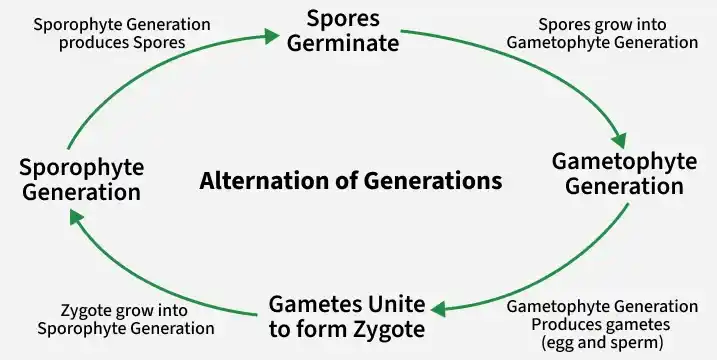
Alternation of generations is a type of life cycle found in plants and some algae in which two different multicellular stages occur one after another.The two types of generation that take place are known as sporophyte generation and gametophyte generation. Sporophyte generation is a stage that generates haploid spores by the process of mitosis, whereas in gametophyte generation, the gametes are produced in the plants. This type of life cycle is observed in algae, plants, and fungi.
Types of Stages in Alternation of Generation
There are two types of stages in alternation of generation, which are mentioned below:
1. Sporophyte Generation
A diploid zygote is formed when two haploid gametes fuse, which results in the formation of a sporophyte. In the sporophyte generation, multiple rounds of mitosis are needed to produce an organism that will be multicellular. After reaching the maturity phase, the reproductive organisms are formed, which are said to be sporangia. Further, these sporangia are used in the creation of haploid spores. At last, these spores are dispersed and carried away by water and air to form a gametophyte.
2. Gametophyte Generation
After the sporophyte, this is the next generation in the alternation of generations. In this, the spore is newly formed, which consists of only half of the DNA of the parent organism, which undergoes mitosis numerous times to form a gametophyte. These types of gametes are formed by gametangia. Whenever these gametes come in contact with the opposite sex, they together produce a zygote, which forms into a sporophyte. They are generally found in ferns.
Life Cycle of Alternation of Generation
These are some of the stages that occur during the alternation of generation, which are mentioned below:

- A diploid sporophyte consists of a structure known as a sporangium.
- Meiosis takes place in the sporangium, which results in the formation of haploid spores.
- The spores evolve into gametophytes, which are haploid in nature.
- A gametophyte consists of reproductive organs that undergo mitosis to give rise to haploid gametes.
- The gamete fertilises, then it forms a haploid zygote.
Types of Alternation of Generation
In plants, alternation of generations means the life cycle of plants in which the number of generations of plants can be distinguished between haploid and diploid organisms.
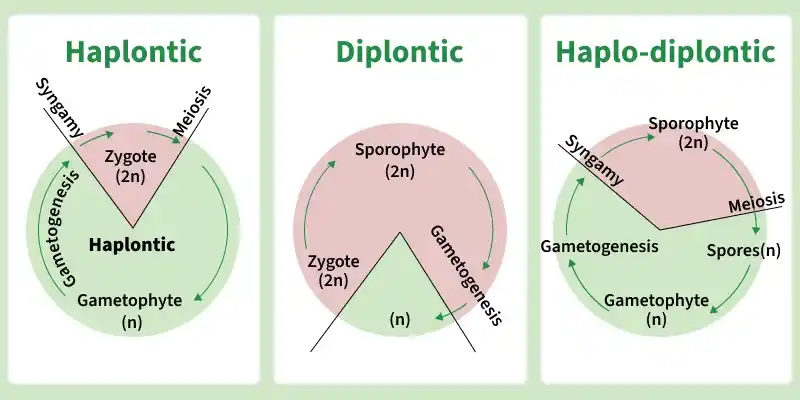
The life cycle in living organisms has been categorised into three different types, which are mentioned below:
- **Haplontic: Haploid cells are the independent stages that give rise to new individuals. The life cycle of organisms that are dominated by the haplontic stage is known as the Haplontic life cycle. For example, in algae, a haplontic type of life cycle is shown.
- **Diplontic: In the diplontic life cycle, the diploid zygotes, which are formed through the fertilisation of gametes, are independent, and when they are divided mitotically, they give rise to new plants. Example- Gymnosperms and angiosperms.
- **Haplo-diplontic: This is a type of life cycle where the sporophyte and gametophyte are multicellular. For example, Bryophytes are gametophytes, whereas Pteridophytes are sporophytes.
Flowering Plants Life Cycle Events
Flowering plants undergo different types of life cycle events, which are discussed below:
- **Germination: It is the first process in the plant's life cycle. The plant begins to grow from a seed, where the roots begin to grow under the soil from that seedling, and after some time, the stem and leaves form above the soil.
- **Pollination****:** It is a process in which pollen is carried away from one flower to another flower by insects or wind.
- **Fertilisation: Fertilisation is a process in which the pollen goes to the ovary of the flower, where the fusion of male and female gametes takes place.
- **Dispersal: Seeds are dispersed by animals and wind. New plants are formed from some of these seeds.