Population Ecology (original) (raw)
Last Updated : 2 Dec, 2025
Population ecology is a more specific field of study of how and why the populations of those organisms transform over time. The population can be open or closed. Population ecology has its most profound historical roots and development in the study of population growth, regulation, dynamics, or demography.
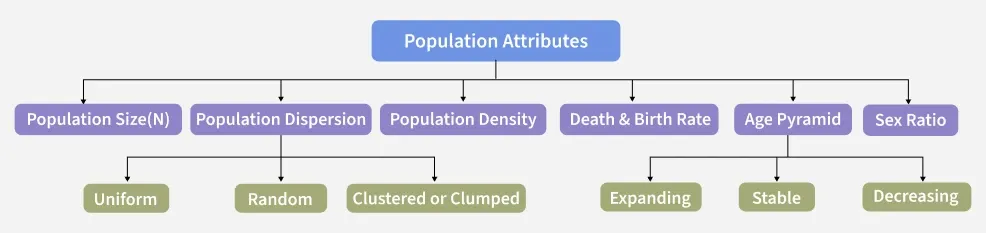
**Population Attributes
Ecologists use diverse terms while understanding and examining populations of organisms. A population is all of one sort of species living in a particular location. Population attributes are given below:
**1. Population size (N)
Refers to the total number of individual organisms in a population. The bigger a population is, the greater its genetic variation and thus its potential for long-term survival. Increased population size can, however, lead to further issues, such as overuse of resources, leading to a population crash.
**2. Population Density
Refers to the number of individual organisms in a particular area. A low-density region would have more organisms spread out. High-density regions would have more individuals residing closer together, leading to greater resource competition. Population size per unit area is known as Population Density.
Population Density=\frac{Area or Volume of habitat}{Total number of individuals}
**3. Population Dispersion
Hauls helpful information regarding how species interact with each other. Researchers can discover more about populations by studying how they are distributed or dispersed.
Population distribution describes how individual organisms of a species are spread out, whether they live close or far apart or massed into groups.
| Population Distributions | Description | Examples |
|---|---|---|
| 1. **Uniform dispersion | Individuals are evenly spaced throughout the habitat | Penguins nesting at equal distances, Animals with territorial boundaries |
| 2. **Random dispersion | Individuals are distributed without a predictable pattern | Wildflowers spread by wind, Forest trees growing by chance |
| 3. **Clustered or clumped dispersion | Individuals live in groups or clusters | Fish in schools, Elephants in herds, Bees in colonies |
4. Age Pyramids
Individuals of various ages make up a population at any given moment. When the percentage of individuals of a certain age or age group is graphed for the population, it produces an age pyramid.
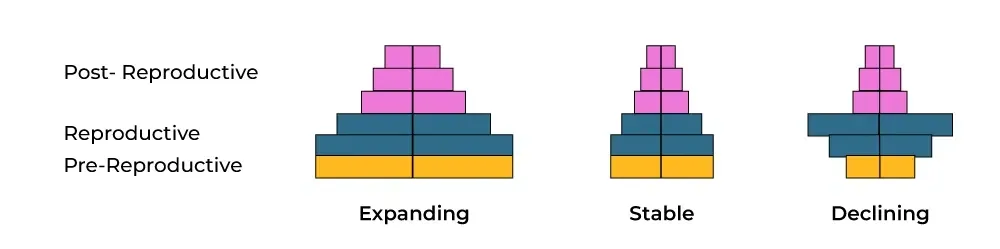
The shape of the pyramids is an indicator of the population's growth status, which can be
- **Expanding: It hasa broad base and a narrow top and shows a high birth rate and a high death rate.
- **Stable: Itsbase and middle portions are almost equal in width and indicating balanced birth and death rates.
- **Decreasing: It has a narrow base and a wider middle/top and indicates a low birth rate and low death rate.
**5. Death and Birth Rate
The population has death and birth rates-
- TheDeath Rate is the number of people per thousand who die in a particular area during a particular period of time.
- Birth Ratein a place is the number of babies born there for every 1000 people during a particular period of time.
**6. Sex Ratio
The population has a sex ratio. The sex ratio is the number of females per 1000 males. It compares the number of females and males in a population group.
Population Growth
The population of a particular species is not always constant; it changes over time. These changes are affected by numerous factors, including the accessibility of food, the existence of predators, and unfavourable weather conditions. These changes indicate whether the population is increasing or decreasing.
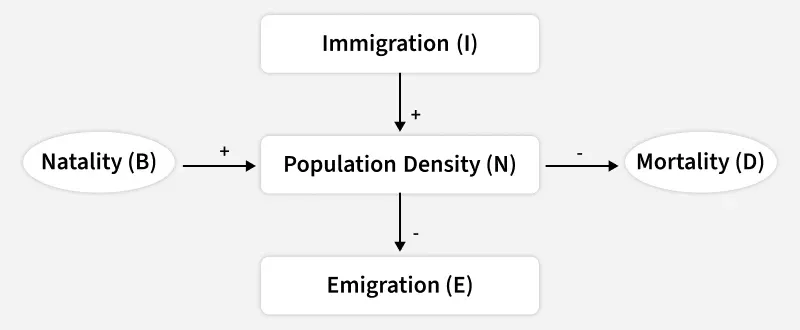
Four processes affect the density of a population in a given habitat:
- **Natality (B): Refers to the number of live births in a specific population during a certain period of time.
- **Mortality (D): Refers to the number of deaths in a specific population during a certain period of time.
- **Immigration (I): The number of individuals of the same species that have come into the habitat from elsewhere during the time period under consideration.
- **Emigration (E): The number of individuals of the population who left the habitat and went elsewhere during the time period under consideration.
Population Growth Model
These are used to analyse and predict the growth of organisms, populations, and biological systems over time. Helps to understand the dynamics of growth, the underlying factors that drive it, and how it changes over time. The two growth models explained here are:

1. Exponential Growth (J-shaped Curve)
- There are no limiting factors, and resources are unlimited.
- The size of the population increases at a rate that is proportional to the current size of the population, leading to a steady increase in population size over time. Graphically, represented as 'J' shaped.
- If in a population of size N, the birth rates are represented as b and the death rates as d, then the increase or decrease in N during a unit time period t (dN/dt) will be
dN/dt = (b – d) × N
- Let (b–d) = r, then dN/dt = rN
- The r in this equation is called the ‘**intrinsic rate of natural increase’; it assesses the impact of biotic and abiotic factors on population growth.
**2. Logistics Growth Models
- The population in an area having limited resources(called as nature's carrying capacity****)** initially exhibits a lag phase, followed by phases of acceleration and deceleration. Finally, when the population density attains the carrying capacity, it reaches an asymptote.
- Defines the concept of 'survival of the fittest'.
- Graphically, represented as a sigmoid curve.
- This type of population growth is called Verhulst-Pearl Logistic Growth****.** Described by the following equation:
dN/dt = rN{K-N}/K
- N = Population density at time t
- r = Intrinsic rate of natural increase
- K = Carrying capacity
**Effects of Population Size
- Genetic variation is more easily supported in large populations than in small ones.
- Random genetic drift can cause a genetic characteristic to be lost in a small population. Many people have at least two forms of a gene. A specific phenotype will be produced if an individual acquires any of the alleles.
- If populations stay small for a long time, they might lose everything except one type of gene.
- Minimising the loss of genetic variation in small populations is one of the major issues faced by biologists.
- Natural selection constantly sorts out the genetic variation found within each population and chooses the most appropriate ones for the current environment.