Food Chains and Food Webs (original) (raw)
Last Updated : 31 Mar, 2026
Living organisms in an ecosystem are interdependent for food and energy. This transfer of energy from one organism to another takes place through food chains and food webs. They explain how energy flows within an ecosystem and how different organisms are connected. The food chain is a linear representation of organisms along the trophic level, while the food web is a multiple interconnected food chains.
The food chain and food web help us understand the interactions among the species and the way they are interdependent. Overall, it gives an impression of the workings of the ecosystem and the balance it maintains within.
Food Chain
A food chain represents the flow of energy and nutrients among different organisms in an ecosystem. It tells us how energy and nutrients are transferred from one trophic level to another and how the organisms interact in an ecosystem.
In a food chain, each organism represents a particular trophic level according to its food behaviour.
- **Producers are living organisms that produce their own food by utilising solar energy through the photosynthesis process. For example, plants, algae, etc.
- **Consumers are living organisms that cannot produce their own food and obtain energy by consuming other organisms. For example, lions, tigers, wolves, foxes, etc.
- **Decomposers are the organisms that break down dead organic matter and recycle nutrients back into the ecosystem. They are present at the last stage of the food chain, which breaks down waste and remains from all other trophic levels. For example, bacteria and fungi.
Types of Food Chain
Food chains are of two types on the basis of the primary energy source: Detritus and Grazing Food Chain.
1. Grazing Food Chain
The primary energy source of the food chain is the green plants or producers. These plants utilise sunlight and convert it into chemical energy through photosynthesis. Herbivores feed on these plants for energy. The energy then flows through the food chain as carnivores (animals that eat other animals) consume herbivores, and so on. The food chain starts with producers and moves up through various trophic levels.
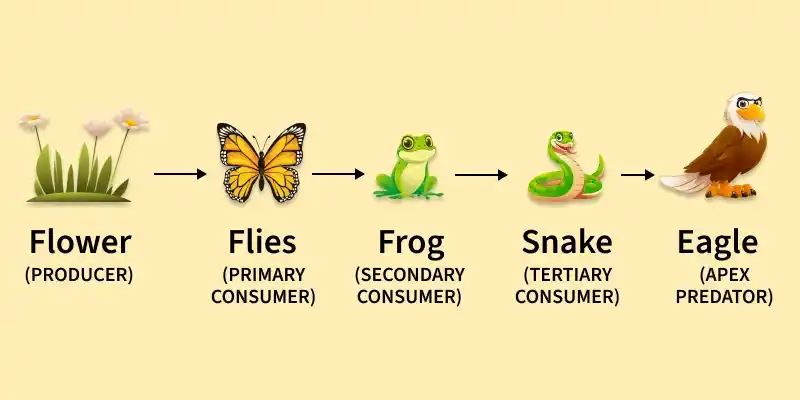
- The food chain starts with the producers or autotrophs. They use energy from sunlight to synthesise their own food through the process of photosynthesis.
- The second link in the food chain is the consumers****.** They get their energy from the food they eat. The primary consumers, or herbivores such as rabbits or insects, eat plants.
- The next layer in the food chain comprises animals that eat other animals. The first group consists of carnivores, such as snakes, that eat herbivores. The other group comprises omnivores, who eat both plants and other animals. Usually, there are several levels, such as secondary consumers, tertiary consumers, and quaternary consumers, that all occupy this sector. Apex predators are the consumers at the top of the food chain.
- The last step of a chain is the decomposers, such as fungi, that use the remains of organisms to grow.
2. Detritus Food Chain
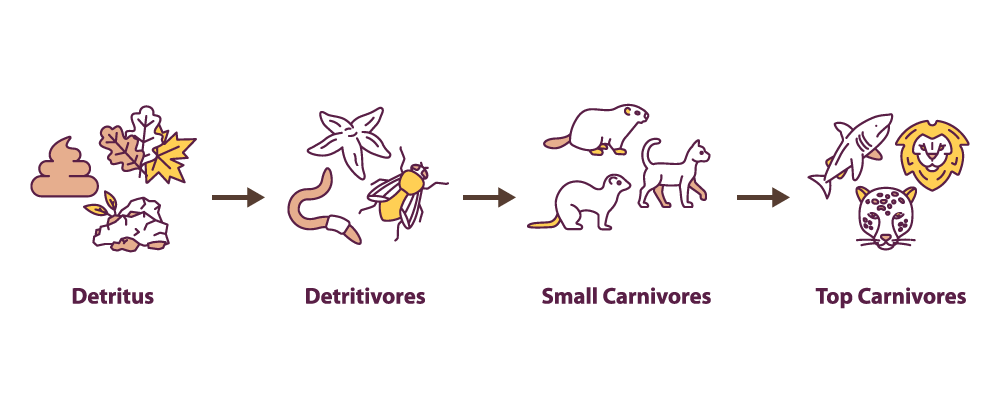
This food chain starts with dead organic material. The Detritus food chain starts with decomposers like bacteria, algae, fungi, etc, which decompose the organic material like the detritus of plants, and dead animals. Decomposers are then consumed by detritivores, which are organisms that feed on decomposed organic matter.
As detritivores are eaten by predators or scavengers, the energy derived from the detritus is transferred through the food chain. Detritus food chains play an important role in recycling nutrients and breaking down organic material.
Food Web
The food web represents multiple interconnected food chains and the complex relationships between producers, consumers, and decomposers. Organisms are arranged into different trophic levels, with producers at the base, followed by primary, secondary, and tertiary consumers. All the organisms, including predators, prey, and scavengers, interact within this food web, which influences the population dynamics.
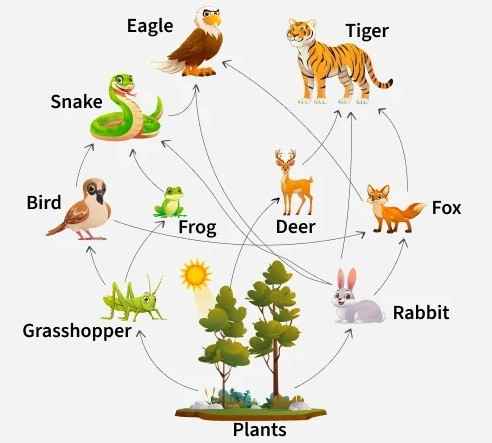
Decomposers break down dead matter, recycling nutrients back into the ecosystem. Each level in the food web depends on the lower level for energy and nutrients. A change in one trophic level impacts the other trophic levels or the whole food web. It shows the dependency of one trophic level on another and the importance of biodiversity.
10 Per cent Energy Rule
Producers can utilise only **1% of the sunlight through photosynthesis to prepare their food. The energy is lost in the form of heat to the environment and in metabolism when plants are eaten by the next trophic level. This rule highlights the efficiency of energy transfer and the challenges of supporting higher trophic levels in ecosystems.
The 10 per cent energy rule states that of the energy available at one trophic level, only about 10 per cent of the energy is transferred to the next trophic level. Because of this 10% energy rule, the food chain can be sustained only up to 4-5 trophic levels.
Difference between the Food Chain and Food Web
| **Food Chain | **Food Web |
|---|---|
| It represents a linear sequence of organisms where each feeds on the one below. | It represents the complex interconnection of multiple food chains within an ecosystem. |
| Single direction of energy flow | An interconnected food chain represents multiple pathways. |
| Includes a few trophic levels. | Includes multiple trophic levels. |
| Represents one feeding relationship. | Represents multiple feeding relationships. |
| Energy flows in a single direction through levels. | Energy flows inone direction, but through multiple pathways |
| Grass → Rabbit → Fox; Phytoplankton → Zooplankton → Fish | Plants → Herbivores → Carnivores → Decomposers → Multiple species interactions |
| Helpful for understanding energy flow in a simplified manner. | Essential for studying ecosystem stability, species relationships, etc. |
Importance of Food Chain and Food Web
Food chains and food webs form the basic structure of an ecosystem and show the interactions between different species along with the flow of energy and nutrients. Their importance is as follows:
- They show the flow of energy from one trophic level to another and help in the transfer of nutrients within the ecosystem.
- They establish interdependence among organisms, which helps in maintaining ecological balance.
- They help us understand predator-prey relationships and regulate population size.
- Food webs show complex feeding relationships and help maintain ecosystem stability.
- They act as indicators of the health of an ecosystem.
- They support conservation efforts by identifying important species and vulnerable links in the ecosystem.