Protozoans (original) (raw)
Last Updated : 8 Jun, 2026
Protozoans are microscopic, single-celled eukaryotic organisms that belong to the Kingdom Protista. They are capable of performing all essential life processes within a single cell despite their simple organisation. Protozoans are widely distributed in aquatic and moist environments, where they may live freely or as parasites. They play important ecological roles and include several species of medical and biological significance.
Characteristics of Protozoans
Protozoans possess several distinctive characteristics that differentiate them from other groups of microorganisms.
- They are unicellular organisms, meaning that their entire body consists of a single cell. However, this single cell is highly specialised and capable of performing functions that, in multicellular organisms, are carried out by different tissues and organs.
- Protozoans are eukaryotic in nature and therefore contain a well-defined nucleus enclosed by a nuclear membrane.
- They also possess various membrane-bound organelles such as mitochondria, endoplasmic reticulum, Golgi apparatus, lysosomes, and vacuoles, which help in carrying out different cellular functions efficiently.
- The size of protozoans varies considerably among different species. While many species are microscopic and can only be observed under a microscope, some species are large enough to be seen with the naked eye.
- Their shapes are highly variable and may be spherical, oval, elongated, irregular, or highly specialised depending on the species and environmental conditions.
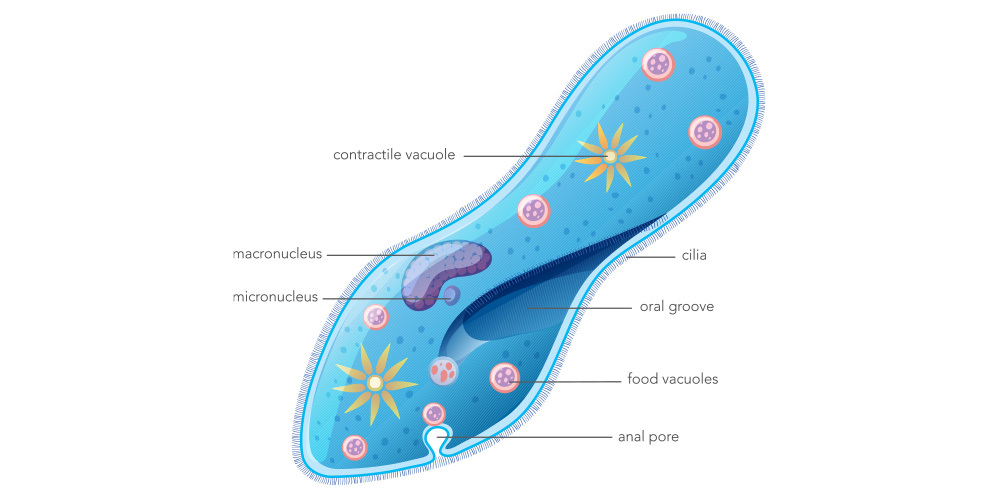
- Most protozoans contain a single nucleus, although some groups, such as ciliates, possess two different types of nuclei. These include a larger macronucleus, which controls everyday cellular activities and metabolism, and a smaller micronucleus, which is primarily involved in reproduction and genetic exchange.
- Movement is one of the most characteristic features of protozoans. Different groups have evolved specialised structures for locomotion. Some move by means of flagella, which are long whip-like appendages that propel the organism through water.
- Most protozoans are heterotrophic organisms, meaning that they cannot prepare their own food and depend on other organisms or organic matter for nutrition.
- Many species exhibit holozoic nutrition, in which food particles are engulfed and digested within food vacuoles.
- Some species are saprophytic and absorb dissolved nutrients from their surroundings, while others obtain nutrients by living as parasites within host organisms.
- Respiration in protozoans generally occurs through simple diffusion across the plasma membrane. Oxygen dissolved in water enters the cell by diffusion, while carbon dioxide produced during cellular respiration diffuses out of the cell.
- Excretion in protozoans is also carried out primarily through diffusion. Metabolic waste products such as ammonia are removed directly through the plasma membrane.
Habitat of Protozoans
- Protozoans inhabit a wide variety of ecological environments. The majority of species are aquatic and occur in freshwater ponds, lakes, rivers, and oceans.
- Many species thrive in moist soil, decomposing vegetation, and organic debris where environmental conditions remain favourable for growth and reproduction.
- Several protozoans have adapted to parasitic lifestyles and live within the tissues, blood, or digestive systems of animals and humans.
- Some species are capable of surviving extreme environmental conditions by forming resistant structures known as cysts.
- These cysts allow protozoans to withstand unfavourable conditions such as drought, temperature fluctuations, and nutrient scarcity until suitable conditions return.
Nutrition in Protozoans
- Protozoans exhibit a remarkable diversity of nutritional modes. Most species are heterotrophic and obtain nutrients by ingesting or absorbing organic matter.
- In holozoic nutrition, food particles such as bacteria, algae, and other microorganisms are engulfed by the cell through phagocytosis.
- Once inside the cell, the food is enclosed within a food vacuole where digestive enzymes break it down into simpler substances that can be absorbed and utilised by the organism.
- In ciliates such as Paramecium, food particles are directed into a specialised oral groove and then pass into a gullet, where food vacuoles are formed.
- Some protozoans absorb dissolved nutrients directly through their cell membrane, while parasitic forms obtain nourishment from the tissues and body fluids of their hosts.
Life Cycle of Protozoans
- The life cycle of many protozoans involves alternating stages that enable them to survive, reproduce, and spread effectively. Two common stages observed in numerous protozoan species are the trophozoite stage and the cyst stage.
- The trophozoite stage represents the active, feeding, growing, and reproducing phase of the organism.
- During this stage, protozoans obtain nutrients, carry out metabolism, and multiply rapidly under favourable environmental conditions.
- The cyst stage is a dormant and resistant phase that develops when environmental conditions become unfavourable.
- The cyst is protected by a thick wall that enables the organism to survive harsh conditions such as dehydration, lack of food, extreme temperatures, and exposure to chemicals.
- The cyst stage also facilitates transmission from one host to another in parasitic species. When favourable conditions return, the cyst undergoes excystation and releases an active trophozoite.
Reproduction in Protozoans
Protozoans reproduce by both asexual and sexual methods. Asexual reproduction is the most common mode and allows rapid population growth under favourable conditions.
- Binary fission is the simplest and most widespread method of asexual reproduction. During this process, the parent cell divides into two identical daughter cells.
- Depending on the species, division may occur longitudinally, transversely, or irregularly.
- Some protozoans reproduce through multiple fission, in which a single parent cell divides repeatedly to produce numerous offspring simultaneously.
- Budding may also occur in certain species.
- Sexual reproduction occurs in several protozoan groups and contributes to genetic variation. Different forms of sexual reproduction include conjugation, syngamy, and gamete formation.
- During conjugation, two organisms exchange genetic material without complete fusion. In syngamy, male and female gametes fuse to form a zygote, resulting in genetic recombination and increased diversity within populations.
Classification of Protozoans
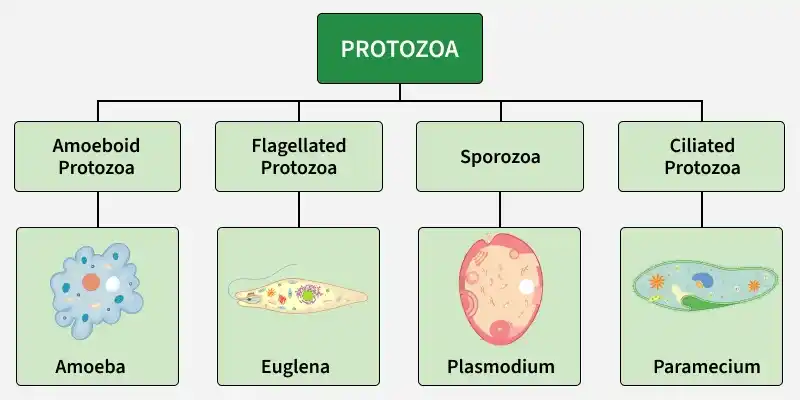
Protozoans are traditionally classified into four major groups based on their mode of locomotion and structural characteristics.
1. Flagellated Protozoans (Mastigophora)
- Flagellated protozoans possess one or more flagella that help them move actively through aquatic environments.
- They may be free-living or parasitic.
- Their body is generally covered by a pellicle that provides support and maintains shape.
- Freshwater species often possess contractile vacuoles for osmoregulation.
- Reproduction occurs primarily through longitudinal binary fission.
**Examples: _Trypanosoma, _Giardia, _Leishmania, and _Trichomonas.
2. Amoeboid Protozoans (Sarcodina)
- Amoeboid protozoans are characterised by the presence of pseudopodia, which are temporary cytoplasmic projections used for locomotion and food capture.
- These organisms are commonly found in freshwater, marine environments, and moist soil.
- They lack a definite shape because their body constantly changes form during movement and feeding.
- Freshwater species usually contain contractile vacuoles.
- Reproduction generally occurs through binary fission, and many species form cysts during unfavourable conditions.
**Examples: _Amoeba and _Entamoeba histolytica.
3. Sporozoans (Apicomplexa)
- Sporozoans are exclusively parasitic protozoans that live inside the bodies of their hosts.
- They lack specialised locomotory structures such as cilia, flagella, and pseudopodia.
- Their life cycles are often complex and involve multiple hosts.
- Reproduction produces infective spores or sporozoites that help spread the parasite.
**Examples: _Plasmodium, _Myxidium, and _Globidium.
4. Ciliates (Ciliophora)
- Ciliates are among the most highly organised protozoans. Their bodies are covered with numerous cilia that assist in locomotion, feeding, and sensory functions.
- They possess a definite shape maintained by a pellicle and generally contain both a macronucleus and a micronucleus. Food is swept into the oral groove by coordinated ciliary movements.
- Many species also possess trichocysts, which function in defence and prey capture.
- Reproduction occurs primarily through transverse binary fission, although sexual reproduction by conjugation is also common.
**Examples: _Paramecium, _Vorticella, and _Balantidium.
Diseases Caused by Protozoans in Humans
- Several protozoans are important human parasites and are responsible for causing serious diseases.
- These organisms invade different tissues and organs of the human body and may produce severe symptoms if left untreated.
- Malaria is caused by species of _Plasmodium and is transmitted through the bite of infected female _Anopheles mosquitoes.
- Amoebic dysentery is caused by _Entamoeba histolytica, which infects the large intestine and spreads through contaminated food and water.
- African sleeping sickness is caused by _Trypanosoma gambiense and is transmitted by the tsetse fly. Giardiasis is caused by _Giardia lamblia, while leishmaniasis is caused by species of _Leishmania.
- Protozoan diseases are transmitted through various routes, including contaminated food and water, direct contact, and insect vectors.
- Many intestinal protozoans spread through the faecal-oral route, whereas blood and tissue parasites are commonly transmitted by mosquitoes, flies, or other arthropods.