Slime Moulds (original) (raw)
Last Updated : 24 Feb, 2026
Slime moulds are simple, fascinating organisms that show characteristics of both plants and animals. They are commonly found in moist, shady places such as damp soil, rotting wood, decaying leaves, and forest floors. Although they were once grouped with fungi because of their spore-forming habit, slime moulds are now considered protists due to their unique structure and life cycle.
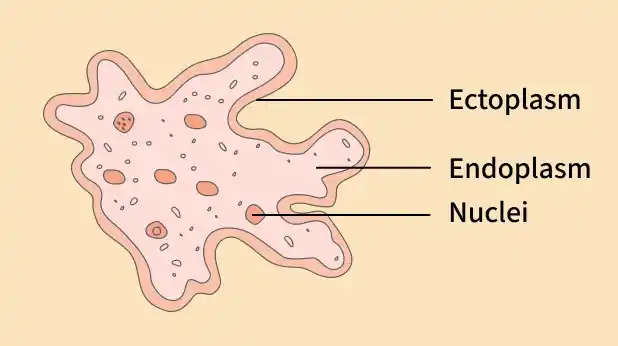
Characteristics of Slime Moulds
- The slime moulds are found creeping on debris, decaying on twigs or leaves, in soil, on tree canopies and mostly found on trees, on the forest floor, and in cold and dark conditions.
- The protoplast is not surrounded by a cell wall in the vegetative phase. They lack chlorophyll and are saprophytic; they feed on microorganisms such as bacteria, fungi and yeasts, and decompose dead organic matter.
- Few slime moulds are parasitic, and they are found in the roots of cabbage and other plants of the Brassicaceae family.
- The plasmodial stage is similar to that of protozoa, and fruiting bodies form spores similar to fungi. The cell wall of spores is made up of cellulose and is resistant to adverse conditions. They can survive for many years.
Types of Slime Moulds
There are two types of Slime Moulds given below:
- **Plasmodial Slime Moulds: Exist as a multinucleate mass called a plasmodium. The cell wall is absent during the vegetative stage. They move and feed by phagocytosis. Example: _Physarum
- **Cellular Slime Moulds: Exist as individual amoeboid cells. Under unfavourable conditions, cells aggregate to form a slug-like structure. Each cell retains its individuality. Example: _Dictyostelium
Reproduction of Slime Moulds
- The reproduction in slime moulds is of a primitive type.
- The nuclei present in the plasmodia contain two sets of chromosomes.
- When this organism is exposed to the sunlight, the plasmodium forms a short stalk with a minute mushroom-like cap.
- The nuclei in the stalks undergo meiosis and chromosomes are reshuffled, and the nuclei divide, forming spores that are haploid (i.e. just one set of chromosomes). These fruiting bodies are called sporangia.
- Forming these spore capsules is deadly for slime moulds, causing the end of the organism, but these spores are spread with the help of wind and germinate in damp places.
- The spores hatch into an amoeba and propagate by engulfing the bacteria around them. They further reproduce by dividing into two mitotically. The amoeba is actually gametes or a sex cell.
- Mostly, there are two types of gametes: one is big and immovable, and the other is small with flagella for movement. But in this case, slime moulds have similar types of gametes with the same size and shape, which is called isogamy.
- When two amoebae with compatible mating cells meet, their gametes merge and their nuclei fuse. After fusion, the nuclei go from haploid to diploid. After this process, the nucleus stops dividing, and the cell expands and forms a new plasmodium.
**Life Cycle of Slime Moulds
The life cycle of slime moulds shows both vegetative (feeding) and reproductive stages and is strongly influenced by environmental conditions such as moisture and food availability.
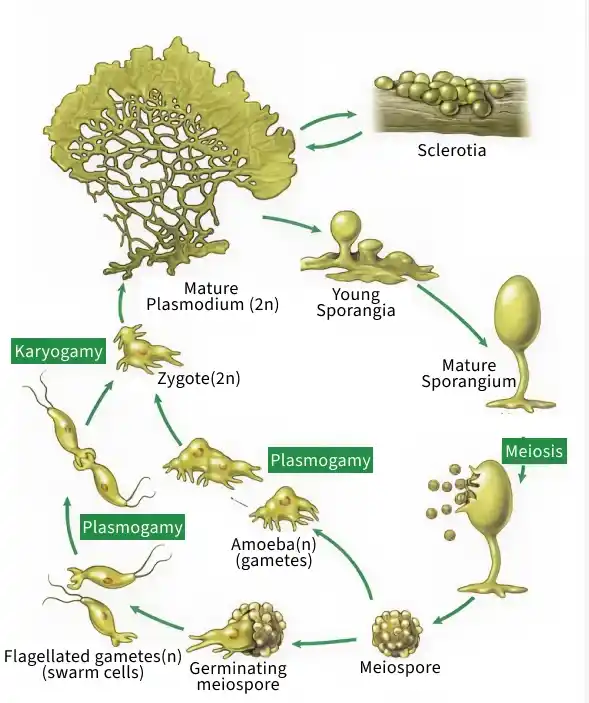
- Sporangia are present on the drying plasmodium, which forms the stalked fruiting bodies.
- Through meiosis, haploid spores are formed in sporangia by meiosis.
- A thick cell wall is present and is extremely resistant to adverse conditions. The spores germinate to form haploid cells under favourable conditions. These haploid cells act as a gamete.
- Depending on the availability of moisture, different cell kinds are developed. Such haploid gametes fuse to form a diploid zygote.
- As the plasmodium doesn’t undergo cytoplasmic division (cytokinesis), it develops the diploid zygote that undergoes multiple mitotic divisions, producing a multinucleated plasmodium.
Economic Importance of Slime Moulds
- Slime moulds are responsible for the decay and decomposition of the organic matter in the soil. This increases the nutrient level in the soil.
- The colour obtained from the slime moulds has artistic value.
- The plasmodium obtained from slime moulds is an excellent material for the study of the structure and physiology of protoplasm.