Pteridophytes (original) (raw)
Last Updated : 16 Feb, 2026
Pteridophytes are seedless vascular plants that occupy an important position in the plant kingdom between bryophytes and gymnosperms. They were the first plants to develop vascular tissues (xylem and phloem), allowing efficient transport of water and food. Pteridophytes mainly grow in moist and shady places, though some are aquatic or adapted to dry habitats.
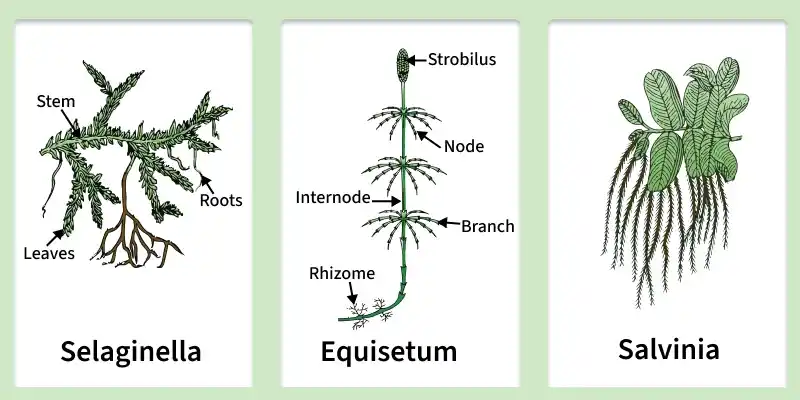
**Characteristics of Pteridophyta
The key characteristics of Pteridophyta are listed below:
- They are mostly grown as ornamentals.
- They are commonly used for medical purposes and can also be used as soil binders.
- The male sex organ is antheridia, and the female organ is archegonia.
- Spores can be Homospores or Heterospores; they are formed in sporangia.
- These pteridophyte plants possess both vascular tissues, xylem and phloem.
- In the phloem, sieve tubes and companion cells are absent, and in the xylem, true vessels are absent.
- They have well-differentiated structures such as leaves, stems, and roots, as well as a vascular system.
- They show true alteration of generation, as the saprophyte and the gametophyte generations are observed in pteridophytes.
- Typical examples are ferns, Marsilea, Pteris, etc. Ferns encompass all living pteridophytes, excluding lycopods, and are vascular, unlike mosses and other bryophytes.
**Classification of Pteridophyta
Based on different types of sporophytes with well-developed vascular tissues, the pteridophytes are classified into four types.
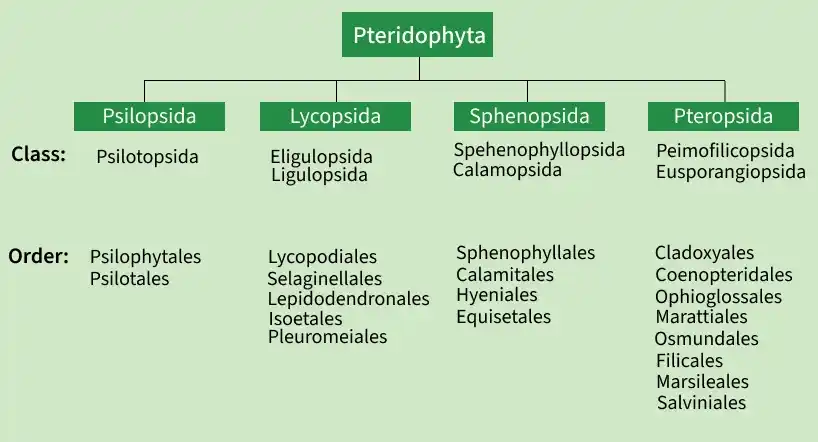
Pteridophytes are classified into four subdivisions:
**1. Psilopsida
- Includes living and fossil plants.
- The body organisation of plants is very simple.
- Members of this division are sporophytic.
- Plant bodies can be differentiated into a subterranean rhizome and an erect aerial portion.
- Roots are absent in these plants.
**2. Lycopsida
- Includes living and fossil plants.
- Members of this division are sporophytic.
- Plant bodies can be differentiated into roots, leaves, and stems.
- Plants have small and simple leaves with a single mid-vein.
- Leaf gaps are absent in these plants.
**3. Sphenopsida
- Includes both fossil and living plants.
- The plant body is sporophytic.
- Plant bodies can be differentiated into roots, leaves, and stems.
- The stem of the plant is divisible into nodes and internodes.
- The leaves of the plants are small, thin, and scaly brown.
- The embryo is without a suspensor.
**4. Pteropsida
- Includes plants that are commonly known as ferns.
- Some members of this subdivision have very small trees, while some have tall trees.
- Leaves may be simple or compound, but they are large in shape.
- An embryo may or may not have a suspensor.
- Vegetative reproduction can be done through fragmentation, stem tubers, adventitious buds, and apogamy.
**Life Cycle of Pteridophytes
In contrast to mosses and seed plants, Pteridophytes contain distinct and free-living generations of haploid gametophyte and diploid sporophyte, which have a life cycle comparable to that of seed-bearing plants.
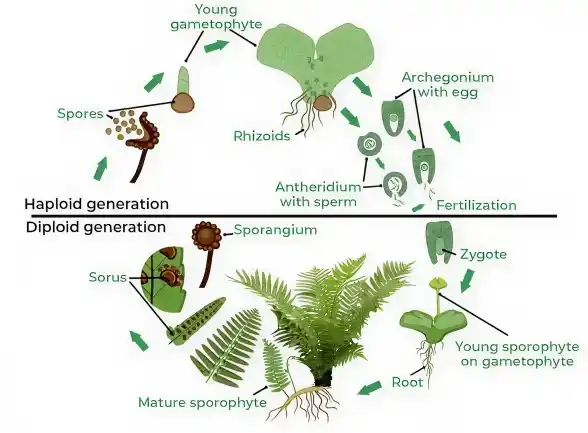
Here is a brief description of a Pteridophyta's life cycle (in the case of ferns):
- Since Pteridophytes do not produce seeds or flowers, they reproduce by spores.
- Spores are initially released into the atmosphere.
- Spores develop into haploid gametophytes with both male and female sex organs that are heart-shaped.
- As soon as the immature gametophyte grows, the sex organs become functional.
- In ferns, the male reproductive organ is called an antheridium, which produces sperm, while the female reproductive organ is called an archegonium, which has eggs.
- Water is necessary for the sperm to flow and fertilise the egg in the case of fern reproduction.
- Through the process of mitosis, a fertilised egg, or zygote, creates new roots, stems, and sporophytes (cell division).
**Similarities in the Sexual Reproduction of Ferns and Moss
- The mode of sexual reproduction is oogamous, as non-motile female gametes are fertilised with motile gametes.
- Female sex organs are flask-shaped with a tubular neck and a swollen basal venter.
- Requirement of external source water for sperm to reach archegonia.
- Shows the true alternation of generations.
**Dissimilarities in the Sexual Reproduction of Ferns and Moss
- Ferns have vascular tissues; moss doesn’t.
- Ferns are sporophyte-dominant, and mosses are gametophyte-dominant.
- Ferns have both male and female parts on the same plant; mosses have separate parts.
**Economic Importance of Pteridophyta
- They are grown as ornamental plants for their delicate and graceful leaves.
- Pteridophytes are grown as a soil-binding agent, as they bind the soil even along hill slopes.
- Equisetum stems have been used for metal polishing and scouring (cleaning of cutlery). Scouring rushes are another name for Equisetum species.
- Anabaena azollae, a cyanobacterium that fixes nitrogen, coexists symbiotically with the water fern Azolla. It is immunised against paddy fields that act as biological fertilisers.
- Pteridophytes serve as a valuable source of food for animals, just like other plants. A water fern called Marsilea produces starch in its sporocarps, which is consumed by the tribal peoples.
- Dryopteris rhizomes are used to make an anthelmintic medication (Male Shield Fern).