Sliding Filament Theory (original) (raw)
Last Updated : 13 Mar, 2026
The Sliding Filament Theory explains the mechanism of muscle contraction in skeletal muscles. According to this theory, muscles contract when thin actin filaments slide over thick myosin filaments, resulting in the shortening of muscle fibres. The filaments themselves do not change in length; instead, the degree of overlap between actin and myosin increases. This theory helps in understanding how muscles produce movement, maintain posture, and generate force in the human body.
Sacromere
A sarcomere is the fundamental unit of muscle contractionand consists of a bundle of thick and thin filaments.
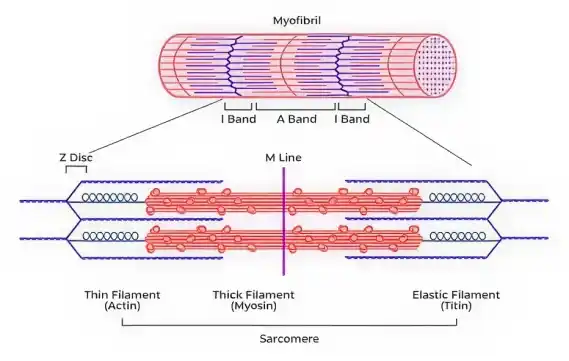
It has the following key features:
- Sarcomeres are present in series to form a myofibril and span from Z-line to Z-line. It is only a few micrometres long. Z-lines mark the boundaries of a sarcomere and anchor the thin filaments.
- It consists of overlapping actin and myosin filaments. It is present in a repeating pattern.
- Actin filaments are thin and extend from the Z-line towards the centre. Myosin filaments, on the other hand,** are thicker and are located in the centre.
- **H- Zone is the central region of a sarcomere where only myosin filaments are present. It shortens during muscle contraction.
- **I-band is the region containing only actin filaments, extending from the Z-line towards the centre, and shortening during muscle contraction.
- **The A-band is the central region of the sarcomere where both actin and myosin filaments overlap.
- **M-line is present at the centre of the A-band that anchors the myosin filaments.
- Muscle contraction occurs as actin and myosin filaments slide past each other, causing the sarcomere to shorten.
- Sarcomeres contract when stimulated by a nerve impulse, leading to the shortening of the muscle fibre and the generation of force.
Steps of the Sliding Filament Theory
The sliding filament theory explains how muscles contract and produce movement. According to this theory, the thin actin filaments slide over the thick myosin filaments, causing the muscle to shorten. Actin filaments are thin and arranged in a double helical structure. Myosin filaments are thicker and contain globular heads.
During contraction, the myosin heads attach to the actin filaments and pull them toward the centre of the muscle fibre. As the filaments slide past each other, the length of the muscle fibre decreases, leading to muscle contraction. This theory is important because it explains the mechanism of muscle movement and how muscles generate force.
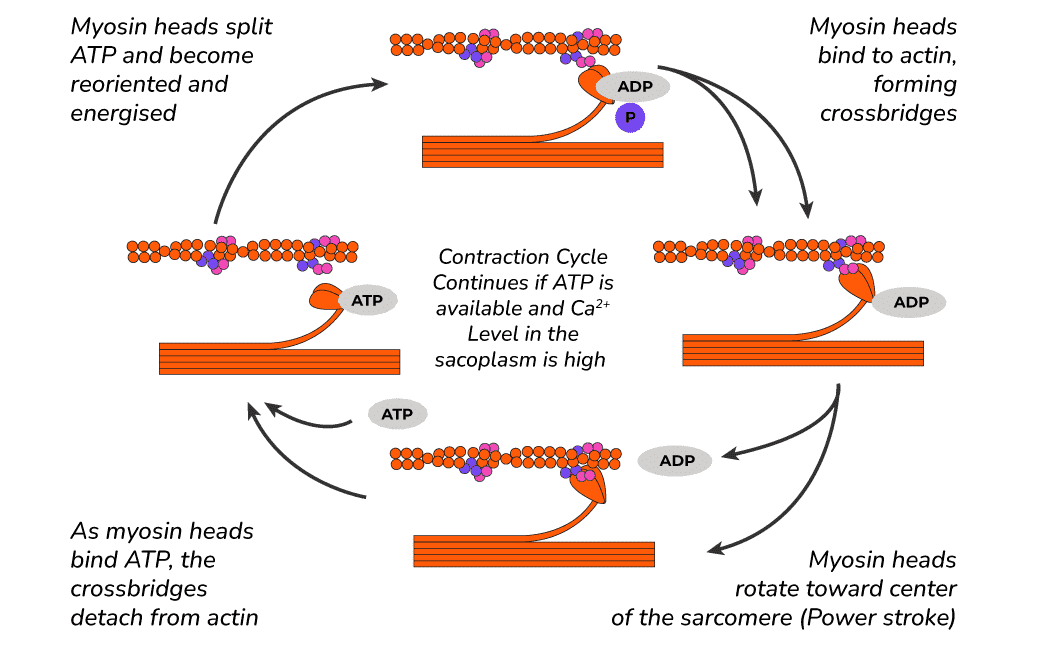
The sliding filament theory of muscle contraction involves the steps:
- **Resting State: Actin and myosin filaments overlap only slightly, and muscle fibres are relaxed.
- **Excitation of the nerve: A nerve impulse stimulates the muscle fibre. It causes the release of calcium ions from the sarcoplasmic reticulum into the sarcoplasm.
- **Cross-Bridge Formation: Calcium ions bind to troponin, causing tropomyosin to move. It exposes the myosin-binding sites on actin. Myosin heads then bind to these sites and form the cross-bridges.
- **Role of ATP: The ATP molecule is hydrolysed and causes the myosin head to pivot. It pulls actin filaments towards the centre of the sarcomere.
- **Repeat: The cycle continues as long as calcium ions are present and ATP is available, resulting in the shortening of sarcomeres and muscle contraction.
How Does Muscle Contraction Occur?
Muscle contraction is a physiological process where muscle fibres generate tension and exert a force, resulting in movement or the stabilisation of body parts.
- Muscle contraction begins with a signal from the central nervous system through a motor neuron.
- The neuromuscular junction connects the motor neuron to the sarcolemma.
- Acetylcholine is released at the neuromuscular junction. It results in the action potential in the sarcolemma.
- An action potential triggers the release of calcium ions from the sarcoplasmic reticulum into the sarcoplasm.
- Calcium ions bind to troponin on actin filaments. It exposes the myosin-binding sites.
- Myosin binds to the exposed active sites on actin and forms the cross-bridges.
- The hydrolysis of ATP at the myosin head causes sliding of thin filaments over thick filaments.
- As thin filaments slide, the Z lines are pulled closer together. It leads to muscle contraction.
- The cycle of cross-bridge formation, contraction, and sliding repeats until calcium ions are actively pumped back into the sarcoplasmic reticulum.
- With decreasing calcium levels, troponin covers the myosin-binding sites on actin, allowing for muscle relaxation.
- Recurrent muscle activation may lead to the accumulation of lactic acid, contributing to muscular fatigue.
- Myoglobin, a pigment in muscles, contributes to their red colour. Muscles rich in myoglobin are adapted for sustained, aerobic activities.
- Red fibres with myoglobin-rich content also have a large number of mitochondria, supporting energy production during prolonged activities.
- Muscles lacking myoglobin appear white and are associated with anaerobic, short cycle of activity.
- As calcium is pumped back, the Z lines return to their initial positions, and the muscle returns to a relaxed state.
Importance of Sliding Filament Theory
The sliding filament theory is the most widely accepted theory for explaining how muscle fibres contract. It describes how the interaction between actin and myosin filaments produces contractile force.
- Explains the molecular mechanism behind muscle contraction.
- Forms the basis for understanding different body movements.
- It helps in diagnosing and treating muscle-related disorders.
- Forms the basis for studying muscle physiology and related disorders.