Types of Antibody and Functions (original) (raw)
Last Updated : 23 Jul, 2025
Types of antibodies include IgA, IgD, IgE, IgG, and IgM. These various types of antibodies and functions help the immune system recognize and neutralize pathogens, toxins, and other foreign substances in the body. These antibodies protect against infections and diseases. In this article, we will cover the types of antibodies, their functions, and their structures in detail.**
Table of Content
- What is Antibody?
- Structure of Antibody
- Types of Antibodies and Their Functions
- Antibody Diversity and Specificity
- Important Points and Facts about Antibody
What is Antibody?
An antibody, also known as immunoglobulin, is a protein produced by the immune system in response to the presence of foreign substances called antigens. These antigens can be bacteria, viruses, toxins, or other harmful invaders. Antibodies are Y-shaped molecules designed to specifically recognize and bind to antigens, marking them for destruction by other immune cells.
They play a role in the body's defence mechanism by helping in neutralization, opsonization, and elimination of pathogens. Antibodies come in various types, including IgG, IgM, IgA, IgE, and IgD, each with specific functions unique to fight different types of threats.
Structure of Antibody
The structure of anitbody is described below:
- Antibodies, also known as immunoglobulins, are Y-shaped proteins.
- They consist of two identical heavy chains and two identical light chains.
- Each chain contains constant (C) and variable (V) regions.
- The variable regions are highly diverse and responsible for antigen binding.
- The constant regions determine the antibody's class or isotype (e.g., IgG, IgM).
- The two arms of the Y-shaped antibody contain antigen-binding sites, allowing antibodies to recognize and bind to specific antigens.
- The stem of the Y-shaped antibody interacts with immune cells to initiate immune responses.
- Antibodies are multi-tasking molecules that play important function in immune defense mechanisms against pathogens and foreign substances.

Types of Antibodies and Their Functions
Isotypes refer to different classes or subclasses of antibodies based on their structural and functional properties. In humans, there are five main isotypes: IgG, IgM, IgA, IgE, and IgD. Each isotype has different function in the immune response which is discussed below:
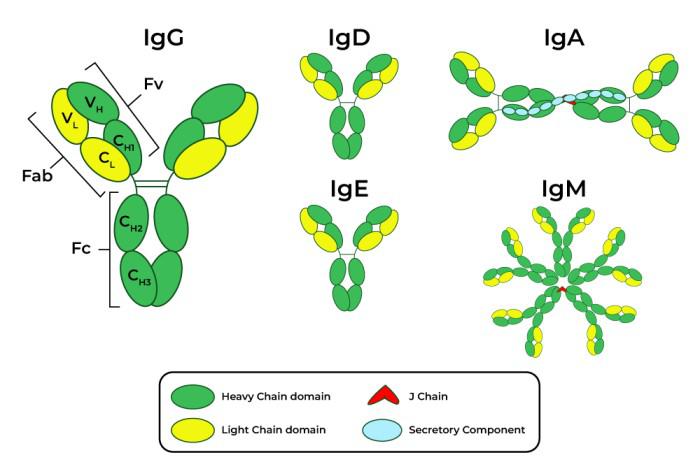
Types of Antibodies
IgG (Immunoglobulin G)
IgG is the main antibody in our blood, accounting for approximately 75% of all antibodies in the body. It has a strong ability to bind to bacteria and toxins.
**Structure of IgG
IgG is a Y-shaped antibody composed of four protein chains - two heavy chains and two light chains. It has a molecular weight of about 150 kDa.
**Function of IgG
- It plays a key role in providing long-term immunity against infections by recognizing and binding to specific antigens.
- IgG antibodies can neutralize toxins, opsonize pathogens for phagocytosis by immune cells, and activate the complement system to enhance immune responses.
- They also play a crucial role in memory immune responses. This enables the body to start a faster and stronger defense upon re-exposure to previously encountered antigens.
- It is unique because it can pass through the placenta, providing protection to newborns from the mother.
IgM (Immunoglobulin M)
It is produced first by B cells when pathogens invade, which plays a key role in the initial defense of the immune system.
**Also Read: Difference Between T Cells And B Cells
**Structure of IgM
- IgM is a pentameric antibody, meaning it consists of five antibody units linked together.
- Each unit contains two heavy chains and two light chains, forming a Y-shaped structure.
Function of IgM
- IgM is the first antibody produced by the immune system during an initial immune response to an antigen.
- It plays a crucial role in the primary immune response, helping to neutralize pathogens and activate other immune cells.
- IgM is efficient at agglutinating pathogens, making it easier for immune cells to recognize and eliminate them.
- Due to its large size and pentameric structure, IgM is not as effective at crossing tissues. So, they primarily stay in the bloodstream to fight systemic infections.
IgA (Immunoglobulin A)
IgA is present as monomers in the blood but forms dimers in secretions like bowel fluid, nasal discharge, and saliva.
**Structure of IgA:
- IgA is a dimeric antibody, meaning it consists of two antibody units joined together by a structure called the J chain.
- Each antibody unit contains two antigen-binding sites, allowing IgA to bind to two antigens simultaneously.
**Function of IgA:
- IgA plays a role in mucosal immunity, protecting mucous membranes in areas like the respiratory and genitourinary tracts.
- It acts as the first line of defense against pathogens by preventing them from attaching to mucosal surfaces and neutralizing toxins.
- IgA also helps to maintain the balance of healthy bacteria in the gut and other mucosal environments.
- IgA is also found in breast milk which protects newborn's gastrointestinal tracts.
IgE (Immunoglobulin E)
IgE is originally related to immunity reactions to parasites. By binding to mast cells, it is involved in allergies such as hay fever.
Structure of IgE
- It is a type of antibody characterized by its Y-shaped structure, similar to other immunoglobulins.
- It consists of two heavy chains and two light chains connected by disulfide bonds, forming a specific binding site for antigens.
**Function of IgE
- IgE has a role in allergic reactions by binding to allergens such as pollen, pet dander, or certain foods.
- Upon binding to allergens, IgE triggers the release of histamine and other inflammatory molecules from mast cells and basophils.
- This immune response leads to the typical symptoms of allergies, including itching, sneezing, runny nose, and swelling.
- IgE also plays a role in defense against parasites by activating eosinophils, a type of white blood cell that helps eliminate parasitic infections.
IgD (Immunoglobulin D)
IgD is present on the surface of B cells.
Structure of IgD
- It consists of two heavy chains and two light chains linked together in a Y-shaped structure.
- IgD antibodies are found on the surface of B cells, where they serve as antigen receptors.
Function of IgD
- The exact function of IgD is not fully understood.
- It is believed to play a role in the activation and regulation of B cells.
- IgD may be involved in the initiation of immune responses by helping B cells recognize and bind to antigens.
- Also, IgD may contribute to the maturation and differentiation of B cells into antibody-secreting plasma cells.
- It has a role in inducing antibody production and preventing respiratory tract infections.
Antibody Diversity and Specificity
Antibodies are special because they can match up with lots of different germs. This matching ability is called A**ntibody diversity. You can understand it like having many different keys for many different locks. Each antibody fits with a certain part of a germ.
Antibodies are really good at finding the exact germ they need to fight. This is known as _Antibody-antigen interaction. It is like each antibody has a unique shape that only fits with one specific germ. This feature is crucial because it helps our immune system to accurately identify and attack the right germs to keep us safe from getting sick, without harming our own body. This ability of antibodies to be diverse and specific is what makes them so good at protecting us from lots of different diseases.
**Important Points and Facts about Antibody
Some interesting facts about antibody are:
- Antibodies are tiny but powerful germ fighters.
- Our bodies can produce billions of unique antibodies.
- Antibodies remember past germs for quicker future responses.
- Some antibodies act fast to stop infections early.
- Mothers pass protective antibodies to their babies.
- Scientists use colors to see antibodies attack germs under microscopes.
- Antibodies change shape to better fight germs.
- Certain antibodies can last in the body for decades.
- Antibodies precisely target specific germs without harming healthy cells.
- Vaccines train our bodies to make antibodies against diseases.
**Also Read: Importance of Vaccines, Vaccination and Immunization
Conclusion - Types of Antibody and Their Functions
In conclusion, antibodies are essential proteins produced by the immune system to defend against foreign substances known as antigens. These antibodies play a critical role in neutralizing, opsonizing, and eliminating pathogens, contributing to the body's defense mechanism. Structurally, antibodies are Y-shaped proteins composed of heavy and light chains, with variable regions responsible for antigen binding and constant regions determining their class or isotype. The five main antibody isotypes, IgG, IgM, IgA, IgE, and IgD, each serve unique functions in the immune response, ranging from providing long-term immunity to initiating primary immune responses.
**Also Read: