What is Data Mining A Complete Beginner's Guide (original) (raw)
Last Updated : 23 Jul, 2025
Data mining is a rapidly growing field. It is the process of discovering patterns and relationships in large datasets using techniques such as machine learning and statistical analysis. The goal of data mining is to extract useful information from large datasets and use it for informed decision-making. It allows organizations to uncover insights and trends in their data that would be difficult or impossible to discover manually.
The above series of images shows how Data Mining converts Raw Textual data to Meaningful insights for Businesses and efficient Information Retrieval.
Data Mining History and Origins
**1950s - 1960s : Origin and Initial Development: Data Mining originated near 1950s when the first computers were developed and used for scientific and mathematical research. As the capabilities of computers and data storage systems improved, researchers began to explore the use of computers to analyze and extract insights from large data sets. Techniques for extracting useful information and insights from data including clustering, classification and decision trees were developed.
**1980s - 2000s : Knowledge Discovery in Databases (KDD): The term KDD was introduced, emphasizing extracting useful patterns from data. Development of decision trees, association rule mining and clustering methods. Adopted in finance, marketing, fraud detection and for automated knowledge extraction processes. Tools like SAS, SPSS and Weka gained popularity.
**2010s – Present : Modern Data Mining: Introduction of Hadoop, Spark, Big Data Technologies and NoSQL databases enabled mining of massive, unstructured datasets. Scalable infrastructure through AWS, Azure and GCP revolutionized real-time mining and processing. Integration with deep learning, NLP and reinforcement learning enhances prediction, pattern recognition and personalization.
Prerequisites for Data Mining
Before you start learning data mining, there are a few key prerequisites. Some of these are listed below:
- **Basic Knowledge of Statistics and Probability: Understand distributions and apply them to analyze, interpret data patterns and evaluating significance.
- **Basic Programming, Problem Solving Skills: Basic coding and debugging skills using Python or R for data analysis, pre-processing and machine learning.
- **Basics of Data Management: Knowledge of databases, data types, queries and normalization to handle large datasets effectively.
- **Basics of Machine Learning: Familiarity with supervised and unsupervised learning and key algorithms used in data mining tasks.
Getting Started with Data Mining
Let's see how to get started with Data mining, there are a few key steps that you can follow:
- **Learn the Fundamentals of Data Mining - Start by understanding basic concepts, techniques and algorithms used in data mining. Learn about data types, applications and common use cases. Use online courses, books and tutorials to build your foundational knowledge.
- **Acquire the Necessary Tools and Technologies - Familiarize yourself with tools like Python, R, SAS or IBM SPSS for data mining. You’ll also need access to datasets and supporting tools like databases and data visualization software to prepare and analyze your data effectively.
- **Practice and Experiment with Data Mining - The best way to learn data mining is to apply techniques and algorithms to real or synthetic datasets to gain hands-on experience. You should experiment, analyze outcomes and refine your skills through continuous exploration and learning.
- **Join a Community of Data Miners - Finally, you can learn more about data mining and improve your skills by engaging with data mining communities through forums, conferences and competitions. Networking helps you learn from peers, stay current with trends and improve through shared experiences and collaboration.
Types of Data Mining

Data Mining Types
Data Mining is used to explore, model and extract insights. It can generally be grouped into three broad categories:
- **Descriptive data mining involves summarizing and describing the characteristics of a data set. This type of data mining is often used to explore and understand the data, identify patterns and trends and summarize the data in a meaningful way.
- **Predictive data mining involves using data to build models that can make predictions or forecasts about future events or outcomes. This type of data mining is often used to identify and model relationships between different variables and to make predictions about future events or outcomes based on those relationships.
- **Prescriptive data mining involves using data and models to make recommendations or suggestions about actions or decisions. This type of data mining is often used to optimize processes, allocate resources or make other decisions that can help organizations achieve their goals.
How Does Data Mining Work?
Data Mining involves a 7-step structured approach which spans understanding the problem, processing data, applying algorithms and evaluating results. This process helps businesses make informed decisions, predict trends and gain competitive advantages.
The above series of images demonstrates how Data Mining works from Collecting the Data from Data Sources to performing ETL, Pre-processing and retrieving Information effectively.
**Key Phases of the Data Mining Process
- **Problem Definition: Clearly define the business problem or question to be answered using data by understanding business context and relevance. This ensures that data mining efforts align with organizational goals.
- **Data Preparation: Collect data from various data sources and pre-process it by cleaning, transforming and formatting to ensure quality, elimination of inconsistencies and usability for analysis.
- **Data Exploration: Use summary statistics and visualization techniques to explore data characteristics, uncover trends and identify patterns or anomalies.
- **Model Building: Select and apply appropriate data mining algorithms like classification, clustering, regression, etc to create predictive or descriptive models for forecasting. This step involves choosing an appropriate modeling technique, fitting the model to the data and evaluating its performance.
- **Model Validation: Evaluate the model’s performance using separate validation datasets to check for accuracy, reliability and generalizability. This step typically involves using a separate data set known as validation set to evaluate the model's performance and make any necessary adjustments.
- **Model Implementation: Deploy the validated model into production systems to enable automated predictions or real-time decision support. This step involves deploying the model and integrating it into the organization's existing systems and processes.
- **Result Evaluation: Measure the impact of the model, assess its effectiveness in achieving goals and refine as needed for improved performance. This step involves measuring the model's performance, comparing it to other models or approaches and making any necessary changes or improvements.
These seven steps form the core of the data mining process and are used to explore, model and make decisions based on data. By following these steps, data miners and other practitioners can uncover valuable insights and information hidden in their data.
**Data Mining Architecture: Core Components
Data mining architecture refers to the overall design and structure of a data mining system. A data mining architecture typically includes several key components which work together to perform data mining tasks and extract useful information from data. The core components are listed below:
- **Data Sources: Includes structured (databases, spreadsheets) and unstructured data (logs, text files, sensors) which feed into the mining process. Data sources provide the raw data that is used in data mining and can be processed, cleaned and transformed to create a usable data set for analysis.
- **Data Preprocessing: Data preprocessing ensures the data is cleaned, integrated, reduced and transformed into a high-quality dataset ready for mining. It aims to remove errors, inconsistencies and irrelevant information and to make it suitable for analysis.
- **Data Mining Algorithms: Utilizes various algorithms including supervised and unsupervised learning algorithms such as regression, classification, clustering and more specialized algorithms like association rule mining and anomaly detection to extract patterns and insights.
- **Pattern Evaluation: Identifies the most interesting and relevant patterns from the mined data, often based on measures like accuracy, support or confidence.
- **Data Visualization: Data visualization presents results and insights through graphs, charts, dashboards or reports to enable easy interpretation and action. It allows data miners to communicate their findings effectively.
Data Mining Techniques

Approaches used for Data Mining
Data mining techniques are algorithms and methods used to extract information and insights from data sets. These techniques are commonly used in the field of data mining and machine learning and they include a variety of methods for exploring, modeling and analyzing data. Some of the most common data mining techniques include:
1. **Regression
- Regression is used to model the relationship between a dependent variable and one or more independent variables.
- It fits a mathematical model to the data to estimate the target variable.
- Accuracy and validity of the predictions are key to evaluating regression models.
- Widely used in finance, marketing and healthcare for trend and risk analysis.
**2. Classification
- Classification assigns data items to predefined categories or classes based on their attributes.
- Evaluates how well the model fits the training data and performs on unseen data.
- Models are assessed using metrics like accuracy, precision, recall and F1-score.
- Common in spam detection, loan approvals and disease diagnosis.
3. Clustering
- Clustering groups data into clusters based on similarity or proximity, without predefined labels.
- Measures similarity using distance metrics such as Euclidean or cosine distance.
- Useful for market segmentation, social network analysis and image grouping.
- It is an unsupervised technique, making it ideal for exploratory analysis.
4. Association rule mining
- Identifies relationships or correlations between variables or items in datasets.
- Evaluates rules using support, confidence and lift metrics.
- Key for market basket analysis, fraud detection and recommendation systems.
- Rules help businesses in cross-selling and strategic planning.
5. Dimensionality Reduction
- Reduces the number of features or variables in the data while preserving structure.
- Answers questions like: What are the most important features? and How to simplify the data without losing meaning?
- Enhances model performance and reduces computational cost.
- Widely used in image processing, NLP and bioinformatics.
There are many other techniques that can be used for exploring, modeling and analyzing data and the appropriate technique will depend on the specific problem or question you are trying to answer with your data.
You can also refer to Data Mining Tutorial to know about these techniques.
1. **Data Mining vs. Data Analytics vs. Data Warehousing
- **Data Mining: Focuses on extracting and uncovering hidden patterns and generating predictions using algorithms on large datasets.
- **Data Analytics: Involves statistical and mathematical analysis on data to draw meaningful insights and conclusions to make informed decisions from data.
- **Data Warehousing: Involves storing and managing large datasets efficiently for access by analytics and mining tools.
- Data warehousing stores the data, analytics interprets it and mining uncovers deeper patterns and predictions.
2. **Data Mining vs. Data Analysis
- **Data Mining: Applies machine learning/statistical algorithms to discover hidden patterns and trends.
- **Data Analysis: Interprets mined data to understand its meaning and implications for decision-making.
- Mining extracts insights; analysis explains and contextualizes them.
3. **Data Mining vs. Data Science
- **Data Mining: A subfield of data science focused on pattern discovery using algorithms.
- **Data Science: A broader discipline encompassing data collection, cleaning, visualization, mining and communication.
- Data mining is a core component of data science; data science covers the end-to-end data workflow.
4. **Data Mining vs. Machine Learning
- **Data Mining: Extracts insights from mostly structured data where relationships are better understood.
- **Machine Learning: Trains models on large datasets (often unstructured) to make predictions or decisions.
- Data mining reveals patterns; machine learning enables systems to learn and adapt from data.
Data Warehousing and Mining Software
- **Relational Database Management Systems (RDBMS): Structured data storage using SQL; supports querying, data integrity and scalability. Example: MySQL, PostgreSQL, Oracle, etc.
- **Data Warehousing Platforms: Designed for large-scale data storage and management; support ETL processes and fast querying. Example: Amazon Redshift, Snowflake, Google Big Query.
- **Data Mining Tools: Used to extract patterns and insights using algorithms like clustering, classification and association rule mining.
- **Data Visualization Tools: Help visually explore and communicate data trends and patterns through graphs and dashboards. Example: Tableau, Power BI, Matplotlib.
Open-Source Software for Data Mining
There are many open-source software applications and platforms that are available for data mining which provide a range of algorithms, techniques and functions that can be used for information retrieval available at no cost. Some popular open-source software for data mining include:
- **RapidMiner - Robust open-source data science platform that supports data preparation, machine learning, deep learning and model deployment. It offers a drag-and-drop interface and supports Python and R integration. Ideal for beginners and professionals alike, it is widely used in industry and academia.
- **Orange - Open-source data visualization and analysis tool that uses a visual programming interface. It is beginner-friendly and ideal for teaching, prototyping and research. It offers a wide range of widgets for data mining tasks like classification, regression, clustering and visualization.
- **KNIME - Modular open-source platform for data analytics, reporting and integration. It enables users to visually create data flows and supports machine learning, data transformation and scripting via Python and R. It’s especially useful for building complex workflows without coding.
- **WEKA - Java-based open-source suite of machine learning software developed at the University of Waikato. It offers a collection of algorithms for classification, regression, clustering and visualization. It is widely used in academic research and educational environments.
Some of the most popular and widely used tools for data mining include:
- **R - R is a powerful programming language for data analysis and statistical computing. It has a rich ecosystem of packages and tools for data mining and is widely used by data miners and other practitioners.
- **Python - Python is a popular data analysis and machine learning programming language. It has a rich ecosystem of libraries and frameworks for data mining and is widely used in the field.
- **SAS - SAS is a commercial software suite for data management, analytics and business intelligence. It has a range of tools and features for data mining and is widely used in the corporate and enterprise sectors.
- **IBM SPSS - IBM SPSS is a commercial software suite for data analysis and predictive modeling. It has a range of tools and features for data mining and is widely used in the social sciences and other fields.
- **RapidMiner - RapidMiner is a commercial data science platform for building and deploying predictive models. It has a range of tools and features for data mining and is widely used by data scientists and other practitioners.
There are many different tools and platforms available for data mining and the best one for you will depend on your specific needs and requirements.
Data Mining in R
R is a statistical programming language ideal for data analysis, data mining and machine learning.
- It supports a wide variety of data types (numeric, categorical, time series, text, etc.).
- R provides tools for every phase of data mining: data cleaning, exploration, modeling, evaluation and deployment.
- Extensive ecosystem of packages specifically for data mining, including classification, clustering, association rule mining and visualization.
caretis used for model training,arulesfor association rules,clusterfor clustering andggplot2for data visualization. - R is especially popular in academia, research and healthcare analytics
- R is open source and freely available, making it cost-effective and accessible for individuals, startups and large organizations.
- A large and active community of users and developers continuously contributes new packages, tutorials and support via forums, blogs and conferences.
- However, R requires technical expertise, making it less accessible to non-programmers or beginners. It can be slower and less scalable compared to other tools.
- R lacks seamless integration with some tools and platforms which reduces its flexibility and interoperability.
Key R Packages for Data Mining
There are many packages and functions that you can use for data mining, including:
- caret (Classification And Regression Training): 200+ ML models, handles data pre-processing, cross-validation, model tuning and evaluation
- arules and arulesViz: Designed for association rule mining like Market Analysis, Measures like support, confidence and lift are calculated easily
- cluster: Implements clustering methods like K-Means, Agglomerative Hierarchical Clustering, etc.
- ggplot2: Advanced plotting system based on the grammar of graphics. Essential for EDA, model evaluation and result communication.
- randomForest and e1071: Models using Ensemble leaning or Support Vector machine, Easy to use and highly effective for classification and regression problems.
You can refer to the Algorithms for Data mining in R for a better understanding: Data Mining Algorithms in R
Real-World Applications of Data Mining
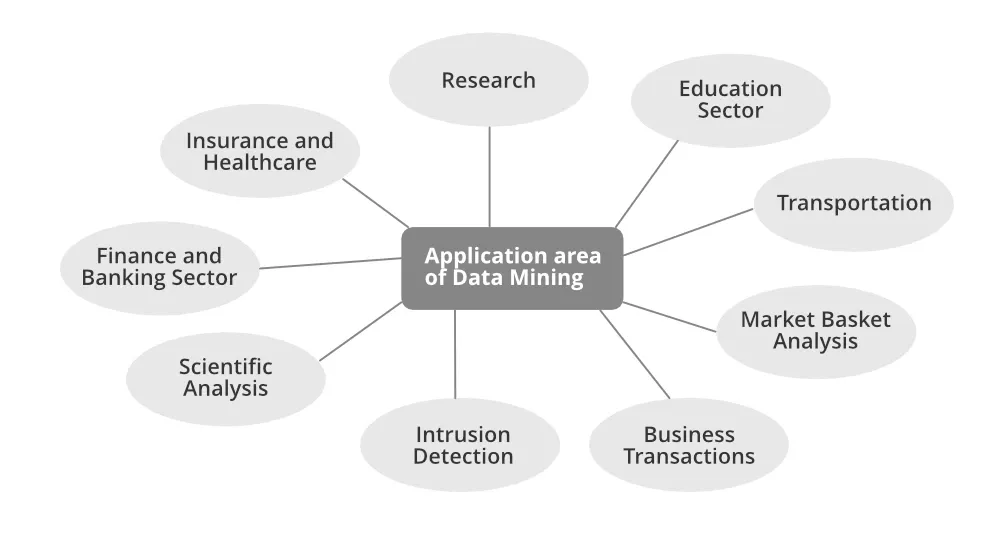
Real World Use cases of Data Mining
Data mining has numerous uses cases across many industries and domains. Some of the most common use cases are:
- **Market Basket Analysis: Identifies items frequently bought together using purchase data in retail and e-commerce, aiding in product recommendations.
- **Fraud Detection: Analyzes transaction and behavior data in finance to detect patterns or anomalies indicating fraudulent activity.
- **Customer Segmentation: Groups customers by behavior and characteristics for targeted marketing and personalized advertising.
- **Predictive Maintenance: Uses equipment performance data in manufacturing to predict failures and schedule maintenance, reducing downtime.
- **Network Intrusion Detection: Monitors network traffic patterns in cybersecurity to detect intrusions and prevent potential attacks.
Advantages of Data Mining
Data mining is a powerful and flexible tool that has many benefits for organizations, including:
- **Improved decision-making - By analyzing data and uncovering hidden patterns, organizations get valuable insights.
- **Increased efficiency and productivity - By automating and streamlining the data analysis process, organizations can save time and resources and help in more efficiency and effectiveness.
- **Reduced costs - By identifying and addressing inefficiencies and waste, data mining can help organizations optimize finances and improve their bottom line.
- **Increased customer satisfaction - By analyzing data on customer behavior and preferences, organizations can understand their customers better and provide more personalized and relevant products and services.
- **Improved risk management - By analyzing data on potential risks and vulnerabilities, organizations can identify and mitigate potential risks and make more strategic decisions.
Disadvantages of Data Mining
There are some challenges associated with Data Mining. Organizations must be aware of the limitations and address them to ensure that their data mining efforts are accurate, reliable and ethical. Some of these limitations include:
- **Data quality - Data mining can only be as accurate and reliable as the data that it is based on and poor-quality data can lead to inaccurate or misleading results.
- **Model bias - If the data is not representative of the population or if there is bias in the way the data is collected or analyzed, the models that are built from the data may be biased and may not accurately reflect the underlying relationships in the data.
- **Ethical considerations - The data that is collected and analyzed may be sensitive or personal and organizations must ensure that they handle this data responsibly and in compliance with relevant laws and regulations.
- **Technical challenges - When dealing with large and complex data sets, mining can be challenging. Extracting useful information and insights from data can require specialized skills and expertise and can be time-consuming and resource-intensive.
Current Advancements and Future in Data Mining
There are many current advancements in data mining, as the field continues to evolve and grow. Some of the key current advancements in data mining include:
1. Integration with Big Data Technologies
- Data mining is increasingly integrated with big data platforms like Hadoop and Spark.
- These technologies enable handling of massive, high-velocity and diverse datasets efficiently.
2. Graph Mining and Network Analysis
- Graph mining uncovers hidden patterns and relationships in complex interrelated network-structured data like social networks, web graphs or biological networks.
- Advances include dynamic graph mining, subgraph matching and community detection algorithms.
3. Machine Learning and Deep Learning Integration
- Data mining is enhanced through powerful machine learning models, especially deep learning for complex pattern extraction.
- Techniques like ensemble learning, Auto ML and neural networks improve prediction accuracy and automate feature extraction.
4. Cloud-Based Data Mining
- Cloud platforms like AWS, Azure and Google Cloud provide scalable infrastructure for data storage, processing and mining.
- It reduces hardware dependency and enhances accessibility to high-performance computing.
5. Privacy-Preserving and Ethical Data Mining
- With growing concerns over data privacy, techniques like differential privacy, federated learning and homomorphic encryption are advancing.
- These methods allow secure mining without compromising user data. Regulatory compliance drives development of responsible mining practices.
The Future of Data Mining
Let's discuss the Future and Scope of Data Mining.
- **Big Data & Cloud Computing: Growing data volumes and cloud technologies will enhance scalability, accessibility and large-scale data mining capabilities. Data mining will help manage and analyze data effectively.
- **Machine Learning & AI: Advanced ML/AI like ML algorithms, NLP and CV will improve accuracy and enable mining on diverse data types and domains.
- **Privacy & Security: Stronger emphasis on data privacy, compliance with laws requires development in new technologies, secure data handling systems and privacy-preserving techniques like differential privacy.
- **Ethics & Governance: Need for ethical frameworks, governance structures, transparent practices and responsible use to prevent misuse and bias in data mining. Stakeholders like data scientists, policymakers and ethicists will need to work together to develop and implement these frameworks.
Data mining will remain a vital tool across domains, driven by tech advancement and increasing need for insights from complex data.
Career Options in Data Mining
Data mining is a valuable and in-demand skill and there are many different careers that use data mining. Some careers that use data mining include:
1. Data Scientist
- Applies data mining techniques to extract useful insights and information from data.
- Uses statistical analysis, machine learning and visualization tools to make predictions and recommendations.
2. Business Intelligence Analyst or Data Analyst
- Transforms data mining results into actionable business insights. Uses BI tools (e.g., Power BI, Tableau) to help organizations make informed decisions.
- Supports strategic planning and performance optimization by identifying trends and patterns in the data, generate reports and dashboards.
3. Marketing Analyst
- Analyzes customer and market data using data mining techniques.
- Generate insights for targeted marketing campaigns.
4. Data Engineer
- Designs and manages data infrastructure to support analytics and mining. Build and maintain pipelines, databases and data warehouses.
- Cleanse, transform and organize raw data for downstream use.
Overall, there are many different careers that use data mining and the most suitable one for a given individual will depend on their interests, skills and experience.