Benchmarking: Meaning, Steps and Types (original) (raw)
Last Updated : 20 May, 2026
Strategic Management Benchmarking is a strategic management technique in which organizations compare their processes, performance, products, or services with those of leading competitors or top-performing companies to identify strengths, weaknesses, and opportunities for improvement. By studying industry best practices and analyzing performance data, businesses can detect gaps in efficiency, quality, productivity, or customer satisfaction and then develop strategies to improve their own operations. This approach helps organizations set realistic performance goals, enhance innovation, reduce costs, and achieve a competitive advantage by continuously learning from successful companies and adapting proven methods to their own business environment
Steps of Benchmarking
Benchmarking involves a series of systematic steps that organisations can follow to effectively compare their performance and practices with industry leaders or competitors. The key steps involved in benchmarking are:

- **Define the Focus: Clearly identify the specific area or process that you intend to benchmark. Whether it's a particular function within your organisation or a specific aspect of your industry, having a clear focus will ensure a targeted approach to improvement.
- **Select Benchmarking Partners: Identify organisations that excel in the chosen area and can serve as valuable benchmarks. Look for both direct competitors and companies from different industries known for their best practices. This diverse selection will provide a broader perspective and fresh insights for your improvement efforts.
- **Gather Data and Information: Collect relevant data and information from your benchmarking partners. Employ various methods such as surveys, interviews, site visits, or accessing publicly available reports. It's crucial to ensure the accuracy and comprehensiveness of the data, focusing specifically on the benchmarks you have identified.
- **Analyse and Compare: Analyse the collected data and compare it with your organisation's own performance. Identify gaps and differences in processes, practices, and performance metrics. This analysis will enable you to gain a deeper understanding of areas for improvement and learn from the best practices of your benchmarking partners.
- **Set Performance Targets: Based on the insights gained from the benchmarking analysis, establish specific performance targets and goals for your organisation. These targets should be challenging yet attainable, aligning closely with your strategic objectives. Clear targets provide a roadmap for your improvement efforts.
- **Develop an Action Plan: Create a comprehensive action plan that outlines the specific steps and initiatives required to bridge performance gaps and achieve the set targets. Ensure the action plan includes well-defined timelines, assigned responsibilities, required resources, and key milestones. Tailor the plan to suit the unique needs and capabilities of your organisation.
- **Implement and Monitor: Put your action plan into motion and execute the identified improvements within your organisation. Regularly monitor progress, tracking relevant performance indicators and metrics tied to your benchmarking focus. Ongoing monitoring allows for timely assessment of the effectiveness of implemented changes and enables necessary adjustments if required.
- **Learn and Iterate: Benchmarking is an iterative process that fosters continuous learning and improvement. Evaluate the outcomes of the implemented changes, draw insights from the results, and identify additional areas for enhancement. Leverage the knowledge gained through benchmarking to refine your processes, practices, and overall performance.
Types of Benchmarking
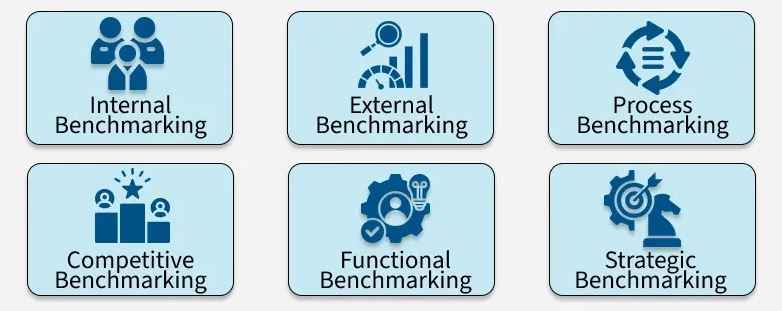
**Internal Benchmarking: Internal benchmarking involves comparing performance and practices within the same organisation. Different departments, units, or branches are analysed to identify internal best practices. Since data is easily available and confidentiality issues are minimal, it is simple to implement and helps improve efficiency using existing strengths.
**External Benchmarking: External benchmarking compares an organisation’s performance with other organisations outside the firm, often industry leaders. It helps identify performance gaps and learn superior practices, though data collection can be challenging due to limited access and confidentiality concerns.
**Process Benchmarking: Process benchmarking focuses on analysing specific business processes such as production, procurement, or customer service. The objective is to improve how work is performed by learning from organisations that execute similar processes more efficiently.
**Competitive Benchmarking: Competitive benchmarking involves comparing products, services, and performance with direct competitors. It helps organisations understand their market position and competitive strengths and weaknesses, although access to detailed competitor information is often restricted.
**Functional Benchmarking: Functional benchmarking compares specific functions like human resources, marketing, finance, or IT with organisations known for excellence in those areas, even if they operate in different industries. It encourages innovation and adoption of best functional practices.
**Strategic Benchmarking: Strategic benchmarking examines long term strategies, business models, and overall approaches adopted by successful organisations. It supports strategic planning and helps firms adapt effective strategies to achieve sustainable competitive advantage.