Causes of Resistance to Change (original) (raw)
Last Updated : 10 Jan, 2026
Resistance to change refers to the opposition or reluctance shown by individuals or groups when an organization tries to introduce new policies, processes, technologies, or structures. People often resist change because they feel uncertain, uncomfortable, or threatened by it.
- Resistance to change can manifest in individuals through three distinct responses: acceptance, indifference, or resistance.
- These responses depend on how individuals perceive the proposed changes.
- It is important to note that resistance to change can originate from both individuals and organizations.
Some key factors that contribute to resistance at the individual and organisational levels:
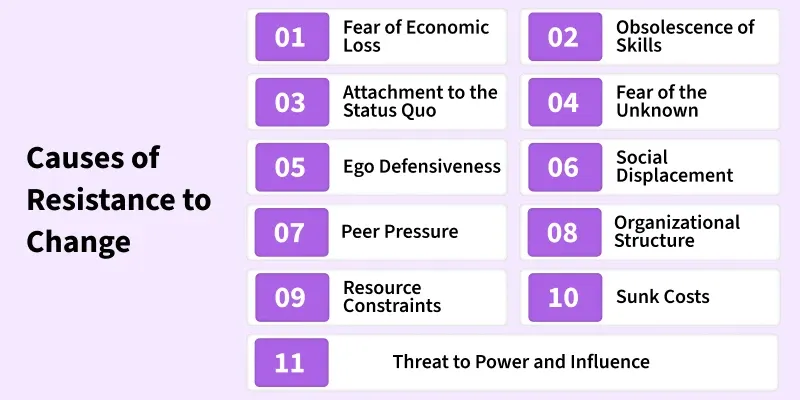
**Fear of economic loss
People often exhibit resistance to change when they perceive potential negative impacts on their economic well-being. This includes concerns about job security, reduced work hours leading to decreased financial benefits, demotion resulting in lower compensation, or changes that may imply a higher workload with reduced incentive wages. The level of resistance typically corresponds to the perceived magnitude of the economic loss.
**Obsolescence of skills
Change often brings about the need for new knowledge and skills, rendering existing ones obsolete. Individuals may resist change when they fear that their expertise will become outdated, affecting their position and prospects within the organization. This resistance is more pronounced for individuals with limited marketable skills or knowledge that is no longer relevant in the evolving landscape.
**Attachment to the status quo
Many people find comfort and security in the familiarity of the current state of affairs. Any proposed changes that disrupt established routines, convenience, or personal comfort can trigger resistance. Individuals may have developed habits and customs that are deeply ingrained, making it challenging to embrace new ways of doing things.
**Fear of the unknown
Change introduces uncertainty and risk, which can be unsettling for individuals. The unknown elements of change create a sense of anxiety and resistance. For example, employees may resist relocation to a remote branch due to concerns about adjusting to an unfamiliar environment, potential disruptions to personal life, or uncertainties regarding the new work dynamics.
**Ego defensiveness
Resistance to change can also stem from individuals' desire to protect their ego or sense of self-worth. Some people may resist change simply because it challenges their authority or implies the need to acknowledge potential shortcomings. This resistance is often driven by a need to maintain a perception of superiority or avoid appearing vulnerable.
Social displacement occurs when individuals or groups experience negative consequences or marginalization due to changes in social structures. This can happen when a particular group loses its social status, influence, or access to resources because of shifting societal norms, technological advancements, or changes in power dynamics.
**Peer pressure
Peer pressure refers to the influence exerted by individuals within a social group to conform to certain behaviours, beliefs, or attitudes. It can involve both positive and negative influences, where individuals may feel compelled to align with their peers to fit in, gain acceptance, or avoid criticism or rejection.
**Organizational structure
Organizational structure refers to how an organization organizes its activities, tasks, and relationships to achieve its objectives. It encompasses elements such as division of labour, hierarchy of authority, communication channels, and coordination mechanisms. Organizational structure provides a framework that defines power distribution and decision-making processes within the organization.
**Resource constraints
Resource constraints occur when there are limitations or shortages of resources, such as financial capital, human resources, technology, or physical assets, that individuals or organizations face. These constraints can impact the ability to pursue certain activities or initiatives, requiring individuals and organizations to prioritize, think creatively, and find alternative solutions within the available resources.
**Sunk costs
Sunk costs refer to costs that have already been incurred and cannot be recovered. When making decisions, it is important to recognize that sunk costs should not be a determining factor, as they are irrelevant to future considerations. However, individuals and organizations often struggle to let go of sunk costs and resist change, even when it may be more beneficial to do so, due to a psychological bias known as the "sunk cost fallacy."
**Threat to power and influence
In the face of change, individuals or groups holding positions of power or influence within an organization may perceive the change as a threat to their authority, control, or status. This perception can lead to resistance, as they may resist relinquishing power or adapting to new dynamics that could potentially diminish their influence or disrupt established power structures.