Organisational Change (original) (raw)
Last Updated : 1 Jun, 2026
Organisational change is an essential process that drives meaningful transformations within a company or institution. It involves making significant modifications to various aspects of the organisation, including its structure, culture, processes, systems, strategies, and personnel. The goal is to enhance performance, effectiveness, and adaptability, ensuring the organisation remains competitive in a dynamic business environment. Organisational change can be triggered by internal or external factors and is guided by the need to foster growth and success. It encompasses diverse areas such as restructuring, cultural evolution, process optimisation, technological advancements, strategic realignment, and people-centric initiatives. Implementing successful organisational change requires meticulous planning, inspiring leadership, and active engagement from stakeholders. By embracing change as a constant, organisations can navigate challenges, seize opportunities, and pave the way for sustained success.
Types of Organizational Changes
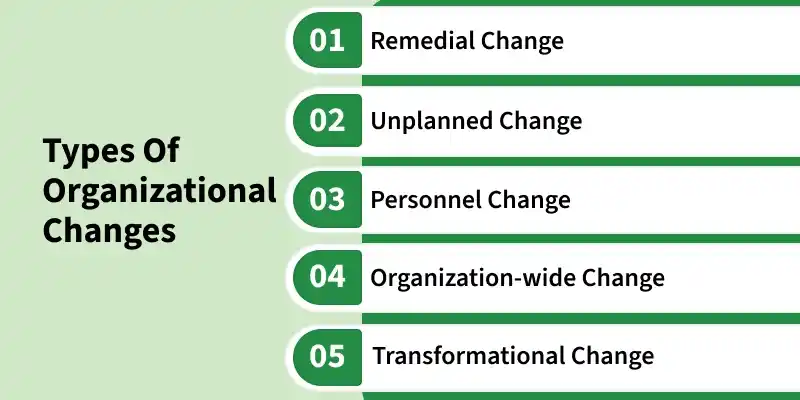
**Remedial Change: Remedial change refers to the changes made to correct existing problems or weaknesses within an organization. These changes are introduced when the organization identifies issues such as low productivity, poor performance, customer complaints, or operational inefficiencies. The main purpose of remedial change is to improve the current situation and help the organization achieve better results.
**Unplanned Change: Unplanned change occurs suddenly and without prior preparation due to unexpected situations or emergencies. These changes may arise because of economic crises, technological failures, natural disasters, government regulations, or sudden market competition. Organizations must respond quickly to such changes in order to survive and continue operating effectively.
**Personnel Change: Personnel change involves changes related to employees and the workforce within an organization. This may include recruitment, promotions, transfers, retirement, resignation, or layoffs. Such changes are important for improving employee performance, filling skill gaps, and maintaining smooth organizational operations.
**Organization-wide Change: Organization-wide change affects the entire organization, including all departments, employees, processes, and systems. These changes are usually implemented to improve overall organizational performance, adapt to market conditions, or achieve long-term goals. Examples include restructuring, introducing new policies, or adopting new technologies across the organization.
**Transformational Change: Transformational change is a major and long-term change that completely changes the structure, culture, strategies, or operations of an organization. It is often introduced to help the organization adapt to major technological advancements, globalization, or changing customer demands. This type of change requires strong leadership and employee support because it significantly impacts the entire organization.
Nature of Organisational Change
The nature of organisational change is inherently dynamic and multifaceted. It encompasses several key characteristics that define its nature and impact on an organisation some of them are:
**Continuous: Organisational change is not a singular event that happens once and then stops. It is an ongoing journey because business environments are continuously evolving. New technologies, customer expectations, market trends, and competitive pressures constantly push organisations to update their systems and methods. Therefore, companies must learn, adapt, and improve consistently to avoid stagnation and protect their market position.
**Complex: Organisational change is complex due to the interplay of various factors, such as organisational structure, culture, processes, technology, and human dynamics. It involves multiple stakeholders, intricate relationships, and interconnected elements that require careful consideration and management.
**Multidimensional: Organisational change affects various dimensions of an organisation simultaneously. It can impact the organisational structure, culture, strategy, processes, systems, technology, and even individual roles and responsibilities. Change initiatives often require a holistic approach that considers the interdependencies among these dimensions.
**Disruptive: Change disrupts the status quo within an organisation. It challenges existing routines, practices, and mindsets. It can create uncertainty, resistance, and discomfort among employees, requiring effective change management strategies to minimise negative impacts and facilitate a smooth transition.
**Contextual: The nature of organisational change is shaped by the unique context of each organisation. Factors such as industry dynamics, market conditions, regulatory requirements, and internal capabilities influence the nature and scope of change initiatives. What works for one organisation may not necessarily work for another.
**Strategic: Organisational change is often driven by strategic considerations. It aligns with the organisation's vision, goals, and long-term objectives. Change initiatives are typically designed to improve performance, enhance competitiveness, foster innovation, capitalise on opportunities, or address challenges that impact the organisation's strategic position.
Causes of Organisational Change
Organisational change can be triggered by various factors, both internal and external, some common causes of organisational change are:
**External influences: Changes in the external environment, such as market trends, technological developments, government regulations, economic conditions, or shifting customer preferences, can push organisations to modify their strategies and operations. To remain relevant and competitive, organisations must respond to these external forces rather than continue with outdated practices.
**Competitive pressures: Intense industry competition or the entry of new rivals often drives organisations to upgrade their products, improve efficiency, redesign processes, or innovate in marketing strategies. Competitive pressure acts as a strong motivator for organisations to differentiate themselves and protect their market share.
**Organisational growth or decline: Periods of rapid growth or decline naturally demand change. Growth creates the need for expanded resources, new roles, decentralised systems, and scalable processes. On the other hand, decline may require restructuring, cost optimisation, workforce realignment, or exploring new business opportunities to ensure survival and recovery.
**Technological advancements: Continuous technological advancements influence organisations to adopt new tools, update digital systems, and automate work processes. Implementing the right technology helps improve accuracy, productivity, communication, and decision making, while resisting technology can lead to inefficiency and loss of competitiveness.
**Mergers and acquisitions: During mergers, acquisitions, or strategic partnerships, organisations undergo change to integrate different structures, cultures, and workflows. It becomes necessary to streamline operations, remove duplication, align policies, and build synergy so that both organisations operate as a unified system.
**Internal inefficiencies or performance gaps: When organisations identify problems such as delays, unnecessary costs, low productivity, outdated methods, or customer dissatisfaction, change becomes essential. Improving internal systems, redesigning processes, or upgrading employee skills helps enhance operational performance and service quality.
**Leadership and strategic shifts: A change in leadership or a shift in organisational priorities often brings new goals, policies, and expectations. To align with the redesigned strategic direction, organisations may change their culture, performance standards, or decision making approaches so that the entire workforce moves toward the new vision.
The Change Process: Kurt Lewin's Model

Kurt Lewin's model of planned change outlines three stages that organisations go through when implementing change. Stages are explained below:
Unfreezing
The first stage is known as "_unfreezing," which involves breaking away from established practices and preparing individuals to embrace new alternatives. During this stage, outdated beliefs, processes, and behaviours are discarded in favour of more suitable approaches for the current situation. The goal is to help organisational members understand that the status quo is no longer viable given the evolving demands of the environment.
Unfreezing involves several steps:
- **Recognising the Driving Forces: Managers must develop a keen awareness of major environmental changes and internal issues that necessitate change. By understanding the pressures for change, they can effectively identify the need for transformation.
- **Increasing the Driving Forces: Once the need for change is recognised, it is essential to communicate this need to the people involved. By explaining the reasons behind the change, individuals are more likely to embrace it willingly.
- **Managing the Resisting Forces: Resistance to change often arises when individuals perceive potential harm or negative impact on their interests. It is crucial to address these concerns and fears by highlighting the benefits of the proposed changes and alleviating any misconceptions.
To achieve unfreezing, various techniques can be employed, such as:
- **Education: Providing information and knowledge regarding the need for change and its advantages.
- **Communication: Engaging in open discussions to clarify the rationale behind the change and address any uncertainties.
- **Participation in decision-making: Involving employees in the change process by encouraging their input and ideas.
- **Negotiation through the exchange of rewards: Offering incentives or rewards to motivate acceptance of the change.
- **Persuasion: Shaping perceptions and attitudes through effective communication and influence strategies.
- **Encouragement and Support: Providing the necessary resources and assistance to facilitate the transition.
These techniques aim to either strengthen the driving forces that propel behaviour away from the status quo or weaken the restraining forces that hinder progress. By unfreezing existing mindsets and behaviours, organisations can create a receptive environment for change and lay the foundation for subsequent stages of the change process.
Changing or Moving
Once individuals embrace the need for change, the proposed changes are introduced systematically, fostering new learning and the adoption of new behaviours. This moving phase encompasses key elements that facilitate a successful transition:
- **Encouraging Compliance: In some cases, change may be enforced through incentives or consequences. However, true transformation requires more than compliance; it requires internalisation and identification.
- **Internalisation: Change becomes meaningful when individuals experience situations that call for new behaviours. Through firsthand encounters, they begin to understand the importance of change and gradually internalise new ways of behaving.
- **Identification: Individuals also identify suitable behavioural models within their environment. They recognise role models whose actions align with the desired change and choose to emulate them.
During the implementation of change, unexpected challenges may arise, requiring effective problem-solving. This period is marked by experimentation, ambiguity, and the need for careful guidance.
To navigate this phase successfully, we should consider the following approaches:
- **Transparent Communication: Communicate the purpose, benefits, and expected outcomes of the change to all members. This ensures a shared understanding and aligns efforts toward a common goal.
- **Supportive Training and Resources: Provide comprehensive training programs and resources to help individuals acquire the skills and competencies needed for new behaviours. Offer guidance and assistance to address any challenges that emerge along the way.
- **Continuous Feedback and Improvement: Establish feedback channels to gather insights and suggestions from employees. This enables ongoing refinement of the change implementation strategy based on real-time input, fostering a sense of ownership and engagement.
- **Foster Adaptability: Cultivate a culture of adaptability and openness to change. Encourage individuals to embrace new alternatives and behaviours, creating an environment that supports growth and development.
- **Leadership Guidance: Effective leadership plays a vital role in guiding organisational members through the change process. Leaders should provide clear direction, and support, and serve as role models for the desired behaviours, inspiring others to embrace the change.
By providing careful guidance and support, organisations can navigate the implementation of change effectively. This enables individuals to successfully transition and adopt the new behaviours and alternatives introduced, ultimately driving positive outcomes for the organisation.
Refreezing
The final phase of the change process is refreezing, where the changes implemented during the moving phase become ingrained as a permanent part of the organisation's culture. During this phase, members of the organisation internalise the new beliefs, attitudes, and behaviours they have learned. It is the responsibility of the manager, acting as the change agent, to ensure the effective integration of these new behaviours with existing patterns. Without proper internalisation, there is a risk of individuals reverting to old ways of doing things.
To solidify the changes and prevent regression, organisations must strive for a state of dynamic equilibrium. This entails maintaining a balance among various components that support the desired behaviours. Continuous reinforcement is essential to ensure the sustainability of the acquired behaviours. Acceptance of new practices and stabilisation of change occurs when sufficient positive outcomes and reinforcements are provided.
We should consider the following approaches during the refreezing phase:
- **Integration and Alignment: Ensure that the new behaviours, beliefs, and attitudes align with the overall organisational goals and values. Seamlessly integrate them into existing systems and processes to foster consistency and coherence.
- **Ongoing Support: Provide continuous support and resources to reinforce newly acquired behaviours. This may include training, coaching, and mentoring to assist individuals in adapting to the changes. Supportive leadership and a positive organisational climate are critical in maintaining the desired behaviours.
- **Celebrate Success: Recognise and celebrate accomplishments related to the change implementation. This helps reinforce positive outcomes and motivates individuals to continue embracing new behaviours.
- **Feedback and Evaluation: Establish feedback mechanisms to monitor the effectiveness of the change and gather insights for improvement. Regular evaluation ensures the sustained adoption of desired behaviours and allows for further refinement, if necessary.
- **Foster an Organisational Culture: Cultivate a culture that values and supports the desired behaviours. This involves aligning performance management systems, rewards, and recognition programs to reinforce the change and encourage its continuation.
By prioritising internalisation and maintaining a supportive environment, organisations can successfully solidify the changes and embed them within the organisation's core. This provides a strong foundation for long-term success and enables the organisation to adapt effectively to future challenges and opportunities.