Coordination (original) (raw)
Last Updated : 9 Jan, 2026
Coordination is the ability of individuals, teams, and departments to work together effectively and efficiently toward a common goal. In every organisation, different activities take place simultaneously, and each department performs specialised functions. Coordination brings these diverse efforts together so that the organisation can achieve its predetermined objectives. It is a planned and deliberate managerial process through which harmony is created among the actions of different people.
The process begins when a manager organises the work of subordinates, establishes a clear sequence of activities, and ensures that everyone works toward a unified purpose. For coordination to be effective, it requires clear communication, defined goals, shared responsibility, and proper utilisation of resources. This helps minimise errors, avoid duplication, and improve the overall efficiency and performance of the organisation.
The ultimate aim of coordination is to achieve organisational goals in a smooth, timely, and organised manner. It is often described through three key elements: balancing, timing, and integrating. Balancing aligns activities, timing ensures proper sequence, and integrating unifies the efforts of all departments.
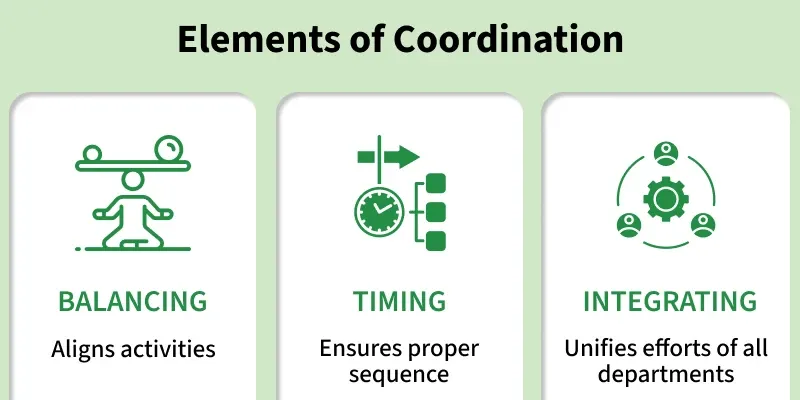
Three key elements of coordination.
Coordination ensures that all members understand their roles and that the decisions of one department do not negatively affect another. In organisations where tasks are interdependent, coordination becomes essential to prevent conflict and ensure smooth workflow. It also helps departments adjust their schedules and activities based on changing situations.
**Characteristics of Coordination
Coordination possesses several important characteristics that explain how it operates within an organisation. These features highlight why coordination is essential for achieving unity of action and maintaining smooth functioning across all departments.
**Integrates Group Efforts
Coordination brings together the efforts of individuals, teams, and departments and aligns them toward a common organisational goal. Since different units perform different tasks, integration ensures that all activities complement one another and contribute to the final result.
**Ensures Unity of Action
It creates a link between departmental goals and overall organisational objectives. Through coordination, the activities of various departments are harmonised, avoiding conflict, confusion, and duplication of work, and ensuring that everyone moves in the same direction.
**Continuous Process
Coordination is not an activity performed once; it is required at every stage of management. Whether planning, implementing, or reviewing tasks, coordination continues throughout the life of an organisation to maintain consistency and order.
**Pervasive Function
Coordination is needed at all levels of management—top, middle, and lower. It is equally important in all managerial functions, whether it is planning, organising, staffing, directing, or controlling, making it a universal aspect of management.
**Responsibility of All Managers
Although top-level managers play a major role in establishing coordination, it is not limited to them. Every manager, at every level, must ensure coordination within their team and across departments. It is a shared responsibility carried out consciously by all.
**Deliberate Function
Coordination does not occur automatically. Managers must make purposeful and conscious efforts to bring people and activities together. It is a deliberate action taken to ensure alignment, mutual understanding, and smooth workflow.
**Importance of Coordination
Coordination is essential for the smooth and successful functioning of an organisation. As organisations grow and activities become more specialised and interdependent, coordination helps maintain harmony, reduce conflicts, and ensure that all efforts contribute effectively to organisational goals. Its importance can be understood through the following points:
**Growth in Size
As organisations expand, the number of employees, teams, and departments increases. With this growth, the complexity of work also rises. Coordination becomes essential to ensure that the activities of different individuals and units are aligned, communication flows smoothly, and work is completed without confusion or delay.
**Functional Differentiation
Modern organisations consist of specialised departments such as production, marketing, finance, and human resources. Each department has its own objectives, tasks, and working styles. Coordination ensures that these diverse functions work together and do not operate in isolation. It helps integrate departmental goals with overall organisational objectives.
**Specialisation
Specialisation improves efficiency but also leads to interdependence among departments and individuals. For example, production depends on marketing forecasts, and marketing depends on product availability. Coordination helps specialists understand each other's requirements, maintain good working relationships, and ensure that interdependent tasks are performed smoothly without conflict or delays.
**Coordination- The Essence of Management
Coordination is the essence of management because integrating and unifying human efforts is management's fundamental goal. As managerial duties are essential for ensuring coordination, they are the pinnacle of the management process. To efficiently achieve the agreed-upon goals, coordination is necessary at all levels of management, from upper management to primary supervisors. The entire management process is tied together by coordination, which connects all of its components. Every function of management is an exercise in coordination. Planning becomes more efficient through coordination, while organization, staffing, directing, and control become more regulated. It can be further explained as follows:
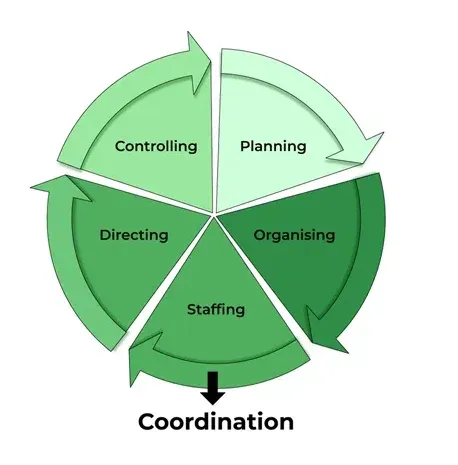
Its importance can be understood more clearly by examining how coordination operates within each managerial function:
**Coordination in Planning
Planning involves setting goals and outlining how to achieve them. Coordination ensures that plans made by different departments—such as marketing, finance, and production—are aligned with one another. Through coordination, conflicts between departmental plans are avoided, and all units work towards a shared organisational objective.
**Coordination in Organising
Organising involves assigning tasks, grouping activities, and defining authority relationships. Coordination helps establish clear roles and responsibilities, ensures that different departments understand their interdependence, and maintains smooth relationships among individuals and teams.
**Coordination in Staffing
Staffing deals with recruitment, training, and placement of employees. Coordination ensures that the right employees are selected and placed in roles where their skills match organisational needs. It also helps align the efforts of employees with the goals of the organisation, promoting teamwork and reducing gaps in performance.
**Coordination in Directing
Directing involves influencing, motivating, guiding, and supervising employees. Coordination integrates communication, leadership, and motivation so that instructions are clear, employees work harmoniously, and team efforts move in the same direction.
**Coordination in Controlling
Controlling compares actual performance with planned standards. Coordination helps ensure that departments provide accurate information, corrective actions are timely, and improvements are made without causing conflict or disruption. It links performance evaluation with organisational goals and ensures smooth execution of corrective measures.
Thus, the process of management facilitates coordination. No function of management can be performed efficiently unless it contributes to coordination. The manager's primary responsibility is to resolve conflicts resulting from different approaches, efforts, or interests and to coordinate personal objectives with organizational goals.
**Techniques of Effective Coordination
**Clearly Defined Goals
When goals are specific and understood by everyone, all departments and employees work towards the same outcome. This reduces confusion and prevents duplication of work.
**Proper Communication
Smooth coordination is possible only when information flows accurately and on time. Clear communication avoids misunderstandings and keeps all members updated about plans, changes, and expectations.
**Effective Leadership
A good leader guides the team, motivates them, and resolves conflicts. Leadership helps unify efforts and ensures that everyone works with a cooperative spirit.
**Cooperation Among Employees
Coordination becomes easier when employees willingly help each other, share information, and work as a team. A cooperative attitude reduces delays and improves efficiency.
**Sound Organisational Structure
A well-designed structure with clear roles, responsibilities, and reporting relationships helps avoid confusion. When everyone knows who to report to and what to do, activities become better aligned.
**Harmonising Individual and Organisational Goals
Managers must ensure that employees’ personal interests align with organisational goals. This reduces conflict, increases motivation, and creates a sense of purpose in work.
**Feedback and Supervision
Regular monitoring helps identify deviations early. Constructive feedback keeps employees on track and ensures that different activities remain coordinated and consistent with overall plans.