Management by Objectives (MBO) (original) (raw)
Last Updated : 10 Jan, 2026
Management by Objective (MBO) is a management approach in which managers and employees work together to set clear, measurable goals for the organization, department, and individual employees. Progress toward these goals is reviewed regularly, and performance is evaluated based on how well the goals are achieved.
**Example: A sales manager and salesperson set a target to increase sales by 10% in 6 months. After 6 months, performance is checked to see if the target was met.
In short, MBO ensures everyone works toward common goals and evaluates performance based on results.
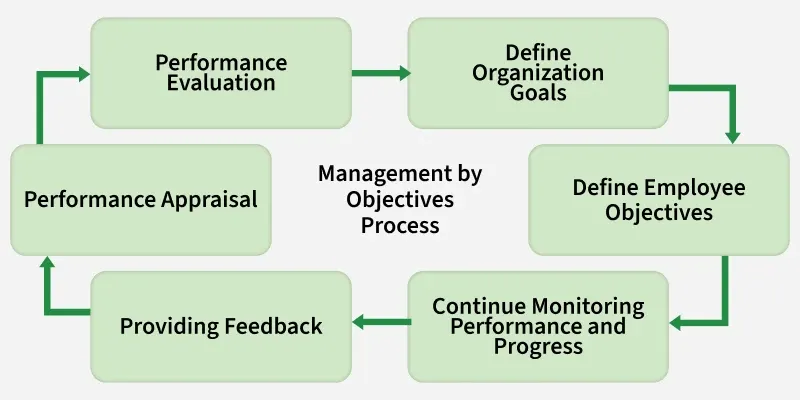
Process of MBO
**Defining Organisational Goals
The MBO process begins with setting organisational goals that guide the entire company. These goals must be clear, specific and achievable within a defined time period. Top-level managers participate actively because these goals determine the direction of all departments. While framing these objectives, management evaluates what the organisation _can and _should achieve, keeping in mind internal capabilities and external conditions. These objectives act as a reference point for the next stages of the MBO process.
**Defining Employee Objectives
Once organisational and departmental objectives are communicated, managers work closely with employees to set their individual goals. This is usually done through one-on-one discussions, where employees express what they believe they can achieve, the resources they would need and the time required. Managers guide them so that their personal goals align with the overall organisational goals. This participative approach increases clarity, commitment and ownership among employees.
**Continuous Monitoring of Performance and Progress
Monitoring is a crucial part of the MBO process. It involves managers regularly checking the progress of employees to ensure that work is aligned with the set objectives. Continuous observation helps identify obstacles, improve employee efforts and provide timely corrections. It ensures that employees remain focused and motivated, and that deviations from the plan are addressed early.
**Performance Evaluation
Under the MBO framework, performance evaluation is conducted by comparing actual results with the goals agreed upon earlier. This evaluation is not one-sided; it is done through discussion and participation of both managers and employees. The focus remains on results and outcomes rather than traits or personality, making the appraisal more objective and fair.
**Providing Feedback
Feedback is one of the most essential parts of the MBO process. Employees receive regular feedback from managers about how well they are progressing toward their objectives. This feedback helps employees adjust their actions, improve their performance and stay aligned with expectations. Along with informal continuous feedback, formal review meetings are also held where both parties discuss achievements, challenges and future improvements.
**Performance Appraisal
In the final step, employee performance is formally appraised based on the results achieved during the review period. This appraisal is used to take major decisions such as promotions, rewards, salary adjustments, training needs and future goal setting. The emphasis remains on measurable performance and individual contribution to organisational objectives, making the appraisal transparent and systematic.
Features of Management by Objectives (MBO)
**Goal-oriented: MBO is goal-oriented rather than work-oriented. It emphasizes what must be achieved within a given time period, ensuring that every activity contributes directly toward the defined organisational results.
**Participation of all: It involves the participation of subordinates and managers in the goal-setting process. Everyone contributes to setting realistic objectives, which increases commitment and improves efforts toward achieving overall organisational goals.
**Focuses on KRAs: MBO stresses measurable and verifiable objectives in key result areas. By concentrating on specific KRAs, it helps maintain balance among the goals of different individuals and departments and ensures accountability.
**Dynamic: MBO is a dynamic and flexible system that adapts to changes in organisational needs. Goals, strategies and action plans are reviewed periodically to keep them relevant and aligned with changing circumstances.
**Managerial philosophy: MBO is not just a technique but a broad managerial philosophy that influences all areas of management. It uses various methods to improve effectiveness and encourages a result-driven culture throughout the organisation.
**Serves as a criterion: Under MBO, organisational, departmental and personal goals act as a criterion for evaluating performance. Managers assess efficiency by comparing planned objectives with actual results, enabling fair and systematic appraisal.
**Continuous process: MBO operates as a continuous cycle of setting goals, reviewing progress and modifying targets when needed. Regular appraisals and updates ensure that performance stays aligned with organisational priorities.
Objectives of Management by Objectives (MBO)
The objectives of Management by Objective are:
- To aid employees in realizing their responsibilities at work.
- To make employees feel valuable in the organization.
- To guarantee the effectiveness among employees.
- To produce clearly specified hierarchies.
- To set a benchmark for every employee.
- To serve as a device for organizational control and integration.
- To serve as a basis for judgements about salary and promotions.
Advantages of Management by Objectives (MBO)
The following are the certain advantages and disadvantages regarding Management by Objectives (MBO):
-copy.webp)