Management by Objectives (MBO) vs Management by Exception (MBE) (original) (raw)
Last Updated : 10 Jan, 2026
Management by Objectives and Management by Exception are two management strategies:
- MBO is a process in which managers and employees jointly set clear, measurable goals for the organisation.
- MBE is a managerial approach where only significant deviations or problems are brought to the attention of top management.
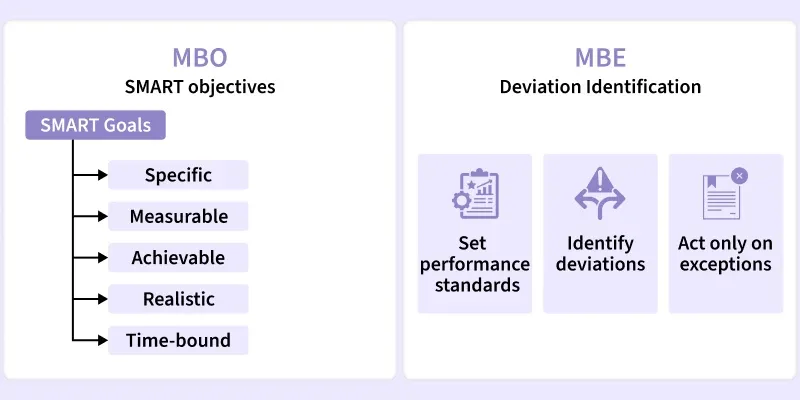
MBO sets clear SMART goals, while MBE acts only when performance deviates significantly.
Management by Objectives(MBO)
**Management by Objectives (MBO)is a management strategy that focuses on setting specific, measurable, achievable, relevant, and time-bound objectives for individuals and teams within an organization. The process involves collaboration between managers and employees to establish objectives that are aligned with the organization's overall goals, and regular communication and feedback to ensure progress toward those objectives. MBO provides a framework for goal-setting and performance management that emphasizes employee participation, ownership, and accountability. It encourages employees to take responsibility for their work and align their efforts with the organization's mission and objectives. MBO also promotes ongoing communication and collaboration between managers and employees, which can help to identify and address performance issues and provide opportunities for coaching and development.
Management by Exception(MBE)
**Management by Exception (MBE) is a management approach that identifies and addresses significant deviations from expected performance. The idea behind MBE is that managers should focus their attention on addressing exceptions or issues that deviate from the norm, rather than spending time monitoring routine operations. In MBE, managers establish performance standards and thresholds for various areas of the organization, such as sales, production, or customer service. Managers intervene to address the issue when actual performance falls outside these standards or thresholds. This allows managers to focus their time and resources on areas of the organization that require attention, rather than micromanaging routine operations. MBE is particularly useful in organizations with large volumes of data or complex operations, where it can be challenging to monitor all activities effectively. By focusing on exceptions or deviations, managers can prioritize their efforts and ensure that they address the organization's most critical issues.
Difference between MBO and (MBE)
| Basis of Difference | Management by Objectives (MBO) | Management by Exception (MBE) |
|---|---|---|
| **Meaning | A management approach where goals are jointly set by managers and employees and performance is evaluated based on achievement of these objectives. | A control method where managers intervene only when actual performance deviates significantly from the set standards. |
| **Focus | Focuses on planning, goal setting, and continuous performance improvement. | Focuses on identifying and correcting exceptions or deviations from expected results. |
| **Nature of Approach | Proactive and forward-looking. | Reactive and problem-oriented. |
| **Employee Involvement | High involvement; employees participate in setting goals. | Low involvement; employees perform tasks unless deviation occurs. |
| **Control and Decision Making | Shared responsibility and decentralized decision-making. | Centralized decision-making; managers take charge during deviations. |
| **Monitoring | Continuous monitoring and regular feedback sessions. | Monitoring only when results fall outside acceptable limits. |
| **Objective | To improve overall effectiveness and motivate employees through clarity of goals. | To save managerial time and effort by focusing only on critical issues. |
| **Best Suitable For | Dynamic and growth-focused organizations requiring strategic goal alignment. | Routine and stable environments where standards are well-defined. |