Knowledge Management (original) (raw)
Last Updated : 10 Jan, 2026
Knowledge Management (KM) is the process of identifying, creating, capturing, organizing, storing, sharing, and using knowledge within an organization. It involves managing valuable resources such as employee skills, best practices, and information systems. The purpose of KM is to ensure that important knowledge is easily accessible and applied to improve decision-making, efficiency, collaboration, and innovation.
**Components of Knowledge Management
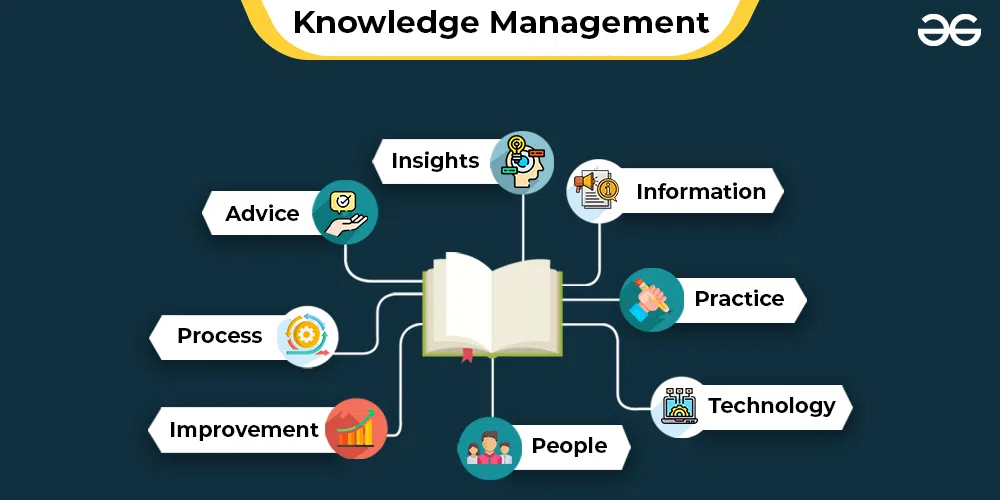
The Knowledge Management process is supported by several key components that allow organizations to capture, store, share, and use knowledge effectively. These components work together to build a strong knowledge-driven environment.
**1. People
People are the core of Knowledge Management because they create, apply, and share knowledge. Their skills, experiences, insights, and willingness to collaborate determine how effectively knowledge flows within the organization.
**2. Processes
Processes refer to the structured activities used to identify, capture, organize, and share knowledge. These workflows ensure that knowledge is handled systematically and is available when needed.
**3. Technology
Technology provides the tools and platforms that support KM activities. Databases, intranets, knowledge bases, collaboration software, and AI-driven systems help store and retrieve knowledge quickly and efficiently.
**4. Information
Information is the actual content that KM manages, such as documents, reports, data, manuals, and digital resources. It forms the foundation upon which knowledge is built and applied.
**5. Insights
Insights represent the deeper understanding gained from analyzing information and experiences. They help employees make better decisions and develop solutions based on patterns, trends, and learned lessons.
**6. Practices
Practices include standard procedures, best practices, and methods that guide how work should be done. They help maintain consistency and allow employees to replicate successful approaches across the organization.
**7. Advice
Advice captures the guidance, recommendations, and expert opinions provided by experienced employees. It supports decision making and helps newer or less experienced staff learn effectively.
**8. Improvement
Improvement focuses on continuously updating and refining knowledge to keep it relevant. Through feedback, learning, and ongoing review, organizations ensure that their knowledge systems remain accurate and useful.
**Objectives of Knowledge Management (KM)
Knowledge Management aims to ensure that valuable knowledge within an organization is effectively created, captured, shared, and applied. Its main objectives are:
**Improve Decision Making
KM provides employees with timely, accurate, and relevant information, allowing them to evaluate situations more clearly and choose the best possible course of action. When knowledge is easily accessible and well organized, decision making becomes faster, more reliable, and more aligned with organizational goals.
**Enhance Organizational Learning
KM strengthens a culture where employees continuously learn from one another through shared experiences, insights, and expertise. It supports long term knowledge development by encouraging reflection, collaboration, and the integration of lessons learned into everyday practices. This helps the organization steadily grow its intellectual capabilities.
**Promote Innovation and Creativity
A strong KM system enables employees to combine diverse ideas, analyze past solutions, and explore new ways of doing things. By making information widely available and encouraging open knowledge exchange, KM helps individuals think creatively, experiment confidently, and introduce innovative improvements in products, processes, or services.
**Increase Efficiency and Productivity
KM reduces redundancy and minimizes the time employees spend searching for information. When knowledge is well documented and easily retrievable, teams can work more smoothly, avoid repeating mistakes, and execute tasks more effectively. This leads to higher productivity and better utilization of organizational resources.
**Preserve Critical Organizational Knowledge
KM ensures that essential expertise, experience, and insights do not disappear when employees retire, resign, or change roles. It captures both explicit and tacit knowledge and stores it in accessible forms. This preservation strengthens continuity, reduces knowledge loss, and maintains organizational stability.
**Strengthen Collaboration and Teamwork
By enabling smoother knowledge flow across departments, KM enhances communication and coordination among employees. Teams can access shared information, learn from one another, and collaborate more effectively. This builds a cooperative environment where collective knowledge is valued and utilized.
**Support Better Customer Service
With quick access to updated information, employees are better equipped to respond to customer queries, solve issues, and offer personalized assistance. KM ensures that best practices and customer insights are available to everyone, improving overall service quality and customer satisfaction.
**Build Competitive Advantage
Organizations that manage knowledge effectively can adapt faster, innovate more frequently, and operate more efficiently than their competitors. KM strengthens strategic decision making, supports rapid problem solving, and helps the organization remain resilient in a changing environment, ultimately creating a sustainable competitive edge.
Process of Knowledge Management (KM)
Knowledge management is the process of identifying, creating, sharing, and effectively utilizing knowledge within an organization. It involves creating an environment that fosters knowledge sharing, as well as the development of systems and processes to manage knowledge effectively. The following are the basic steps involved in the knowledge management process:
**1) Knowledge Identification
The process begins with identifying the knowledge that already exists within the organization. This includes explicit knowledge stored in documents and databases, as well as tacit knowledge held by employees. Identification is done by studying existing records, conducting interviews, interacting with teams, or running surveys to understand what knowledge assets the organization possesses and where they are located.
**2) Knowledge Capture
After identifying key knowledge, the next step is to capture and document it in a usable form. This involves converting tacit knowledge into explicit knowledge and storing it in accessible formats. Organizations may use tools such as databases, knowledge bases, wikis, manuals, or digital repositories. Effective capture ensures that valuable insights do not remain limited to individuals.
**3) Knowledge Organization
Captured knowledge must be organized logically so employees can easily find and use it. This includes categorizing information by topic, using tags and metadata, creating taxonomies, and structuring content into coherent sections. A well-organized knowledge system reduces time spent searching for information and improves overall efficiency.
**4) Knowledge Sharing
Once organized, knowledge needs to be shared across the organization. Sharing ensures that information spreads to the right people at the right time. Methods include meetings, training programs, intranet portals, newsletters, team collaborations, and digital communication tools. A strong culture of sharing reduces duplication of work and supports continuous learning.
**5) Knowledge Transfer
Knowledge transfer focuses on moving knowledge from one individual or team to another. This is especially important during employee transitions, new team formations, or skill development programs. Organizations use mentoring, coaching, job shadowing, on-the-job training, workshops, and cross-functional interactions to ensure smooth transfer of expertise.
**6) Knowledge Application
The main purpose of KM is to apply knowledge to improve performance. Knowledge is used to solve problems, support decision-making, innovate products and services, improve processes, and enhance customer experience. When knowledge is applied effectively, it creates value and strengthens organizational capabilities.
**7) Knowledge Evaluation
Organizations must periodically evaluate how well their knowledge management practices are working. Evaluation involves collecting feedback, analyzing user engagement, measuring performance improvements, and reviewing the accuracy and usefulness of stored knowledge. This helps identify gaps and areas for refinement.
**8) Knowledge Maintenance
Knowledge must be updated regularly to keep it relevant and accurate. Maintenance includes reviewing outdated information, updating documents, refreshing databases, and providing ongoing training. Continuous maintenance ensures that the knowledge repository remains current and valuable for long-term organizational use.
Throughout the knowledge management process, it is important to measure the effectiveness of knowledge management initiatives and adjust them as necessary to ensure that they are meeting organizational objectives.
Significance of Knowledge Management (KM)
Knowledge management is a critical process for any organization because it allows them to effectively utilize the knowledge that exists within the organization. The following are some of the key benefits of knowledge management:
**Improved decision-making
By capturing and organizing knowledge, organizations can make more informed decisions. This is because they have access to more accurate and up-to-date information, and they can easily find the knowledge they need to make the right decisions.
**Increased innovation
Knowledge management can foster innovation by encouraging employees to share their ideas and insights. This can lead to new products, services, and processes that can help the organization to stay competitive.
**Enhanced collaboration
Knowledge management systems can facilitate collaboration between employees by making it easy to share information and ideas. This can lead to better teamwork and more effective problem-solving.
**Improved customer service
By capturing and organizing knowledge about customers, organizations can provide better customer service. They can quickly access information about a customer's history with the organization and provide personalized service that meets their needs.
**Reduced risk
Knowledge management can help organizations to reduce risk by ensuring that employees have access to accurate and up-to-date information. This can help to prevent mistakes and avoid potential legal or financial issues.
**Better employee retention
Knowledge management can help organizations to retain their employees by creating a culture of learning and development. Employees are more likely to stay with an organization that values their knowledge and invests in their professional growth.
**Increased efficiency
Knowledge management can help organizations to be more efficient by reducing the time and resources required to find information. By creating a centralized knowledge repository, employees can quickly access the information they need without wasting time searching for it.
Overall, knowledge management is critical for organizations that want to stay competitive and agile in a rapidly changing business environment. It helps organizations to effectively utilize the knowledge that exists within the organization and to continuously improve their processes, products, and services.