Lean Manufacturing (original) (raw)
Last Updated : 30 May, 2026
Lean Manufacturing is a production methodology that focuses on improving efficiency and reducing waste within manufacturing systems. It aims to eliminate non-value-adding activities based on customer needs. Also known as lean production, it emphasizes key principles such as Just-in-Time (JIT), Continuous Improvement (Kaizen), and Production Levelling (Heijunka).
The main goal is the continuous removal of waste from the manufacturing process to deliver higher-quality products at lower costs and with shorter lead times.
Lean Manufacturing Principles
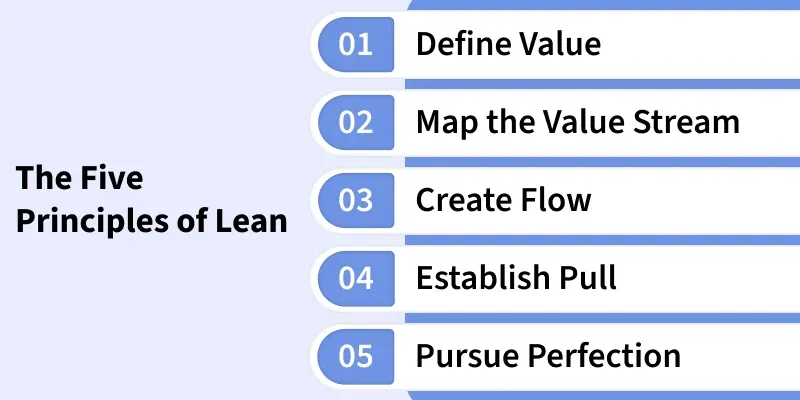
**Value: To commence the lean manufacturing journey, it is pivotal to detect and comprehend the value anticipated and desired by customers. It involves engaging in meaningful interactions to get a deep understanding of customer expectations. By aligning manufacturing processes with customer value, firms can ensure that their efforts are dedicated to producing products that genuinely meet customer needs.
**Value Stream: Understanding the value stream for products is pivotal to delivering the desired value to customers. It focuses on analysing the complete life cycle of a given product and identifying each stage from concept to delivery. By doing so, firms can pinpoint areas for enhancement within the value stream, optimize processes, and ensure efficiency across the entire production cycle.
**Flow: Creating a continuous flow of products and services is a pivotal aspect of lean manufacturing. It involves limiting interruptions, backflows, or stoppages in the production process. The goal is to streamline the workflow, ensuring a seamless and efficient progression from one stage to the next, ultimately enhancing productivity and reducing lead times.
**Pull: Implementing a pull system is a distinctive feature of lean manufacturing, where products are pulled through the production system based on actual customer demand. This approach contrasts with traditional push systems, where products are produced in anticipation of demand. A pull system will ensure that production is aligned with real-time customer needs, minimizing excess inventory and optimizing resource utilization.
**Perfection: The pursuit of perfection is a continuous process improvement endeavour, often referred to as Kaizen. This principle involves targeting the root causes of quality issues and eliminating wasteful practices throughout the manufacturing process. By adopting a mindset of continuous enhancement, firms strive for perfection in their operations, boosting overall efficiency, and delivering high-quality products to meet customer expectations.
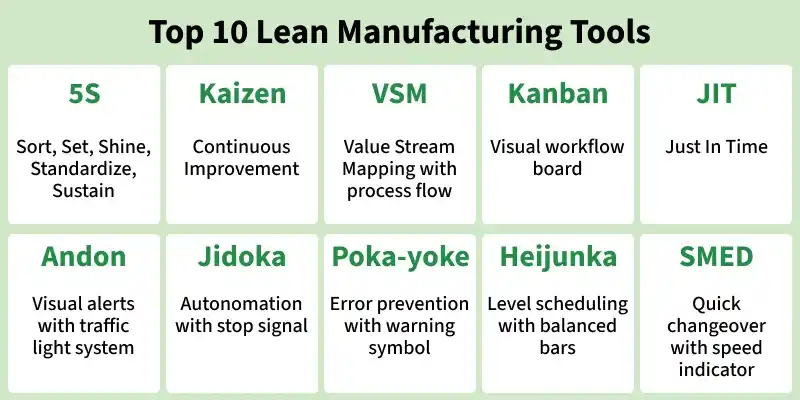
**5S: The 5S tool is instrumental in organizing the work area to eliminate waste resulting from poorly organized spaces, reducing time wasted on searching for tools.
**Andon: Andon serves as a visual feedback system for the plant floor, providing real-time production status indicators, signalling when assistance is needed, and empowering operators to halt the production process if necessary.
**Kaizen: Techniques used to improve efficiency, reduce waste, and enhance productivity in organizations. Common Kaizen tools include 5S, Value Stream Mapping, Kanban, and Root Cause Analysis, which help identify problems, organize work processes, and support continuous improvement.
**Value Stream Mapping: Value stream mapping is a comprehensive tool that documents each step of the production plan, accelerates process cycle times, detects and eliminates waste, and integrates improvements into business practices.
**Just-in-Time****:** JIT analyses customer demands to determine which parts to produce, enabling the production of items only when needed.
**Jidoka: Principle that means “automation with a human touch.” It allows machines or workers to stop production immediately when a problem or defect is detected, helping maintain product quality and prevent errors from continuing in the production process
**Kanban: Kanban is a lean management tool used to visualize and manage workflow efficiently. It uses cards or boards to track tasks and production stages, helping teams improve productivity, reduce waste, and ensure smooth workflow management.
**SMED: SMED (Single-Minute Exchange of Die) is a lean manufacturing technique used to reduce machine setup or changeover time. It improves efficiency by separating internal and external setup activities, allowing faster production changes, reduced downtime, and increased flexibility in manufacturing processes.
**Heijunka: Heijunka aims to level the type and quantity of production, reduce batching, and create a more efficient manufacturing process.
**Poka-Yoke: Poka-Yoke aims to prevent mistakes or defects by incorporating devices to prevent errors, also known as mistake-proofing.