Tokens in C (original) (raw)
Tokens are the smallest meaningful units of a C program. Every C program is made up of tokens, which the compiler uses to understand and execute the code.
- Tokens are the basic building blocks of a C program.
- The C compiler identifies tokens to form valid statements and expressions.
- C tokens are classified into six main categories.
Types of Tokens in C
The tokens of C language can be classified into six types based on the functions they are used to perform. The types of C tokens are as follows:
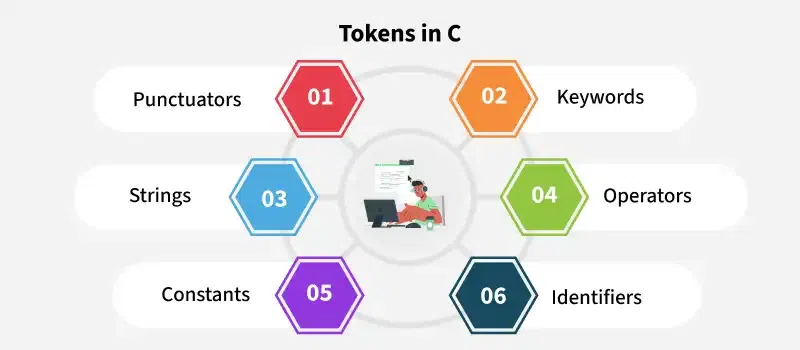
Punctuators
The following special symbols are used in C having some special meaning and thus, cannot be used for some other purpose. Some of these are listed below:
- **Brackets[]: Opening and closing brackets are used as array element references. These indicate single and multidimensional subscripts.
- **Parentheses(): These special symbols are used to indicate function calls and function parameters.
- **Braces{}: These opening and ending curly braces mark the start and end of a block of code containing more than one executable statement.
- **Comma (, ): It is used to separate more than one statement like for separating parameters in function calls.
- **Colon(:): It is an operator that essentially invokes something called an initialization list.
- **Semicolon(;): It is known as a statement terminator. It indicates the end of one logical entity. That's why each individual statement must be ended with a semicolon.
- **Asterisk (*): It is used to create a pointer variable and for the multiplication of variables.
- **Assignment operator(=): It is used to assign values and for logical operation validation.
- **Pre-processor (#): The preprocessor is a macro processor that is used automatically by the compiler to transform your program before actual compilation.
- **Dot (.): Used to access members of a structure or union.
- **Tilde(~): Bitwise One's Complement Operator. C `
#include <stdio.h>
int main() {
// '\n' is a special symbol that
// represents a newline
printf("Hello, \n World!");
return 0;
}
`
Keywords
Keywords are reserved words that have predefined meanings in C. These cannot be used as identifiers (variable names, function names, etc.). Keywords define the structure and behavior of the program C language supports 32 keywords such as int, for, if, ... etc.
C `
#include <stdio.h>
int main() {
// 'int' is a keyword used to define
// variable type
int x = 5;
printf("%d", x);

// 'return' is a keyword used to exit
// main function
return 0;
}
`
**Note: The number of keywords may change depending on the version of C you are using. For example, keywords present in ANSI C are 32 while in C11, it was increased to 44. Moreover, in the latest c23, it is increased to around 54.
Strings
Strings are nothing but an array of characters ended with a null character (‘\0’). This null character indicates the end of the string. Strings are always enclosed in double quotes. Whereas a character is enclosed in single quotes in C and C++.
C `
#include <stdio.h>
int main() {
// "Hello, World!" is a string literal
char str[] = "Hello, World!";
printf("%s", str);
return 0;
}
`
Operators
Operators are symbols that trigger an action when applied to C variables and other objects. The data items on which operators act are called operands.
C `
#include <stdio.h>
int main() { int a = 10, b = 5;
// '+' is an arithmetic operator used
// for addition
int sum = a + b;
printf("%d", sum);
return 0;
}
`
Identifiers
Identifiers are names given to variables, functions, arrays, and other user-defined items. They must begin with a letter (a-z, A-Z) or an underscore (_) and can be followed by letters, digits (0-9), and underscores.
C `
#include <stdio.h>
int main() {
// 'num' is an identifier used to name
// a variable
int num = 10;
printf("%d", num);
return 0;
}
`
Constants
Constants are fixed values used in a C program. These values do not change during the execution of the program. Constants can be integers, floating-point numbers, characters, or strings.
C `
#include <stdio.h>
int main() {
// 'MAX_VALUE' is a constant that holds
// a fixed value
const int MAX_VALUE = 100;
printf("%d", MAX_VALUE);
return 0;
}
`