Alkanes (original) (raw)
Last Updated : 14 May, 2026
Alkanes are the simplest hydrocarbons, consisting of only carbon and hydrogen atoms, in which all carbon atoms are connected by single covalent bonds. They are called saturated hydrocarbons and have the general formula CnH2n+2. Each carbon atom is sp3 hybridised with a tetrahedral geometry, making alkanes relatively less reactive, hence also known as paraffins. They occur naturally in petroleum and natural gas and form a homologous series.
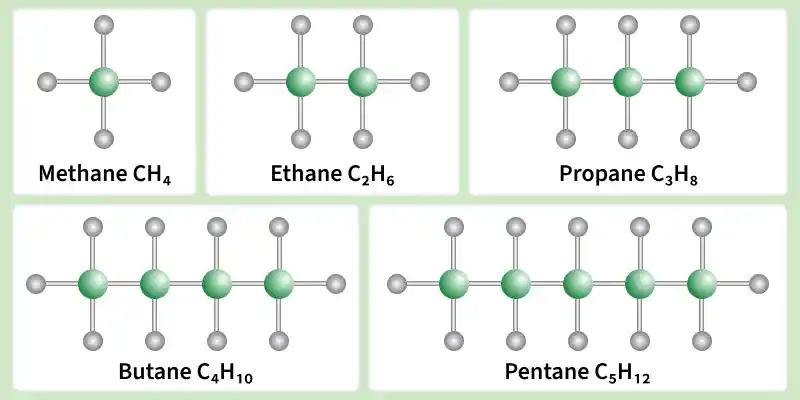
Different Structure Of Alkane
**Nomenclature of Alkanes
Alkanes are named according to the IUPAC system of nomenclature. The longest continuous chain of carbon atoms is selected as the parent chain and named using word roots like methane, ethane, propane, etc.
- The carbon chain is numbered in such a way that substituents get the lowest possible numbers.
- Alkyl groups attached to the main chain are named as substituents, and their positions are indicated by numbers.
- If the same substituent occurs more than once, prefixes like di-, tri-, etc., are used.
- The final name is written by placing substituents (in alphabetical order) before the parent alkane name.
| **Formula | **IUPAC Name |
|---|---|
| CH4 | Methane |
| C2H6 | Ethane |
| C3H8 | Propane |
| C4H10 | Butane |
| C5H12 | Pentane |
| C6H14 | Hexane |
| C7H16 | Heptane |
| C8H18 | Octane |
| C9H20 | Nonane |
| C10H22 | Decane |
Structure and Isomerism of Alkanes
In alkanes, each carbon atom is sp3 hybridised and forms four sigma (σ) bonds—either with hydrogen or other carbon atoms. The four bonds are arranged in a tetrahedral geometry with a bond angle of about 109.5°. Due to single C–C bonds, there is free rotation around these bonds, giving rise to different spatial arrangements called conformations (like staggered and eclipsed in ethane).
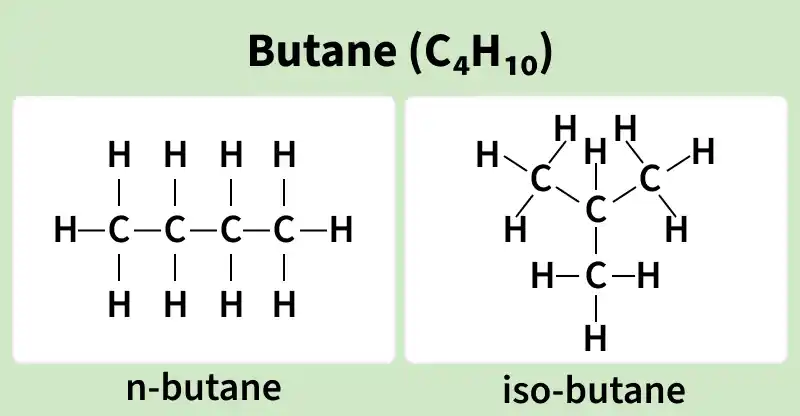
Alkanes show chain isomerism, which arises due to different possible arrangements of the carbon skeleton. This type of isomerism starts from butane (C4H10) onwards.
- Chain isomers have the same molecular formula but different carbon chain arrangements (straight or branched).
- For example, butane has two isomers: n-butane (straight chain) and isobutane (branched chain).
- As the number of carbon atoms increases, the number of possible isomers also increases.
**Physical Properties of Alkanes
Alkanes show regular variation in their physical properties due to their non-polar nature and increase in molecular size along the homologous series.
- **Nature (Non-polar character): Alkanes are non-polar because the electronegativity difference between carbon and hydrogen is very small. Due to this, they do not form hydrogen bonds and have weak intermolecular forces (van der Waals forces).
- **Solubility: Alkanes are insoluble in water because they cannot form hydrogen bonds with water molecules. However, they are soluble in non-polar organic solvents like ether, benzene, and carbon tetrachloride.
- **Boiling Point: The boiling point of alkanes increases with increase in molecular mass because the strength of van der Waals forces increases. However, branching in alkanes decreases the boiling point as it reduces the surface area of the molecule, leading to weaker intermolecular attractions.
- **Melting Point: Melting points also generally increase with increase in molecular mass. However, the trend is not very regular due to differences in packing of molecules in the solid state.
- **Physical State: The physical state of alkanes depends on the number of carbon atoms, lower members (C1–C4) are gases, middle members (C5–C17) are liquids, and higher members are solids. This is due to increasing intermolecular forces with increase in size.
- **Colour and Odour: Alkanes are generally colourless and odourless in pure form.
Chemical Properties of Alkanes
Alkanes are generally less reactive due to strong C–C and C–H bonds and their non-polar nature. However, they undergo some important reactions under suitable conditions.
**1. Combustion: Alkanes burn in the presence of oxygen to produce carbon dioxide and water, releasing a large amount of heat and light. In limited oxygen, incomplete combustion occurs, forming carbon monoxide or carbon (soot).
CH4 + 2O2 →CO2 + 2H2O + heat
**2. Halogenation: Alkanes react with halogens like chlorine and bromine in the presence of sunlight or heat. In this reaction, one or more hydrogen atoms are replaced by halogen atoms. It is a substitution reaction and proceeds through a free radical mechanism.
In presence of sunlight/UV light:
CH4 + Cl2 →CH3Cl + HCl
Further substitution can occur:
CH3Cl + Cl2 →CH2Cl2 + HCl
**3. Nitration: On heating with concentrated nitric acid at high temperature, alkanes form nitroalkanes. This reaction involves substitution of a hydrogen atom by a nitro group (–NO2).
CH4 + HNO3 →CH3NO2 + H2O
**4. Oxidation: Under controlled conditions, alkanes can be oxidised to form alcohols, aldehydes, or acids. Strong oxidation leads to complete combustion, forming CO2 and H2O.
CH4 + [O] →CH3OH
**5. Pyrolysis (Cracking): When alkanes are heated strongly in the absence of air, they break down into smaller alkanes, alkenes, or hydrogen gas. This process is important in the petroleum industry.
C2H6 →C2H4 + H2 (heating)
Preparation of Alkanes
Alkanes can be prepared by different methods, mainly involving addition, reduction, or removal of functional groups. These methods help convert unsaturated or substituted compounds into saturated hydrocarbons.
**1. From Unsaturated Hydrocarbons (Hydrogenation)
Alkenes and alkynes are converted into alkanes by adding hydrogen in the presence of catalysts like nickel, palladium, or platinum.
- The reaction involves breaking of π-bonds and formation of single bonds.
- It is an example of an addition reaction.
- This is an important industrial method for preparing alkanes.
C_2H_4 + H_2 \xrightarrow{Ni/Pd/Pt} C_2H_6
**2. From Alkyl Halides (Wurtz Reaction)
Alkyl halides react with sodium metal in the presence of dry ether to form higher alkanes.
- Two alkyl groups combine to form a new C–C bond.
- Mainly used to prepare symmetrical alkanes (same alkyl groups).
- If different alkyl halides are used, a mixture of products is formed.
2CH_3Cl + 2Na \xrightarrow{dry\ ether} C_2H_6 + 2NaCl
3. From Carboxylic Acids (Decarboxylation)
Sodium salts of carboxylic acids, when heated with soda lime (NaOH + CaO), give alkanes with one carbon less.
- The –COOH group is removed as carbon dioxide.
- This reaction reduces the carbon chain length by one.
- Useful for preparing lower alkanes.
CH_3COONa + NaOH \xrightarrow{CaO,\ \Delta} CH_4 + Na_2CO_3
4. From Grignard Reagents (Hydrolysis)
Grignard reagents react with water or alcohol to give alkanes.
- The alkyl group (R–) takes hydrogen from water to form the alkane.
- This is a simple method to convert organic compounds into alkanes.
CH_3MgBr + H_2O \rightarrow CH_4 + Mg(OH)Br
5. From Reduction of Alkyl Halides
Alkyl halides can be reduced to alkanes using hydrogen in the presence of catalysts like palladium or by nascent hydrogen.
- Halogen atom is replaced by hydrogen.
CH_3Cl + H_2 \xrightarrow{Pd/C} CH_4 + HCl