IUPAC Nomenclature of Organic Compounds (original) (raw)
Last Updated : 8 Apr, 2026
In organic chemistry, a very large number of carbon compounds exist, and many of them may have similar structures. In earlier times, compounds were given common or trivial names, which often varied from place to place and sometimes caused confusion. To avoid this problem, a systematic method of naming compounds was developed by the International Union of Pure and Applied Chemistry (IUPAC). This system is known as IUPAC Nomenclature of Organic Compounds.
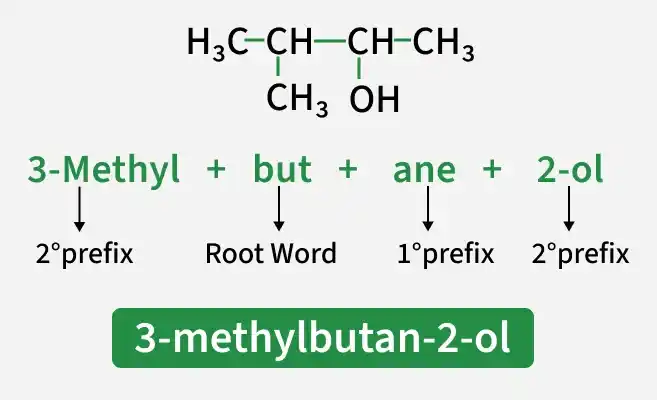
Need of Nomenclature for Organic Compounds
Since organic chemistry contains a very large number of carbon compounds, it is important to have a systematic way to name them. A proper naming system helps scientists identify and study these compounds easily. The need for nomenclature can be understood from the following points:
- **Large number of compounds: There are millions of organic compounds, so a systematic naming method is required to identify them clearly.
- **Avoid confusion: Many compounds have common or trivial names that may vary in different regions, which can create confusion.
- **Identification of structure: A proper name can help indicate the structure and composition of the compound.
- **Universal system: The system developed by the International Union of Pure and Applied Chemistry provides a standard method for naming compounds worldwide.
- **Easy communication: It helps chemists communicate chemical information clearly and accurately in scientific studies.
IUPAC System of Nomenclature
In the IUPAC Nomenclature of Organic Compounds developed by the International Union of Pure and Applied Chemistry, the name of an organic compound is formed in a systematic way based on its molecular structure. Each IUPAC name is generally made up of different parts that provide information about the carbon chain and the groups attached to it.
**The main parts of an IUPAC name are root word, prefix, and suffix:
**1) Root Word
- The root word represents the number of carbon atoms present in the longest continuous carbon chain, which is called the parent chain.
- It forms the basic part of the name of an organic compound.
- The root word helps in identifying how many carbon atoms are present in the main chain of the molecule.
- Different root words are used for different numbers of carbon atoms.
**Example:
The compound CH3−CH2−CH3 contains three carbon atoms in its longest chain.Therefore, the root word used is prop, and the complete name becomes propane.
| **Carbon in Chain | **Root Word | **Carbon in Chain | **Root Word |
|---|---|---|---|
| 1 | Meth- | 11 | Undec- |
| 2 | Eth- | 12 | Dodec- |
| 3 | Prop- | 13 | Tridec- |
| 4 | But- | 14 | Tetradec- |
| 5 | Pent- | 15 | Pentadec- |
| 6 | Hex- | 16 | Hexadec- |
| 7 | Hept- | 17 | Heptadec- |
| 8 | Oct- | 18 | Octadec- |
| 9 | Non- | 19 | Nonadec- |
| 10 | Dec- | 20 | Icos- |
**2) Suffix
- The suffix is the last part of the name of an organic compound.
- It provides information about the type of carbon–carbon bonding and the functional group present in the compound.
**The suffix is divided into two types: primary suffix and secondary suffix.
**a) Primary Suffix
The primary suffix indicates the nature of carbon–carbon bonds present in the parent chain of the compound.
**Example:
The compound CH3−CH3contains two carbon atoms connected by a single bond.
- Root word: Eth (two carbon atoms)
- Primary suffix: –ane (single bond)
Therefore, the name of the compound is ethane.
| Nature of Carbon Chain | Primary Suffix | General Name |
|---|---|---|
| Saturated (C–C) | -ane | Alkane |
| Unsaturated, containing one double bond (C=C) | -ene | Alkene |
| Unsaturated, containing one triple bond (C≡C) | -yne | Alkyne |
**b) Secondary Suffix
- The secondary suffix indicates the functional group present in the organic compound.
- It is written after the primary suffix and gives information about the main functional group in the molecule.
**Example:
The compound CH3CH2OH contains an –OH (alcohol) functional group.
- Root word: Eth (two carbon atoms)
- Primary suffix: –ane
- Secondary suffix: –ol
Therefore, the IUPAC name of the compound is ethanol .
| Class of Organic Compounds | Functional Group | Secondary Suffix |
|---|---|---|
| Alcohol | R-OH | -ol |
| Aldehyde | R-CHO | -al |
| Amine | R-NH₂ | -amine |
| Carboxylic Acid | R-COOH | -oic acid |
| Ketone | R-CO-R' | -one |
It is to be noted that when adding a secondary suffix to a primary suffix if the secondary suffix starts with "a," I "o," "u," or "y," the main suffix's terminal "e" is dropped.
| Organic compounds | Word root | Primary suffix | Secondary suffix | IUPAC name(Word root + Primary suffix + Secondary suffix) |
|---|---|---|---|---|
| CH3CH2OH | Eth | -ane | -ol | Ethanol |
| CH3CH2CHO | Prop | -ane | -al | Propanal |
| CH3CH2COOH | Prop | -ane | -oic acid | Propanoic acid |
| CH3CH2CH2NH2 | Prop | -ane | -amine | Propanamine |
| CH3CH2CN | Prop | -ane | -nitrile | Propanenitrile |
**3) Prefix
- The prefix is the part of the name written before the root word.
- It indicates the substituents or groups attached to the main carbon chain.
- Prefixes provide information about the type and number of groups present in the molecule.
**Prefixes can be classified into primary prefix and secondary prefix.
**a) Primary Prefix
- The primary prefix indicates the nature of the carbon skeleton or the type of ring structure present in the compound.
**Example:
The compound having three carbon atoms arranged in a ring is named cyclopropane.
- Prefix: cyclo– (ring structure)
- Root word: prop (three carbon atoms)
- Suffix: –ane
| Type of Structure | Prefix | Example |
|---|---|---|
| Straight chain | n– | n-butane |
| Branched chain | iso– | isobutane |
| Cyclic structure | cyclo– | cyclopropane |

**b) Secondary Prefix
- The secondary prefix indicates the substituents or functional groups attached to the parent chain.
- These groups replace one or more hydrogen atoms of the main carbon chain.
**Example:
The compound CH3Cl contains a chlorine atom attached to methane.
- Prefix: chloro–
- Root word: meth
- Suffix: –ane
Therefore, the name of the compound is chloromethane.
| Substituent | Prefix | Example |
|---|---|---|
| –CH₃ | methyl | methylpropane |
| –Cl | chloro | chloromethane |
| –Br | bromo | bromomethane |
| –NO₂ | nitro | nitromethane |
Rules of IUPAC Nomenclature
After understanding the different parts of an IUPAC name such as prefix, root word, and suffix, it is important to learn the rules used to name organic compounds correctly. Certain rules are followed to give a systematic and unique name to every organic compound.
- **Selection of the longest carbon chain: The longest continuous chain of carbon atoms is selected as the parent chain.
- **Identification of the principal functional group: Identify the highest priority functional group. It decides suffix and parent chain.
- **Numbering of the carbon atoms: The carbon atoms in the parent chain are numbered in such a way that the substituents get the lowest possible numbers.
- **Identification of substituents: The groups attached to the parent chain are identified and written as prefixes.
- **Arrangement of substituents in alphabetical order: Arrange substituents alphabetically. Ignore di-, tri-, tetra- while ordering.
- **Use of commas and hyphens: Add commas between numbers (2,3-) and hyphens between number and word (2-methyl).
- **Position of substituents: The position of each substituent is indicated by a number (locant) before the prefix.
- **Writing the complete name
The final name is written in the order:
Prefix + Root Word + Suffix
IUPAC Nomenclature of Some Organic Compounds
After understanding the rules and method of the IUPAC Nomenclature of Organic Compounds it becomes easier to name different types of organic compounds. Organic compounds are classified into different groups depending on the type of carbon–carbon bonds present in them.
Some of the common organic compounds whose nomenclature can be explained using the IUPAC system are alkanes, carboxylic acid, ether.
**1) IUPAC Name of Alkanes
- Alkanes are saturated hydrocarbons that contain only single bonds between carbon atoms.
- In IUPAC nomenclature, alkanes are named using the suffix –ane.
**Example:
CH3−CH2−CH3
- Number of carbon atoms = 3
- Root word = prop
- Suffix = –ane
Therefore, the IUPAC name is propane.
**2) IUPAC Name of carboxylic acid
- Carboxylic acids are organic compounds that contain the carboxyl functional group (–COOH).
- In the IUPAC Nomenclature , carboxylic acids are named by adding the suffix –oic acid to the root word that indicates the number of carbon atoms in the parent chain.
**Example:
CH3COOH
- Number of carbon atoms = 2
- Root word = eth
- Suffix = –oic acid
Therefore, the IUPAC name is ethanoic acid.
**3) IUPAC Name of ethers
- Ethers are organic compounds in which an oxygen atom is present between two alkyl groups (R–O–R').
- In IUPAC nomenclature, ethers are generally named as alkoxyalkanes.
- In this method, the smaller alkyl group attached to oxygen is written as an alkoxy group, and the larger carbon chain is taken as the parent alkane.
**Example :
CH3−O−CH3
- Two methyl groups are attached to oxygen
- One methyl group is treated as methoxy
- Parent chain = methane
Therefore, the IUPAC name is methoxymethane.
**Related Articles:
Solved Examples
**Example 1: Write the name of the given organic compound.

**Solution:
**Word root: Prop
**Prefix: methyl
**Primary suffix: -ane
**Secondary suffix: -ol
Thus, IUPAC name of the compound is, 2-methyl-propane-1-ol
**Example 2: Write the name of the given organic compound.
.png)
**Solution:
**Word root: Pent
**Primary suffix: -ane
**Secondary suffix: -ol
Thus, IUPAC name of the compound is, pentan-2-ol
**Example 3: Write the name of the given organic compound.

**Solution:
**Word root: Pent
**Prefix: methyl
**Primary suffix: -ane
Thus, IUPAC name of the compound is, 3-methylpentane.
**Example 4: Write the name of the given organic compound.
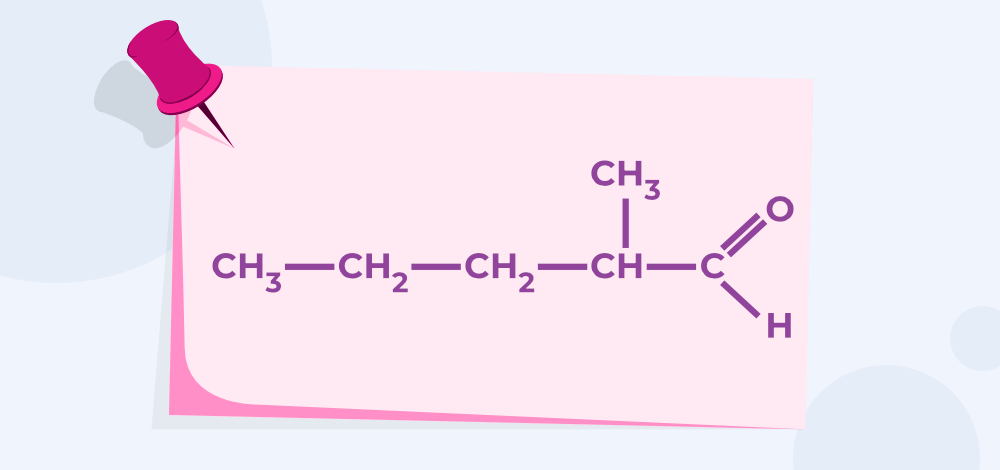
**Solution:
**Word root: Pent
**Prefix: methyl
**Primary suffix: -ane
**Secondary suffix: -al
Thus, IUPAC name of the compound is, 2-methylpentanal. is this c